Editorial Team
6 min read
European individuals secured about $1.1 billion of Anthropic shares, roughly 1.4% of the public offering’s value. The UK offer combines broad participation with rationing, while the AI lab’s governance and compute commitments define what investors are buying.
Individual investors in the UK and continental Europe secured about $1.1 billion of shares in Anthropic, the AI research lab behind the Claude models, platform and applications, according to a report based on regulatory filings. The allocation gives individuals an entry at the flotation price, but amounts to roughly 1.4% of the public offering’s value.
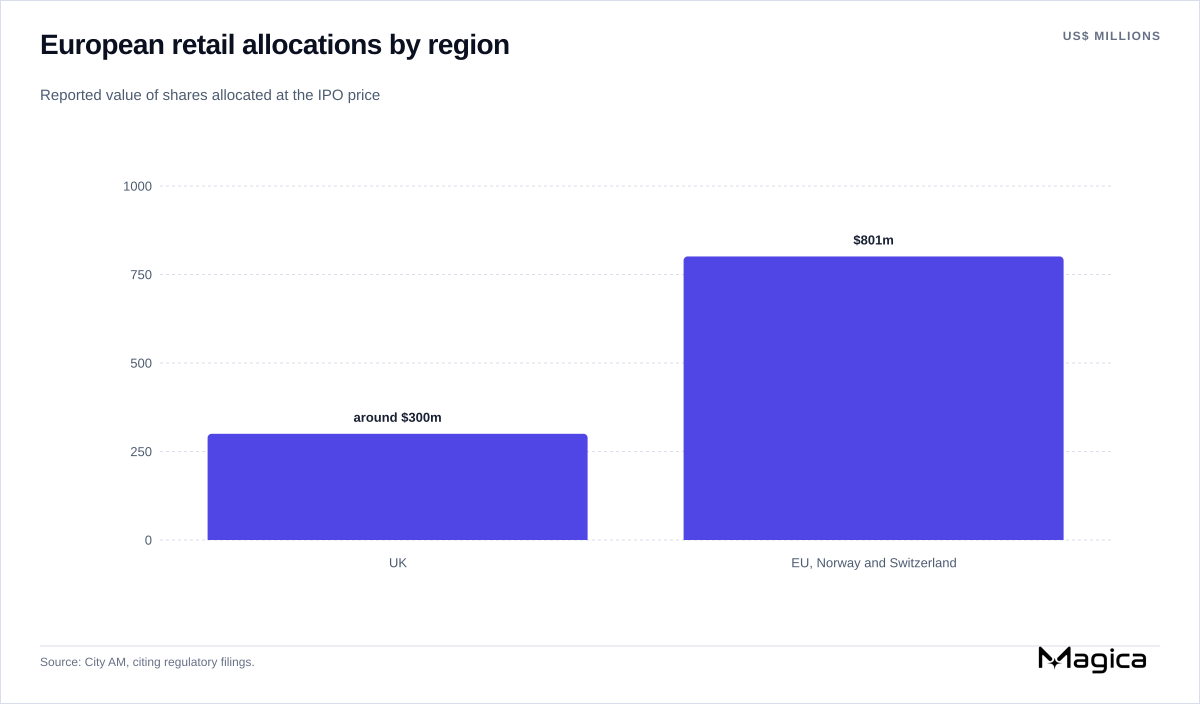
Reported retail allocations total about $300 million in the UK and $801 million in the EU, Norway and Switzerland. Source: City AM.
The reported allocation comprises just over 3.6 million shares in the UK and nearly 9.7 million in the European Union, Norway and Switzerland. A separate account of the distribution values those tranches at about $300 million and $801 million respectively.
RetailBook, the UK Financial Conduct Authority-authorised public offer platform operator coordinating the UK sale through participating brokers, specifies 3,614,976 UK shares in its allocation announcement. At $83 each, their value is almost exactly $300 million.
The announcement puts the global public offering at 980 million shares. At $83, that is $81.34 billion, the denominator for the roughly 1.4% European retail share. This calculation measures the regional allocation rather than retail participation worldwide, and excludes the underwriters’ option to buy additional shares.
The gross offering value also differs from the money going to Anthropic. It includes 956,351,354 newly issued shares and 23,648,646 shares sold by existing stockholders: approximately $79.38 billion and $1.96 billion respectively at the offer price, before expenses. Existing stockholders’ shares are excluded from the UK offer.
The separate account reports a further $26 billion private placement involving technology companies including Nvidia and Google. Its approximately $107 billion combined financing figure includes that placement as well as the public offering. It also puts Anthropic’s debut valuation at $1.5 trillion.
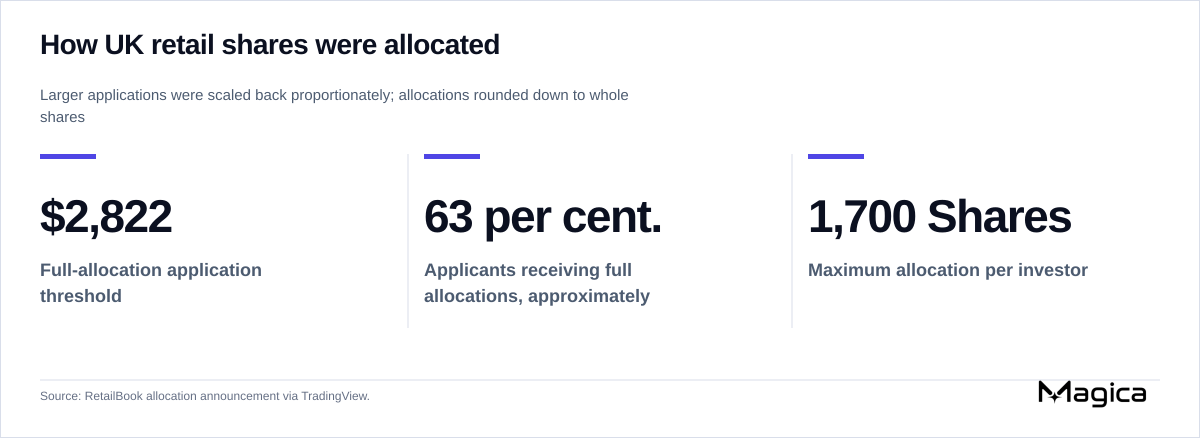
RetailBook reports full allocation for applications up to $2,822, subject to whole-share rounding; approximately 63% of applicants received full allocations, with a maximum of 1,700 shares per investor. Source: Retail Book Limited via TradingView.
The final $83 price exceeded the marketed $70–$78 range, and the offering increased from an indicative 825 million shares to 980 million. RetailBook says UK participants acquire shares at the same dollar offer price as other global offering investors. For sterling applicants, the announced price is £63.20 per share after currency conversion and rounding.
According to RetailBook, UK applications up to $2,822 (£2,171) were allocated in full, rounded down to whole shares. Larger applications were reduced proportionately, with a maximum allocation of 1,700 shares per individual. Approximately 63% of UK applicants received a full allocation.
Hargreaves Lansdown, one of the participating brokers, said 45,811 clients applied, with an average application of £6,661, according to the separate account. Its clients received 33.6% of the shares requested. That measures shares requested at one broker; RetailBook’s 63% measures applicants across the UK offer.
The access mechanism has a precedent. The same account says British retail investors used the FCA’s Public Offer Platform regime in June to secure about $355 million of SpaceX shares ahead of its flotation. More than 100,000 individuals applied. Anthropic’s UK allocation is smaller than that earlier allocation.
The instrument investors receive also differs. RetailBook says dollar applicants applied for Class A shares directly. Sterling applicants generally applied for CREST depository interests: separate English-law instruments representing rights to the shares one-for-one, held and settled through the UK’s CREST system. The disclosure summary sets out how those interests differ from direct share ownership.
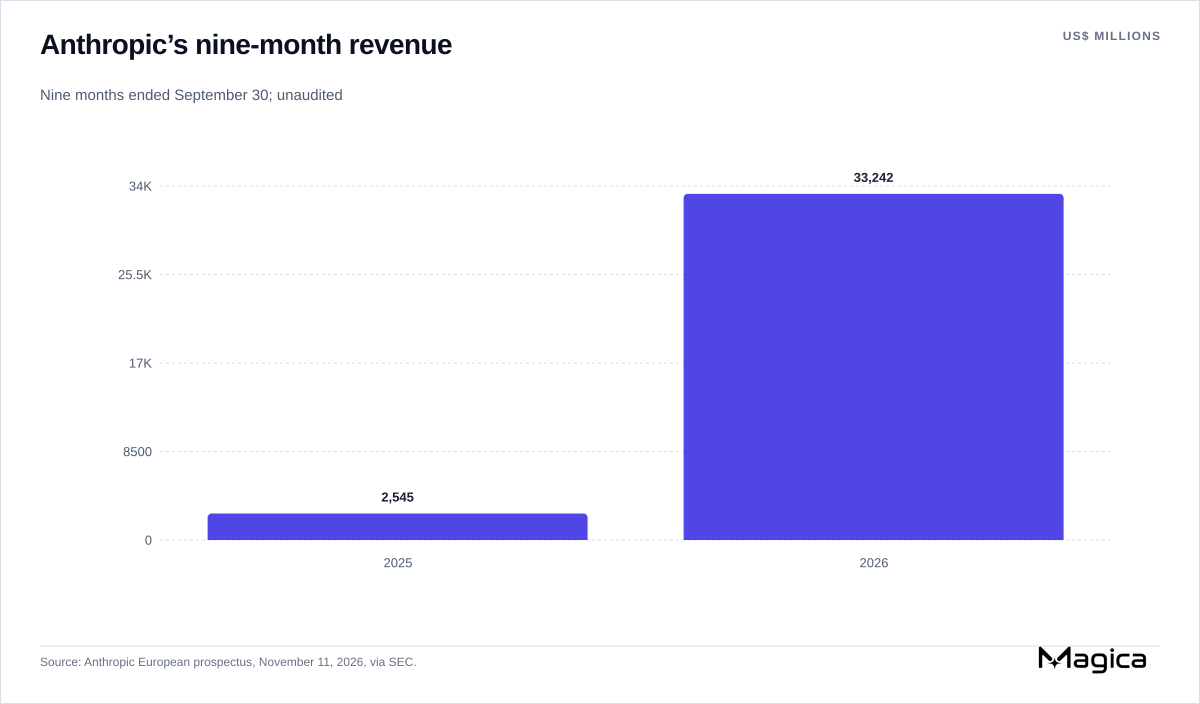
Company-reported, unaudited revenue for the nine months ended September 30 in 2025 and 2026. Source: Anthropic European prospectus via SEC.
Anthropic was founded in January 2021 as a Delaware public benefit corporation. Its November 11 European prospectus describes a business supplying AI models to developers and enterprises, competing directly with OpenAI and Google. Google’s involvement in the private placement therefore sits alongside its role as a competitor.
The prospectus’s unaudited results show revenue of $33.24 billion for the nine months ended September 30, 2026, against $2.55 billion in the same period of 2025. Operating losses narrowed to $1.26 billion from $5.22 billion. The net loss was much larger, at $104.04 billion, including $94.3 billion of fair-value changes in convertible notes, derivative liabilities and simple agreements for future equity. The filing says those changes were primarily driven by a rising enterprise valuation. Neither loss measure should be equated with cash spending.
Anthropic says it intends to use offering and private-placement proceeds for purposes including compute, infrastructure, operating expenses and hiring. It retains broad discretion over the proceeds. The prospectus warns that the company has previously underestimated compute requirements, constraining product development and deployment.
As of and subsequent to September 30, 2026, the filing reports approximately $900.9 billion of unaudited purchase and lease commitments, substantially all related to compute and infrastructure. About $70.7 billion is due in the 12 months following September 30, 2026; much of the total extends into 2031–2045. These commitments span different time horizons.
The financing risk is a mismatch in duration: Anthropic says revenue is primarily consumption-based and much is not backed by long-term customer commitments, while compute obligations generally run for years. It also warns that growing infrastructure investment may increase cash outflows even if financial performance improves.
The prospectus provides for a single Class F share held by an entity initially comprising Anthropic’s seven co-founders. It carries 50.1% of voting power on matters submitted to shareholders generally, including director elections other than those reserved for Class T directors.
Those reserved elections matter. The Long-Term Benefit Trust, designed as an independent body of five financially disinterested trustees to support Anthropic’s stated purpose of developing advanced AI for humanity’s long-term benefit, generally has authority through Class T stock to elect and remove a majority of the board. Anthropic says the trust and founder entity will collectively be able to elect all directors. Ordinary Class A holders therefore cannot determine board composition through their votes.
The founder structure has an eventual sunset mechanism: fewer than three qualifying continuing founders for 90 consecutive days triggers a 450-day transition, after which Class F stock is redeemed.
RetailBook’s announcement expects Nasdaq trading under the symbol ANT to begin on November 19, with settlement of dollar shares and sterling depository interests on November 20. Participating intermediaries will confirm allocations and return unused application money. The announcement does not establish an opening-market price or investor return.
The shares will have no UK exchange listing, and RetailBook notes that the US regulatory framework differs from that for a UK listing. For investors, the immediate test is delivery of the allocated holding. Subsequent financial disclosures will be needed to assess whether revenue growth and cash generation can support the compute obligations described in the prospectus.
Anthropic raised $81.3 billion in a record IPO and opened 34% above its offer price before retreating. Rapid revenue growth and adjusted operating profits sit alongside vast computing commitments and limited investor control.
The Kimi developer reportedly abandoned planned Nvidia B300 capacity for 2027 after new US restrictions. The deal exposes financing risks for overseas AI clouds, but neither a model delay nor a $150 million cash loss is established.
Kong is expanding from API management into hosting AI agents and applications. Volcano bundles backend services with a LavaFlow repair preview, but human review, plan restrictions and deployment controls narrow its autonomous-software pitch.
Anthropic's pre-debut price indications reached $105, about 26.5% above its offer price, after an $81.3 billion IPO. Strong demand for the Claude maker confronts enormous computing commitments and a governance structure that limits ordinary shareholders' influence.
Google has booked New Glenn for a dedicated Project Suncatcher launch in early 2029. Laboratory tests support parts of its orbital AI design, but deployment, launch reliability and commercial economics remain unproven.
Canva is rolling out free controls for Free and Pro accounts to disable supported generative AI tools and reduce AI-made assets in search. The settings extend individual choice while leaving AI enabled by default and preserving the company's investment in generation.
Alibaba targets 30%–45% cloud revenue growth next fiscal year and may reduce its long-term capacity plan. Domestic chips underpin its unchanged 2030 revenue ambition, but production, funding and customer allocation remain critical tests.
Singapore’s central bank plans a common protocol for financial institutions to assess customer AI agents, alongside a sandbox for treasury and payments. Its digital settlement network has completed a S$100 million bill issuance, but wider adoption, cost savings and agent accountability remain unresolved.
Jeff Bezos says Prometheus tools are in private trials, including two Blue Origin projects. Its claims of faster design now face the harder test of manufacturing gains, as rivals automate existing engineering workflows.
The IEA projects data-center electricity demand reaching 1,000 terawatt-hours annually by 2030, but connection queues, equipment shortages and local opposition could limit how much of the investment boom gets built.
Federal prosecutors accuse Igor D’iu of acting for Russia to surveil employees of a Silicon Valley defense technology company identified in reports as Palantir. An FBI affidavit describes screen photographs, employee dossiers and $45,000 in reported payments, but leaves the handlers’ identities and the success of attempted electronic collection unresolved.
Alibaba’s September-quarter profit more than tripled as investment gains and a commerce recovery amplified stronger cloud earnings. Cloud revenue rose 53%, but AI application losses widened and infrastructure spending left free cash flow negative. A large share placement bolstered liquidity.
President Donald Trump rejected international restrictions on advanced AI at APEC. His administration has already outlined voluntary cybersecurity cooperation, alongside deregulation and support for American AI exports and infrastructure.
London-based LATO has raised $4.7 million to expand AI agents that interview customers and experts for investment research. Its early traction claims come as rivals offer similar research workflows and Salesforce absorbs Listen Labs; comparative cost and quality remain unproven.
Snap’s free Easy Lens CLI connects AI coding assistants to Snapchat’s AR creation and publishing workflow. It builds on earlier prompt-based tools as TikTok offers a competing approach.
Nvidia’s first earnings report since Jensen Huang’s departure showed revenue more than doubling, but shares fell 2.9%. Interim CEO Colette Kress faces a permanent leadership search, lower forecast margins and expanding infrastructure commitments, including conditional guarantees.
Needham’s $150 target stands about 81% above Anthropic’s $83 IPO price, versus Morningstar’s $92 fair-value estimate. Rapid enterprise growth and fresh financing support the business, but pricing power, compute commitments and shareholder control complicate the investment case.
A cyberattack disrupted access to European Commission payslips, leave management and medical reimbursements. The HR platform is back online, while the health insurance system remains unavailable and the extent of any staff data theft is unknown.
Waymo suspended Bay Area service during the November 18 storm after reports of robotaxis obstructing flooded streets, raising questions about how it withdraws its fleet when road conditions deteriorate.
Lenovo reported record quarterly revenue of $30.2 billion as its infrastructure business swung into profit. A $1.91 billion noncash warrant charge drove a reported loss, while expanding inventories and overdue receivables raised the stakes for cash collection.