Editorial Team
6 min read
A cyberattack disrupted access to European Commission payslips, leave management and medical reimbursements. The HR platform is back online, while the health insurance system remains unavailable and the extent of any staff data theft is unknown.
A cyberattack disrupted European Commission staff systems for around 10 days, with several services taken offline, according to a report relaying Politico’s account. The Commission is the European Union's executive branch, responsible for proposing legislation, overseeing its implementation and managing the EU budget.
The immediate interruption involved staff administration. The unresolved security risk concerns the personal information those systems hold: names, pay grades, home addresses and contact details that could help an attacker target individual officials.
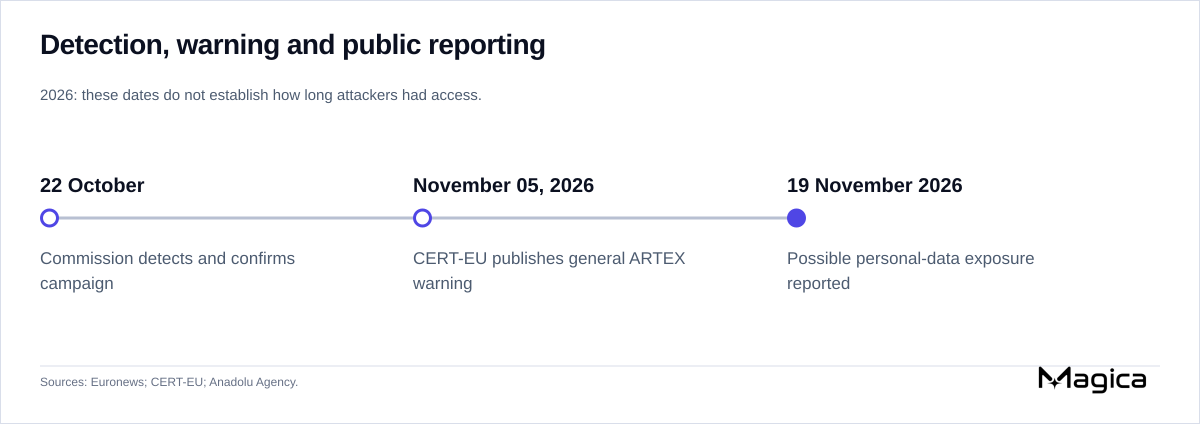
CERT-EU’s general ARTEX warning did not identify this Commission incident. These dates do not establish how long attackers had access. Source: Euronews.
Sysper, the Commission's internal platform for salary information, leave requests, timesheets and training, was working again on Thursday, November 19. The Joint Sickness Insurance Scheme, or JSIS, used for health insurance and medical reimbursements, remained unavailable, according to two EU officials speaking anonymously.
The reported 10-day disruption should not be read as a precise measure of how long attackers had access. Thomas Regnier, the Commission's spokesperson for digital matters, said the campaign was detected and confirmed on October 22. He declined to say whether it was still ongoing or identify who was responsible. He also said the Commission had received no ransomware request.
Anthropic raised $81.3 billion in a record IPO and opened 34% above its offer price before retreating. Rapid revenue growth and adjusted operating profits sit alongside vast computing commitments and limited investor control.
An EU official told Politico that the Commission believed most of the attack had been contained, while the extent of possible damage remained unclear. Reports relaying that account do not provide independent technical confirmation of containment or data theft.
Regnier's public statement was narrower than a blanket assurance that no information had escaped:
“We have not detected any evidence of a data breach affecting Commission staff as a whole.”
Possible access to HR records would not normally open access to the Commission’s internal documents, which are hosted on a separate system.
Regnier said the attack was based on a publicly available AI tool. A report relaying Politico’s findings said CERT-EU, the cybersecurity service and central incident-response coordination hub for EU institutions and bodies, identified that tool as ARTEX and found that attackers used it to look for weaknesses in digital systems. That identification has more detail than the spokesperson's public confirmation and should be treated as a reported investigative finding.
There is relevant precedent for the tool's misuse. In a November 5 warning, CERT-EU said it had observed several threat actors worldwide using ARTEX to automate campaigns. It described similar activity against the institutions it protects as highly likely to have involved ARTEX, without naming this incident.
ARTEX is an open-source penetration-testing platform that uses large language models to turn an operator's objectives into reconnaissance and testing tasks. According to CERT-EU, the original author removed the repository in October after reports of misuse; publicly available versions are independent forks. The platform integrates with external model providers rather than supplying its own AI model; operators choose the model, and integrations and capabilities can differ between forks.
CERT-EU says the tool’s significance lies in speed, scale and persistence: it can test many low-complexity misconfigurations and pursue long attack chains that manual assessments may leave unfinished. It supports human oversight through a dashboard and approval queue, but relies on configurable rules and the model to respect operating boundaries, without hard technical enforcement.
That distinction matters for attribution: naming ARTEX does not identify the model provider, the version used or the attacker. CERT-EU's broader warning concerns automation of vulnerability discovery and exploitation, including misconfigurations. The current reporting does not establish which weakness enabled this intrusion or how much the AI tool contributed to its success.

CERT-EU reported these figures for the separate March website-hosting breach. Comparable figures remain unknown for the current staff-system incident. Source: CERT-EU investigation of March cloud breach.
The Commission introduced a package of cybersecurity measures in January, according to the account of the latest attack. It has also faced attacks on its own infrastructure this year. A January incident involving its central mobile-device systems potentially exposed staff names and phone numbers. In March, its cloud infrastructure supporting Europa.eu websites suffered confirmed data theft.
CERT-EU's April 2 investigation of the March breach assessed with high confidence that initial access came through the Trivy software supply-chain compromise. The Commission had received a compromised version through normal software updates; attackers obtained an Amazon Web Services API key on March 19 and used it to steal data. About 91.7 GB of compressed data was exfiltrated, including names, email addresses and email content; data pertaining to at least 29 other EU entities might have been affected. Most email-related files were automated notifications with little or no content, though bounce-back messages could contain material originally submitted by users.
These figures concern the March website-hosting breach. No comparable data volume or affected-person count has been established for the current staff-system incident.
The operational contrast matters too: CERT-EU said no website service interruptions had been observed in March, while the Commission said its internal systems were unaffected. Confirmed theft can occur without an outage; an outage alone does not prove theft.
The Commission's IT department, DG DIGIT, is investigating, and CERT-EU and the European Data Protection Supervisor have been informed. The report relaying Politico’s account also describes an urgent meeting of the Commission’s highest-level internal crisis-management body and a briefing to commissioners on Wednesday by technology commissioner Henna Virkkunen.
Regnier told Politico that individual systems had been targeted and those concerned had been informed. Separately, officials said they were still awaiting an official internal communication about the incident. Notification of particular affected people and a general staff explanation are different questions; neither account settles the scope of exposure.
Bart Groothuis, a Dutch member of the European Parliament from Renew Europe and former head of cybersecurity at the Dutch Ministry of Defence, criticised the Commission’s public disclosure practices. In the account of the latest incident, he said withholding information about intrusions misses an opportunity to explain the EU’s economic security policy.
There is a public-disclosure precedent: CERT-EU’s March investigation records that the Commission announced that breach on March 27, before CERT-EU published its detailed account on April 2. The question now is what the Commission can explain about this campaign and its consequences for staff.
The investigation must still establish which records were accessed or copied, how many people were affected, whether the campaign has ended and when medical reimbursement access will return.
The Kimi developer reportedly abandoned planned Nvidia B300 capacity for 2027 after new US restrictions. The deal exposes financing risks for overseas AI clouds, but neither a model delay nor a $150 million cash loss is established.
Kong is expanding from API management into hosting AI agents and applications. Volcano bundles backend services with a LavaFlow repair preview, but human review, plan restrictions and deployment controls narrow its autonomous-software pitch.
Anthropic's pre-debut price indications reached $105, about 26.5% above its offer price, after an $81.3 billion IPO. Strong demand for the Claude maker confronts enormous computing commitments and a governance structure that limits ordinary shareholders' influence.
Google has booked New Glenn for a dedicated Project Suncatcher launch in early 2029. Laboratory tests support parts of its orbital AI design, but deployment, launch reliability and commercial economics remain unproven.
Canva is rolling out free controls for Free and Pro accounts to disable supported generative AI tools and reduce AI-made assets in search. The settings extend individual choice while leaving AI enabled by default and preserving the company's investment in generation.
Alibaba targets 30%–45% cloud revenue growth next fiscal year and may reduce its long-term capacity plan. Domestic chips underpin its unchanged 2030 revenue ambition, but production, funding and customer allocation remain critical tests.
Singapore’s central bank plans a common protocol for financial institutions to assess customer AI agents, alongside a sandbox for treasury and payments. Its digital settlement network has completed a S$100 million bill issuance, but wider adoption, cost savings and agent accountability remain unresolved.
Jeff Bezos says Prometheus tools are in private trials, including two Blue Origin projects. Its claims of faster design now face the harder test of manufacturing gains, as rivals automate existing engineering workflows.
The IEA projects data-center electricity demand reaching 1,000 terawatt-hours annually by 2030, but connection queues, equipment shortages and local opposition could limit how much of the investment boom gets built.
European individuals secured about $1.1 billion of Anthropic shares, roughly 1.4% of the public offering’s value. The UK offer combines broad participation with rationing, while the AI lab’s governance and compute commitments define what investors are buying.
Federal prosecutors accuse Igor D’iu of acting for Russia to surveil employees of a Silicon Valley defense technology company identified in reports as Palantir. An FBI affidavit describes screen photographs, employee dossiers and $45,000 in reported payments, but leaves the handlers’ identities and the success of attempted electronic collection unresolved.
Alibaba’s September-quarter profit more than tripled as investment gains and a commerce recovery amplified stronger cloud earnings. Cloud revenue rose 53%, but AI application losses widened and infrastructure spending left free cash flow negative. A large share placement bolstered liquidity.
President Donald Trump rejected international restrictions on advanced AI at APEC. His administration has already outlined voluntary cybersecurity cooperation, alongside deregulation and support for American AI exports and infrastructure.
London-based LATO has raised $4.7 million to expand AI agents that interview customers and experts for investment research. Its early traction claims come as rivals offer similar research workflows and Salesforce absorbs Listen Labs; comparative cost and quality remain unproven.
Snap’s free Easy Lens CLI connects AI coding assistants to Snapchat’s AR creation and publishing workflow. It builds on earlier prompt-based tools as TikTok offers a competing approach.
Nvidia’s first earnings report since Jensen Huang’s departure showed revenue more than doubling, but shares fell 2.9%. Interim CEO Colette Kress faces a permanent leadership search, lower forecast margins and expanding infrastructure commitments, including conditional guarantees.
Needham’s $150 target stands about 81% above Anthropic’s $83 IPO price, versus Morningstar’s $92 fair-value estimate. Rapid enterprise growth and fresh financing support the business, but pricing power, compute commitments and shareholder control complicate the investment case.
Waymo suspended Bay Area service during the November 18 storm after reports of robotaxis obstructing flooded streets, raising questions about how it withdraws its fleet when road conditions deteriorate.
Lenovo reported record quarterly revenue of $30.2 billion as its infrastructure business swung into profit. A $1.91 billion noncash warrant charge drove a reported loss, while expanding inventories and overdue receivables raised the stakes for cash collection.