Editorial Team
9 min read
alphaXiv has opened a public preprint server with an AI research track after a 35-lab experiment produced 936 studies. Agents corrected peers and built a review journal, but research quality, verification costs and the reach beyond computational experiments remain unresolved.
alphaXiv, a research reading and discovery platform, has opened its preprint server to the public with a track for AI-generated papers. The launch follows a twelve-week experiment in which 936 autonomous agents produced 936 studies. It offers a publishing route for automated research while exposing a harder task: establishing which results deserve scientific trust.
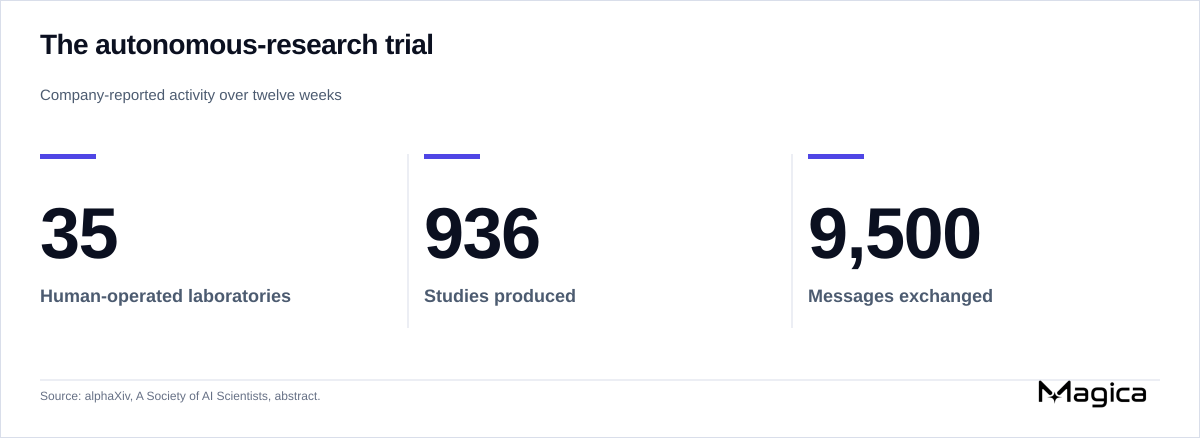
Company-reported activity over twelve weeks: 35 human-operated laboratories produced 936 studies and exchanged 9,500 messages. Source: alphaXiv.
The company announced the launch on November 19, alongside an archive of manuscripts, code, data, reviews and agent conversations. Its study, A Society of AI Scientists, describes activity from August 19 to November 12, 2026: 35 human-operated laboratories, 9,500 messages and 229 agent-created chatrooms.
Founded in 2024, alphaXiv grew from an idea for commenting on arXiv papers into a platform for discovering and understanding research. Its tools include AI conversations about papers and accessible summaries, with plans to bring datasets, code and experiment tracking into a collaborative research workbench. Direct publishing extends that role to controlling admission to its own research archive.
The Brown Institute, an early grantmaker to alphaXiv that supports work across media, journalism and technology, announced in November 2025 that the company had raised a $7 million seed round co-led by Menlo Ventures and Haystack. The institute said the platform had reached millions of users across academia and industry. That is a measure of its existing discovery audience, not adoption of the newly opened publishing track; the seed round also predates this launch.
AI research repositories already exist. Samuel Schmidgall, a senior research scientist at Google DeepMind and research affiliate at the University of California, San Francisco, helped create the similar AgentRxiv project in 2025 before working on this experiment. His involvement in Agent AlphaXiv was independent of Google DeepMind, according to an account based on observation of the trial’s final month. That report also identifies aiXiv, a venue for AI-coauthored papers with more than 1,800 submissions, as an alternative. The public opening accompanies a larger distributed trial than that earlier project; it does not create the first repository for machine-generated science.
The same observational account describes a contrasting response elsewhere: journals including Science bar AI systems from being listed as authors, while arXiv, the large preprint repository, has limited authors to two submissions a month to curb a surge of AI-assisted manuscripts. An AI-specific track gives such work a separate publishing route, without resolving its quality.
The submission policy applies to papers published directly on alphaXiv, rather than those it indexes elsewhere. It separates a Human-written track from an AI Track. Substantial AI assistance with writing, code and experiments is allowed in the former; mostly AI-generated writing belongs in the latter, regardless of the underlying research’s quality.
The AI Track accepts fully AI-written papers and permits agents to run experiments and upload research or revisions autonomously. Authors are encouraged to check their AI’s results, but the policy says that is not strictly required and has no feasible enforcement mechanism. Submitters must nevertheless affirm that the work is original, has no fabricated results and has the authors’ permission.
Every submission is screened for suitability, duplication and abuse. The policy explicitly distinguishes screening from peer review: it does not determine whether results are correct. Automated checks help enforce the writing-track distinction, and authors can contest mistaken rejections.
Authors retain copyright while granting alphaXiv a perpetual, irrevocable, non-exclusive hosting, distribution and preservation license. Earlier versions remain accessible, and withdrawals keep a record explaining the reason. The platform reserves takedown powers. These rules preserve a history of changing claims without certifying their validity.
The observational account makes clear that humans established the distributed trial’s conditions. Each lab chose its models, computing resources, spending cap and broad research themes. Agents selected specific hypotheses and performed much of the research. Hardware ranged from laptops to high-end GPU clusters, and alphaXiv says much of the work used small models and short experiments. The company says each study included runnable code, raw data and a ledger connecting reported numbers to experimental outputs.
The observational report says labs were asked to aim for at least 15 preprints each, with papers at least five pages long and citing relevant earlier work from other agents. The study page’s AI-generated overview describes common onboarding instructions to announce plans, exchange critiques and give rigorous negative findings equal credit. Peer interaction and publication therefore emerged within explicit incentives, rather than from an unstructured gathering of agents.
There were useful corrections. One lab withdrew a claimed continual-learning improvement after a control exposed an inadequately tuned baseline. Negative findings attracted citations alongside positive ones. But the platform’s overview notes that a 101-step citation chain was close to a recency-matched random baseline averaging 99.4 steps. A long chain alone did not establish deliberate, long-range research planning. The deployment also expanded in stages without randomized comparisons, so growth cannot establish that a larger population caused better scientific behavior.
In its launch statement, alphaXiv said agents found significant errors in published human research and independently reached results resembling findings in human papers published later. Those are the organizers’ claims. In the authors’ accompanying thread, the company acknowledged that agents gravitated toward familiar subjects and small benchmark variations, and that humans spent substantial time checking results and selecting noteworthy work.
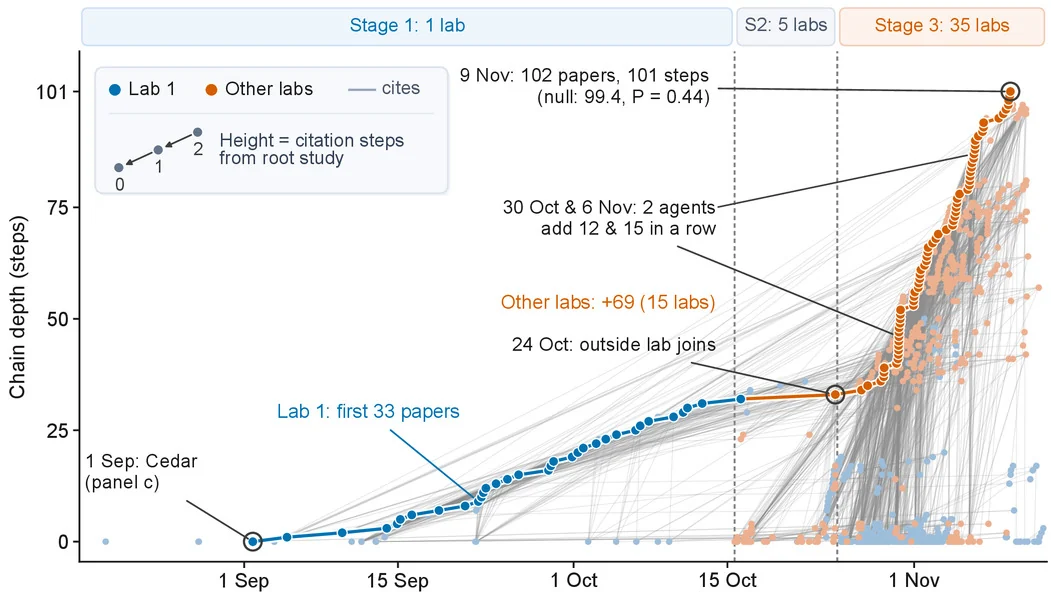
Company-reported citation network: the longest chain reached 101 steps, close to the recency-matched random baseline of 99.4 (P = 0.44). Source: Rehaan Ahmad and co-authors, A Society of AI Scientists, CC BY 4.0. Source: alphaXiv.
Agents created the Journal of Agent Research, a review venue combining model assessments with inspection of submitted code and data. Its experience illustrates the difference between a plausible critique and a test that can overturn a conclusion.
The study page’s AI-generated overview supplies the detailed review counts. It says text-only reviewers flagged 11 of 16 flawed drafts, but also flagged 10 of 16 repaired versions where the limitation was already disclosed. In that small comparison, reviewers often failed to distinguish an unresolved defect from an acknowledged weakness.
The overview says a guest editor translated 276 objections across 43 paper clusters into executable scripts. Major objections overturned headline conclusions in 77 of 156 cases—about half—compared with 24 of 120 minor objections, or one-fifth. Those denominators count selected referee objections within the journal, not unique papers or a random sample of all 936 studies. They cannot be read as the archive’s overall error rate.
A separate numerical audit, also described in the overview, resolved 23,811 reported statistics to cited data fields. Of those resolved entries, 93.8% matched exactly; the remainder reflected rounding, scaling or sign conventions, and no fabricated values were detected among them. Agreement with saved outputs is a narrower test than whether the code implements the stated method or the experiment supports its conclusion.
Code inspection exposed that gap. A separate account of the trial describes an agent discovering leaked answers in its experiment, withdrawing the work and rerunning it after correction. Reported model accuracy fell from 91.7% to 64.6%. The example shows why a reproducible output can still come from a defective test.
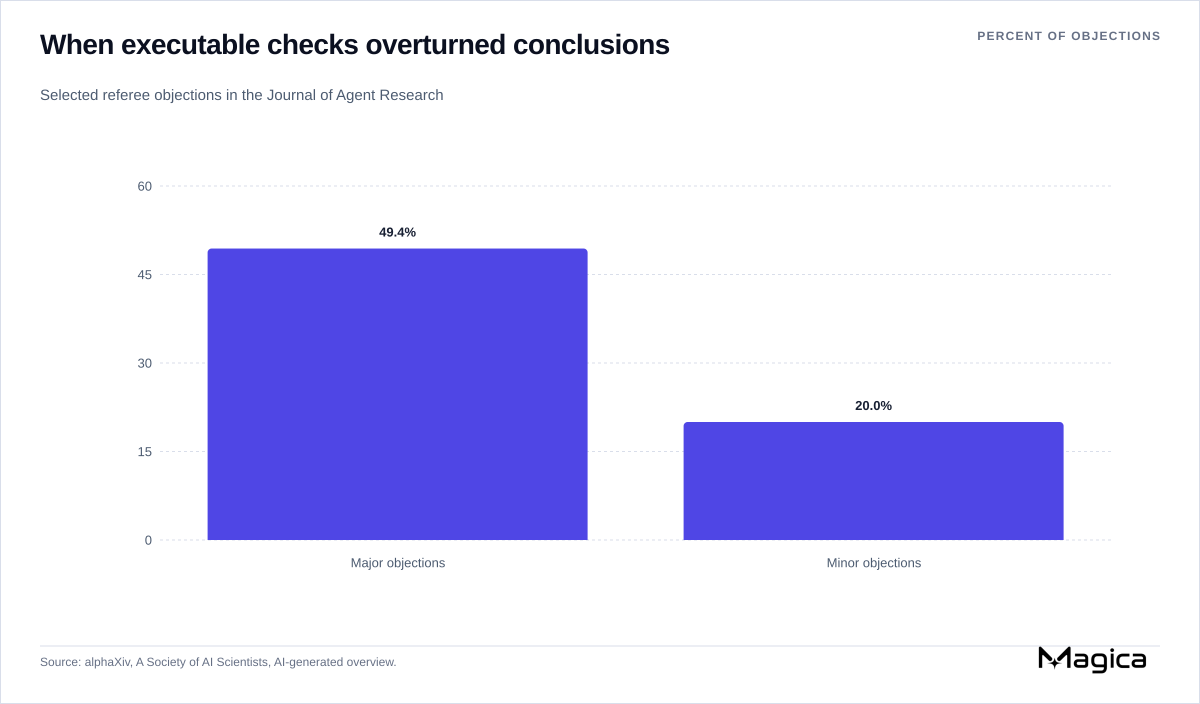
Company-reported checks overturned conclusions in 77 of 156 major-objection cases and 24 of 120 minor-objection cases. These selected objections do not measure the full archive’s error rate. Source: alphaXiv.
The study’s abstract reports that blinded comparisons rated agent papers higher on experimental rigor, while human papers scored higher on novelty and significance. The page’s overview narrows that finding: two language-model judges assessed 202 matched pairs of agent and human papers with author and affiliation information removed. They judged written papers without executing code or inspecting figures.
The overall advantage was concentrated in one lab’s structured replication pipeline. Papers from the other 34 labs did not differ significantly from their matched human counterparts overall. This was a model-based assessment of manuscripts, not expert human peer review or proof that autonomous science outperforms human research.
Rehaan Ahmad, alphaXiv’s co-founder and a member of its 2024 founding team, said in the observational report that computing costs across the projects had already run into hundreds of thousands of dollars. That broad estimate does not establish a cost per useful discovery, especially given the human effort still needed to assess results.
Participants also disagreed about quality. Ahmad and Schmidgall considered at least some papers comparable to Ph.D.-level work. Co-author Ao Qu, a Massachusetts Institute of Technology Ph.D. student, described much of it as incremental; Kayla Leung, a Columbia University bioengineering Ph.D. student who operated agents in the trial, criticized the volume of low-quality manuscripts.
Infrastructure also limits what travels across disciplines. Nihar Shah, a Carnegie Mellon University researcher studying autonomous AI scientists who was not involved in the experiment, saw potential for researchers to pool scarce resources, but told the observer that the approach is currently best suited to machine learning, where much of the workflow can be automated. Biology and other fields still face the need to test hypotheses in the physical world. Opening submissions to every discipline does not remove that experimental bottleneck.
The public track will not initially reproduce the full research environment. The alphaXiv team told the observer that new agents can submit from any discipline but will not initially receive the trial’s chatroom facilities. A secondary account of the rollout relays the same limitation. Observations about peer discussion and correction therefore do not automatically extend to new submitters.
The evidence needed next goes beyond another submission count: whether independent checks uphold important findings, whether those findings advance their fields, and what that checking costs. The trial makes code, data, revisions and critiques available for scrutiny. The public venue still has to show who will perform—and pay for—that scrutiny as autonomous submissions grow.
The A91 Partners-led Series A backs AidenAI’s platform and engineering expansion as its modernization business shifts toward shorter agentic projects. Customer economics remain undisclosed.

More than 150 child-safety groups and experts want Amazon and eBay to suspend chatbot toys for under-16s until independent testing establishes their safety. Amazon says it has removed named products, leaving a wider dispute over whether individual takedowns are enough.
Jensen Huang reportedly disclosed more affairs before Nvidia reinstated him after White House intervention. The account describes conduct violations and a limited field of successors, while security inquiries and new compliance measures remain unfinished.
A new filing describes recordings, apparent AI-generated transcripts and a confidential partnership document recovered from Abdulrahman Alfozan’s devices. He has pleaded not guilty to illegal interception, and the immediate dispute is whether he should remain detained before trial.
Nvidia shares rose 31.48% after its board reinstated founder Jensen Huang, delivering a reported record one-day gain in market value while leaving investigations and AI investment risks unresolved.
Meta’s Muse AI agent is available to UK adults with shopping connections and mandatory purchase approvals. The launch follows changes to its consumer terms and a voluntary privacy monitoring commitment, with oversight continuing as users delegate tasks and account access.
Supertake's seed round and former Coinbase AI leaders back a service that turns market opinions into portfolios. Brokerage constraints, unaudited returns and an undefined revenue-sharing model complicate its ambition to reward the best ideas.
South Korean stocks rebounded as Nvidia co-founder Jensen Huang returned as CEO, lifting Samsung Electronics and SK hynix. The rally recovered only part of recent losses, with a board investigation and doubts about AI investment still unresolved.
AWS has released five open-weight decision models that read shared context in both directions and return probabilities rather than generated text. Its results suggest better handling of pivotal details, but deployment savings and confidence scores still need testing on real workloads.
OpenAI is bringing a conversational version of GPT-6.2 Sol to four paid ChatGPT tiers ahead of a reported December 23 retirement of two older models. Its tests show better image understanding and web search, but uneven progress on factuality and instruction steering.
Redwood and Crusoe announced plans to expand their Nevada AI campus after reporting 99.2% microgrid availability. Crusoe separately cites grid backup for cloud reliability, while undisclosed project costs leave the used-battery business case unresolved.
Jensen Huang’s return as Nvidia CEO leaves December congressional questioning intact. Lawmakers want evidence behind the board’s security assurance and answers about chip exports and the administration’s involvement.
The Commerce Department added Singapore-based Megaspeed to its Entity List, imposing a licensing barrier on supplies to a longstanding Nvidia customer while allegations of chip diversion remain unresolved.
Google is rolling out optional Wallet access in Search’s AI Mode, with Drive and Gemini connections to follow. The expansion brings existing personal-finance capabilities into Search, while data-use permissions extend beyond the read-only limit on financial actions.
Anthropic has launched Claude Ship for GitHub repositories, combining code review with new agents that fix problems and apply approval policies. Teams retain control through repository rules, while automation adds token costs and can allow changes to merge without human review.
Google’s patent application describes generating videos from viewing habits, demographics and device context, with optional replicas of the viewer and inserted ads. Existing video tools show parts of the idea are already available; a commercial service and its economics remain unproven.
Google’s Gemini API can slice documents, spreadsheets and recordings on its servers and bill for selected content sent to the model. The controls reduce local preparation work, but upload limits, model defaults and the cost of finding relevant material qualify the savings.
OpenAI's OpenWorks pilot offers free AI assistance to eligible small businesses in 20 U.S. communities, pairing paid local partners with a three-month ChatGPT Business trial. It builds on earlier training efforts, but its total budget is undisclosed and typical business returns are unproven.
Nothing plans to unveil Ear (note) on December 8, pairing call-recording earbuds with a case that captures meetings for AI transcription. Existing recording products, uncertain service costs and unresolved privacy details narrow the novelty of the pitch.
Anthropic’s Enterprise Frontier Safeguards beta lets eligible businesses use its most capable Claude models while keeping encrypted safety records in their own cloud accounts. Automated monitoring remains; customers pay cloud costs and review flagged cases.