Editorial Team
5 min read
Sean Cairncross is leaving as national cyber director, with Pentagon CIO Kirsten A. Davies reportedly selected to succeed him. The transition puts Senate confirmation at the center of a cybersecurity leadership reshuffle.
Sean Cairncross, the White House national cyber director and a former Republican National Committee chief operating officer who later led a federal foreign-aid agency, is leaving his post. A White House official confirmed the departure in a report published November 19. Pentagon chief information officer Kirsten A. Davies, whose earlier career included leading information security at Unilever, has been named to succeed him, according to a separate report.
The change puts a Senate-confirmed coordinating role in play just before control of the chamber changes. The Office of the National Cyber Director coordinates cybersecurity policy and strategy across the federal government; selecting a successor does not complete the confirmation process.

Sean Cairncross, then CEO of the Millennium Challenge Corporation, speaks in Malawi in 2019. Photo: U.S. Embassy Lilongwe via Flickr. Source: The Record.
Two sources described Cairncross’s departure as amicable. But a senior administration official said Stephen Miller, the new White House chief of staff, sought the change, according to the report naming Davies. It did not establish why Davies was chosen beyond highlighting her greater experience in the field.
Earlier accounts offered a timing rationale: Cairncross did not want to serve another two years and was leaving to give the White House time to confirm a replacement before Democrats take control of Congress in January. That explanation appears in the earlier coverage and the report quoting the White House official. Both attributed that explanation to earlier Axios reporting rather than an on-record explanation from Cairncross. They did not independently establish his reasoning.
The management company supporting Japan's Shonan Beauty Clinic network disclosed stolen customer passwords stored without encryption and a separate booking-service incident. Treatment-related submissions were also exposed, while the affected population and financial impact remain under investigation.
President Donald Trump’s Republican Party lost its majorities in both chambers in this month’s midterm elections. The confirmation window therefore gives the departure an immediate institutional consequence, even though the available accounts do not settle who initiated it.
Davies brings a corporate information-security record to her current Pentagon role. A report on her Pentagon nomination, citing her LinkedIn biography, identified her as Unilever’s chief information security officer from September 2021 to June 2024, with earlier senior security roles at Estée Lauder, Barclays, Hewlett-Packard and Siemens. The Defense Department directed the publication to that profile and confirmed it was hers.
The same profile identified Davies as founder and chief executive of the nonprofit Institute for Cyber Civics, which focuses on citizens’ safety, security and privacy when using technology. The institute had produced a cybersecurity handbook for poll watchers and election observers. Those activities add to her corporate security record, but do not establish the White House’s reasons for choosing her.
Cairncross’s route was through political management and government leadership. An official nomination announcement identifies him as the Republican National Committee’s chief operating officer during the 2016 election cycle and subsequently a senior adviser to the White House chief of staff. He later led the Millennium Challenge Corporation, an independent federal foreign-aid agency that uses grants and assistance to promote economic growth and reduce poverty.
During his first-term White House service, Cairncross represented the chief of staff on National Security Council committees. He also worked with the intelligence community and dealt with cyber threats at the RNC, according to the report naming Davies. His background therefore included national-security responsibilities as well as party management.
His limited technical background was scrutinized during his cyber-director confirmation. Yet the Senate approved him 59–35, and the first national cyber director, Chris Inglis, publicly supported him, according to coverage of his 2025 confirmation. Cairncross argued that his management experience qualified him for the job. The office itself was established in 2021, making this another leadership transition in a comparatively young institution.
Cairncross was involved in the administration’s AI decisions as well as its cyber policy. He held technical meetings with AI developer Anthropic’s leaders over the summer after Commerce Department export controls effectively took its models offline, according to the report naming Davies. His head of policy and senior adviser, Thomas Lind, left in June and joined AI developer OpenAI in October, the same report said.
The handoff comes after technical outages affecting U.S. air travel, banking and national-security systems. Democrats have criticized the administration’s response and warned about AI-enabled cyber threats. Those concerns should be distinguished from the cause of the disruptions: top officials have repeatedly said the outages were separate and unrelated to cyberattacks, according to the report confirming Cairncross’s departure. The reporting does not establish that the outages prompted the personnel change.
Other cyber leadership appointments are also pending. Michael LoSapio, a Palantir executive selected to lead the Cybersecurity and Infrastructure Security Agency, faced a contentious confirmation hearing on November 19, according to the report naming Davies. That agency helps defend federal civilian networks and critical infrastructure, a distinct function from the White House office’s policy coordination.
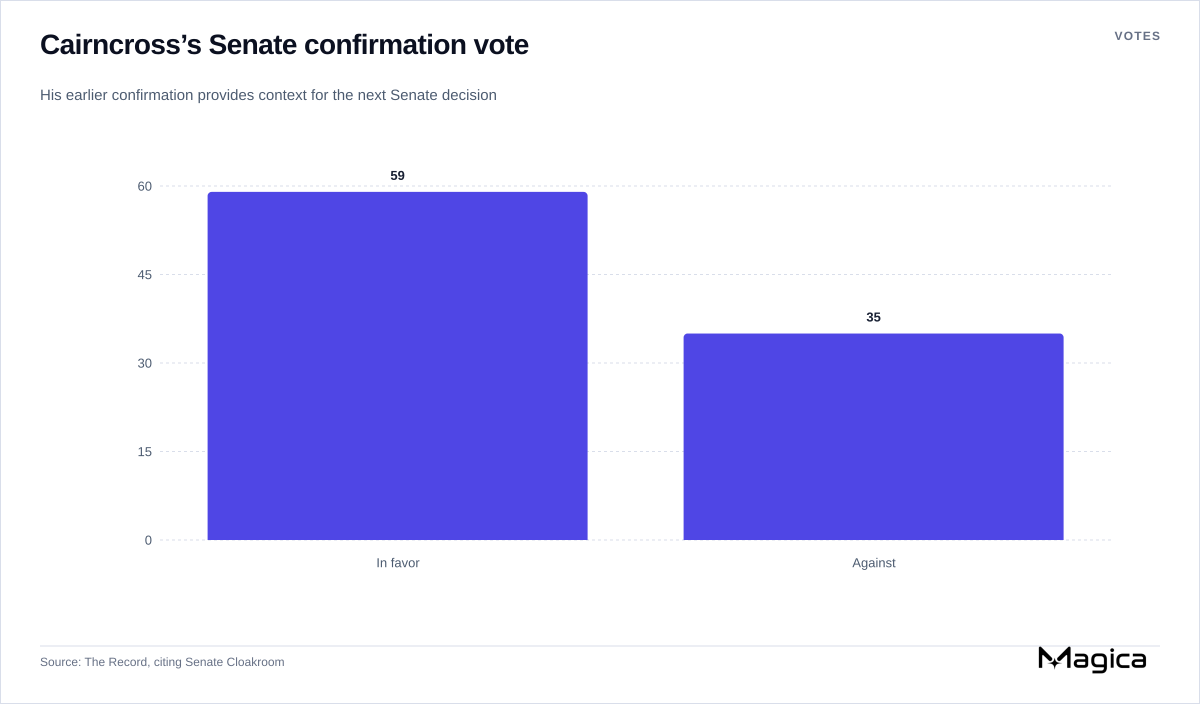
The Senate confirmed Cairncross by 59–35. His successor will also require Senate confirmation. Source: The Record.
The immediate questions are when Cairncross leaves and whether Davies can secure confirmation before the Senate changes hands. The available reporting gives no firm departure or confirmation timetable. A reported successor leaves the timing of the handoff unresolved.
N-able says an intruder reached a server supporting Mail Assure and SpamExperts Hosted Cloud. Mail delivery and filtering continued, but customers lost management access as the company revoked tokens and worked to restore services securely.
Microsoft is testing an optional Edge mode that blocks WebGL and WebGPU to reduce opportunities for browser exploitation. An early hands-on test found that restoring graphics for a trusted site also removed its broader Enhanced Security protections.
A critical authentication bypass gave a suspected China-linked espionage group access to VMware's virtualization control plane. Mandiant says the campaign stole signing keys and virtual-machine data, making compromise checks essential alongside patching.
PHP’s November 19 security releases address seven critical flaws, including unauthenticated code execution through reused backend connections. Patching takes priority, but applications that retain session upload progress must also check shared storage and serialization settings.
TfL has shut its Oyster photocard website after a breach that may have exposed around 265,000 customers’ account details, including security answers. Existing cards still work, while the attack method and restoration timetable remain undisclosed.
Around 40 Irish credit unions are implicated in a saved-payee data breach at software supplier Wellington IT. Missing logs leave the victim count unresolved, while a minister is seeking answers about the disclosure delay.
JPMorganChase says it believes attackers accessed marketing data at outside service providers, potentially exposing customer names and email addresses. The bank says services are unaffected, but has not identified the vendors or disclosed the attack date.
Apache confirms exploitation of a Roller code-execution flaw that survives disabling XML-RPC in its administration panel. Attacks on the retired Axis 1.x library also expose enterprise applications, making product-specific mitigation and compromise checks urgent.
StepSecurity’s Elephant-led Series A will fund broader protection for developer machines, package downloads and build pipelines, alongside planned defenses for AI-agent sandboxes. Its challenge is turning open-source adoption into a larger commercial platform while proving the extra controls earn their place.
Nvidia says it has found no indication its own systems were affected after The Gentlemen ransomware group listed it on a leak site. The investigation concerns a possible incident at a partner, while the gang has supplied no public proof.
Senators from both parties plan to delay the CISA nomination of Palantir security chief Michael LoSapio after his Jan. 6 denial, adding a confirmation obstacle as the agency faces staffing losses and funding decisions.
Windows baseline protection combines existing PC safeguards into a verifiable pass-or-fail result. Microsoft defines the standard; developers choose whether failure means a warning, fewer features or blocked access.
F5 lists fixed releases for a critical nginx HTTP/2 flaw, while the wider NGINX2Root disclosure covers five independent nginx attack paths and a separate Linux kernel bug. Remediation depends on configuration, supplier patch levels and replacing vulnerable running processes.
Tyler Robert Buchanan received six years in U.S. prison for a phishing and SIM-swapping conspiracy that stole at least $11.6 million from individuals. He is the last of five defendants sentenced; restitution remains pending.
The new Threat Disruption Center makes TRM Labs its main technology partner following a reported $94.66 million sole-source award for Homeland Security Task Force investigations. A rival lost its court challenge, but the launch leaves the center’s share of that spending and its performance benchmarks undisclosed.
Fandango says payment details from certain October 8–11 transactions may have been exposed. State disclosures provide only a partial affected count, while the company has not explained how the checkout page was compromised.
Norway’s state-controlled oil and gas group is working to neutralise an attack on some IT systems. Employee services may be disrupted, but Equinor says operations and production remain unaffected and it has found no indications of data theft.
Tor urges relay operators to install 0.4.9.17 as a continuing DDoS attack strains its privacy network. A post-upgrade operator account describes further disruption, while Bitcoin connectivity measurements show partial recovery with important limits.
Malicious code in Optimizely website-testing projects could swap cryptocurrency addresses and skim payment cards. Optimizely says it has fixed the vulnerability and removed the code, but visitor exposure and losses remain unquantified.