Editorial Team
5 min read
Tyler Robert Buchanan received six years in U.S. prison for a phishing and SIM-swapping conspiracy that stole at least $11.6 million from individuals. He is the last of five defendants sentenced; restitution remains pending.
Tyler Robert Buchanan, a 24-year-old hacker from Dundee, Scotland, who helped run a channel collecting stolen employee logins, was sentenced on November 17, 2026, to six years in U.S. federal prison. His admitted role in a phishing and SIM-swapping conspiracy involved intrusions at at least a dozen companies and the theft of at least $11.6 million in cryptocurrency from individuals across the United States.
The case shows how information stolen from businesses could become a route into individuals’ financial accounts. The conspirators used it to identify crypto holders, then seized control of phone numbers to intercept authentication codes and access their accounts, according to the Justice Department’s sentencing announcement.
U.S. District Judge John W. Holcomb imposed the sentence in Santa Ana, California. Buchanan pleaded guilty on April 17, 2026, to one count of conspiracy to commit wire fraud and one count of aggravated identity theft. He is the fifth and final defendant sentenced in this case and is identified in reporting as a member of the Scattered Spider cybercrime collective.
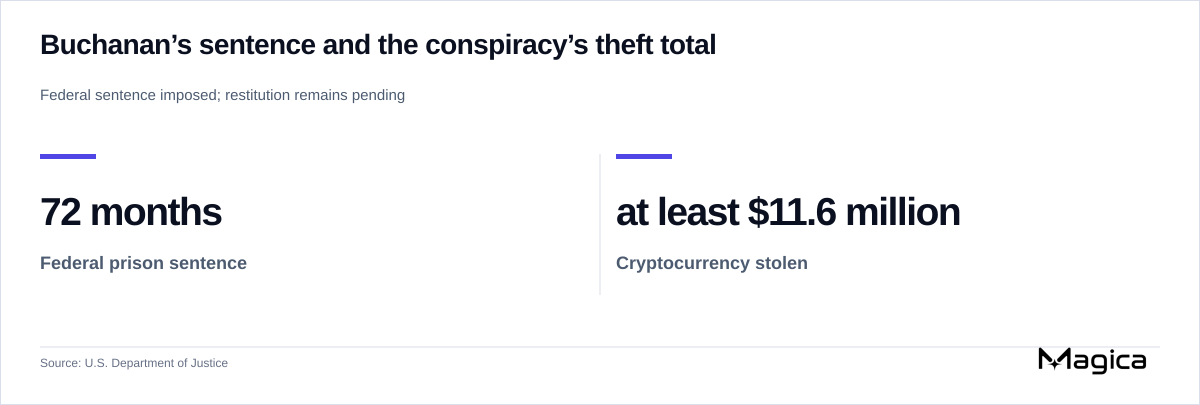
DOJ figures show Buchanan’s sentence and the conspiracy’s minimum theft total. Restitution remains pending. Source: U.S. Department of Justice.
The conspiracy ran from September 2021 to April 2023, according to Buchanan’s plea agreement as described by prosecutors. Victims and intended victims spanned telecommunications, technology, interactive entertainment, outsourced business services, IT suppliers, cloud communications and cryptocurrency businesses, as well as individuals.
The attacks began with hundreds of text messages impersonating employers or their contracted information technology and business process outsourcing suppliers. Links led employees to counterfeit websites that collected usernames, passwords and personal information.
The management company supporting Japan's Shonan Beauty Clinic network disclosed stolen customer passwords stored without encryption and a separate booking-service incident. Treatment-related submissions were also exposed, while the affected population and financial impact remain under investigation.
The conspirators’ phishing kit sent captured credentials to a Telegram channel administered by Buchanan and another conspirator. Those credentials enabled access to corporate systems and confidential information, including work product and, at some companies, names, email addresses, telephone numbers and account credentials.
The next stage targeted individuals. Buchanan admitted that the group used information stolen during company intrusions to identify and access victims’ virtual-currency accounts and wallets. Through SIM swaps, the conspirators fraudulently persuaded mobile carriers to move victims’ telephone numbers to devices under their control. That let them receive security codes sent by text or telephone call and bypass those authentication checks.
Evidence recovered at Buchanan’s Scottish residence in April 2023 included files concerning victim companies, individual victims’ names and addresses, and a text file containing cryptocurrency seed phrases and login information for one victim’s account, prosecutors said.
Known online as Tylerb, Buchanan was subsequently arrested in Spain in 2024 and extradited to the United States, according to a court report. He has been in U.S. federal custody since April 2025. The FBI investigated the case with assistance from Police Scotland, Spanish police and other U.S. authorities.
The $11.6 million minimum describes cryptocurrency stolen by the conspiracy from individual victims. The sentencing announcement does not identify that sum as Buchanan’s personal proceeds.
At his guilty plea, prosecutors had put the theft at at least $8 million; the reported minimum reached $11.6 million at sentencing. A BBC account cited in reporting on the sentence identified the largest single theft as $1.67 million from one victim in December 2022. Prosecutors said the thefts caused severe, life-changing harm to many victims.
Those figures measure losses, rather than money recovered or compensation paid. The restitution amount remains a separate question for the court.
Scattered Spider is a loose-knit collective of young, English-speaking hackers who coordinate through Telegram, Discord and hacking forums, according to reporting on the group. Its broader record includes corporate data theft and ransomware activity. Those wider associations should not be read as findings that Buchanan participated in every attack attributed to the collective.
A November 16, 2023, joint advisory from the Federal Bureau of Investigation and Cybersecurity and Infrastructure Security Agency described a group targeting large companies and their contracted IT help desks. Alongside phishing and SIM swaps, it described repeated authentication prompts intended to wear users down and impersonation used to persuade help-desk staff to reset passwords or authentication tokens.
The agencies recommended FIDO/WebAuthn authentication or public-key-infrastructure-based multifactor authentication, describing those implementations as resistant to phishing, repeated-prompt attacks and SIM swaps. They also urged organizations to test their defenses against the documented attack techniques. The advisory addresses the wider group’s methods, rather than establishing that every technique was used in Buchanan’s case.
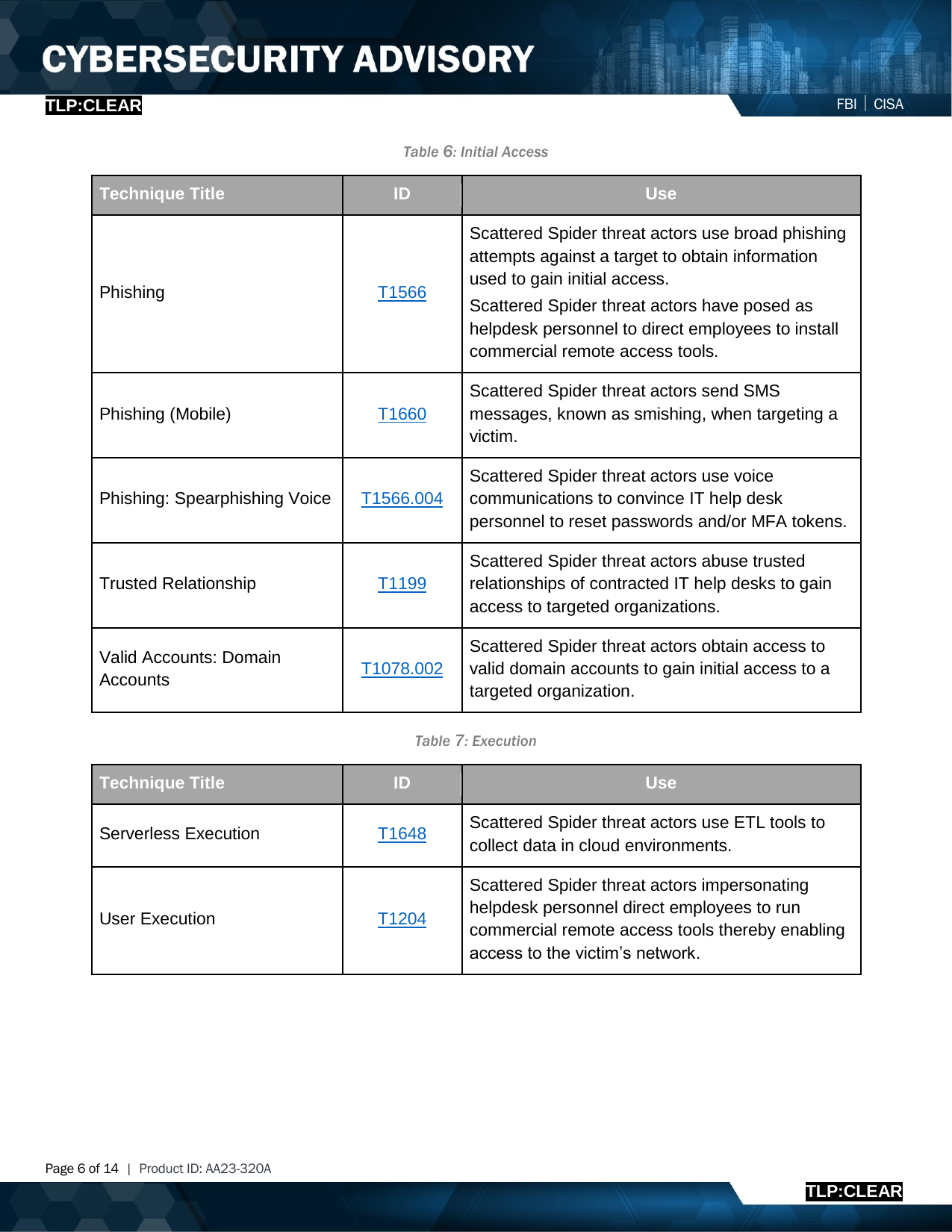
FBI/CISA’s November 2023 advisory lists techniques attributed to the wider Scattered Spider group; it does not establish that Buchanan used every technique. Source: FBI and CISA cybersecurity advisory.
The other four defendants have also pleaded guilty and received prison terms. Noah Michael Urban is serving 10 years after pleading guilty to three fraud-related counts. Ahmed Hossam Eldin Elbadawy and Evans Onyeaka Osiebo each received 45 months for wire-fraud conspiracy and aggravated identity theft; Joel Martin Evans received two years for wire-fraud conspiracy. The different convictions limit direct comparisons between their sentences.
Holcomb scheduled Buchanan’s restitution hearing for December 11, when the amount he must repay will be addressed. The sentencing announcement does not say how much victims have recovered. Their financial recovery remains unresolved as sentencing in this five-defendant case concludes.
N-able says an intruder reached a server supporting Mail Assure and SpamExperts Hosted Cloud. Mail delivery and filtering continued, but customers lost management access as the company revoked tokens and worked to restore services securely.
Microsoft is testing an optional Edge mode that blocks WebGL and WebGPU to reduce opportunities for browser exploitation. An early hands-on test found that restoring graphics for a trusted site also removed its broader Enhanced Security protections.
A critical authentication bypass gave a suspected China-linked espionage group access to VMware's virtualization control plane. Mandiant says the campaign stole signing keys and virtual-machine data, making compromise checks essential alongside patching.
PHP’s November 19 security releases address seven critical flaws, including unauthenticated code execution through reused backend connections. Patching takes priority, but applications that retain session upload progress must also check shared storage and serialization settings.
TfL has shut its Oyster photocard website after a breach that may have exposed around 265,000 customers’ account details, including security answers. Existing cards still work, while the attack method and restoration timetable remain undisclosed.
Around 40 Irish credit unions are implicated in a saved-payee data breach at software supplier Wellington IT. Missing logs leave the victim count unresolved, while a minister is seeking answers about the disclosure delay.
JPMorganChase says it believes attackers accessed marketing data at outside service providers, potentially exposing customer names and email addresses. The bank says services are unaffected, but has not identified the vendors or disclosed the attack date.
Apache confirms exploitation of a Roller code-execution flaw that survives disabling XML-RPC in its administration panel. Attacks on the retired Axis 1.x library also expose enterprise applications, making product-specific mitigation and compromise checks urgent.
StepSecurity’s Elephant-led Series A will fund broader protection for developer machines, package downloads and build pipelines, alongside planned defenses for AI-agent sandboxes. Its challenge is turning open-source adoption into a larger commercial platform while proving the extra controls earn their place.
Nvidia says it has found no indication its own systems were affected after The Gentlemen ransomware group listed it on a leak site. The investigation concerns a possible incident at a partner, while the gang has supplied no public proof.
Senators from both parties plan to delay the CISA nomination of Palantir security chief Michael LoSapio after his Jan. 6 denial, adding a confirmation obstacle as the agency faces staffing losses and funding decisions.
Sean Cairncross is leaving as national cyber director, with Pentagon CIO Kirsten A. Davies reportedly selected to succeed him. The transition puts Senate confirmation at the center of a cybersecurity leadership reshuffle.
Windows baseline protection combines existing PC safeguards into a verifiable pass-or-fail result. Microsoft defines the standard; developers choose whether failure means a warning, fewer features or blocked access.
F5 lists fixed releases for a critical nginx HTTP/2 flaw, while the wider NGINX2Root disclosure covers five independent nginx attack paths and a separate Linux kernel bug. Remediation depends on configuration, supplier patch levels and replacing vulnerable running processes.
The new Threat Disruption Center makes TRM Labs its main technology partner following a reported $94.66 million sole-source award for Homeland Security Task Force investigations. A rival lost its court challenge, but the launch leaves the center’s share of that spending and its performance benchmarks undisclosed.
Fandango says payment details from certain October 8–11 transactions may have been exposed. State disclosures provide only a partial affected count, while the company has not explained how the checkout page was compromised.
Norway’s state-controlled oil and gas group is working to neutralise an attack on some IT systems. Employee services may be disrupted, but Equinor says operations and production remain unaffected and it has found no indications of data theft.
Tor urges relay operators to install 0.4.9.17 as a continuing DDoS attack strains its privacy network. A post-upgrade operator account describes further disruption, while Bitcoin connectivity measurements show partial recovery with important limits.
Malicious code in Optimizely website-testing projects could swap cryptocurrency addresses and skim payment cards. Optimizely says it has fixed the vulnerability and removed the code, but visitor exposure and losses remain unquantified.