Editorial Team
6 min read
Around 40 Irish credit unions are implicated in a saved-payee data breach at software supplier Wellington IT. Missing logs leave the victim count unresolved, while a minister is seeking answers about the disclosure delay.
A breach involving Wellington IT, a Belfast-based banking software supplier to about 50 credit unions, including 43 in Ireland, has exposed saved payment-recipient records. Company correspondence described in a report on customer notifications says Wellington cannot identify precisely which records were retrieved because the necessary logs are unavailable.
The incident implicates around 40 Irish credit unions. That is an institution count, not a tally of victims. Reassurances about account security leave a separate risk: stolen names, bank identifiers and payment references could make fraudulent messages more convincing.
North East Credit Union, one of the institutions using Wellington’s CU Online banking platform, said in its November 18 member notice that potentially accessed information includes saved payees’ account names, references, bank identifier codes (BICs), international bank account numbers (IBANs) and payer addresses.
The distinction between a payee and a member matters. A payee is a recipient saved for payments; the exposed information can therefore concern someone other than the credit union member who stored it. Other credit unions’ notices describe potentially exposed fields including payee nicknames, bank account numbers, sort codes and address information. Records could also show which member saved a particular recipient, according to a compilation of those disclosures. The notices do not establish that every field was taken from every institution.
North East said Wellington had confirmed that members’ own credit union account numbers, balances, transaction details and login details, including PINs and passwords, were not involved. It said the security issue was fixed and members did not need to change anything on their accounts.
Its warning concerns impersonation: a name and IBAN could help make a fraudulent call, text or email appear genuine. It advises everyone, including non-members, to avoid links in unexpected messages and never share a PIN, password or one-time code.
The management company supporting Japan's Shonan Beauty Clinic network disclosed stolen customer passwords stored without encryption and a separate booking-service incident. Treatment-related submissions were also exposed, while the affected population and financial impact remain under investigation.
Wellington’s correspondence, as described in the report on its Monday notification, says an automated client using a valid member login exploited an authorisation flaw between October 2 and 4, making five million requests. The company said the attacker was able to access saved-payee records.
The reported authorisation flaw allowed a requester using a valid login to reach saved-payee records it was not entitled to access.
The company said logs showing which members were requested or what each response contained were unavailable. It was therefore treating all saved-payee records on the platform during the attack period as potentially affected and promised figures on affected people as soon as possible. That precaution does not confirm that every record was stolen.
The public accounts also differ on the attack itself. A separate report dates the exploitation to October 6 and says Wellington’s Monday email described about 1.4 million malicious requests. Neither request figure measures distinct victims. The reports do not reconcile their dates or totals. The Department of Finance initially described the number of affected credit unions as limited, without providing a count, according to the initial report. The available accounts do not establish a confirmed total of affected people.
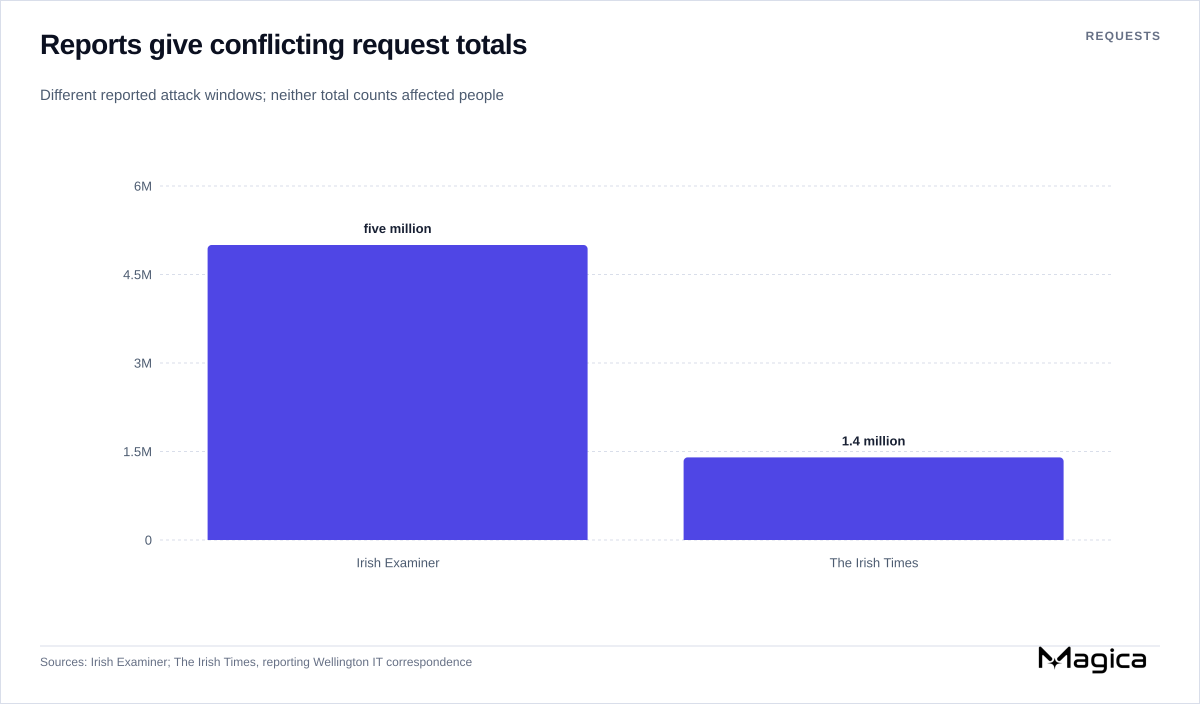
Company-reported request totals differ across accounts describing October 2–4 and October 6. Neither establishes a victim count. Chart: Magica. Source: Irish Examiner.
Wellington has supplied credit-union infrastructure for more than a decade. When specialist software acquirer Volaris Group announced its purchase of Wellington in December 2014, it described the supplier’s credit-union software as supporting online banking, smartphone apps and access to national clearing. The current incident concerns CU Online; that earlier description does not establish exposure in its other services.
Credit unions are community-based, member-focused mutual institutions. For context, the Central Bank of Ireland’s February 2026 supervisory outlook listed 172 active credit unions in Ireland. A problem involving around 40 institutions therefore reaches a substantial part of the sector, even though the number of affected individuals is unresolved.
The Central Bank, which supervises the sector, had already reviewed credit unions’ IT risk management, controls and governance in 2025. Its outlook said findings and expected follow-up actions had been communicated to all credit unions. It emphasised boards’ responsibility for secure, reliable information systems and adequate oversight of IT outsourcing.
The regulator planned to validate remediation programmes at specific credit unions and assess institutions’ ownership of IT risk, including outsourced services. It also planned engagement on preparation for the Digital Operational Resilience Act, the EU framework for financial-sector technology resilience, from January 2028 for credit unions. These were earlier sector-wide priorities, not findings that Wellington or any particular customer caused this breach.
North East says it notified the Central Bank and the data-protection regulator. Ireland’s Data Protection Commission said it had received several breach notifications and was contacting relevant parties as a priority, according to the initial reporting. The Central Bank urged credit unions to communicate clearly and inform potentially affected members without undue delay.
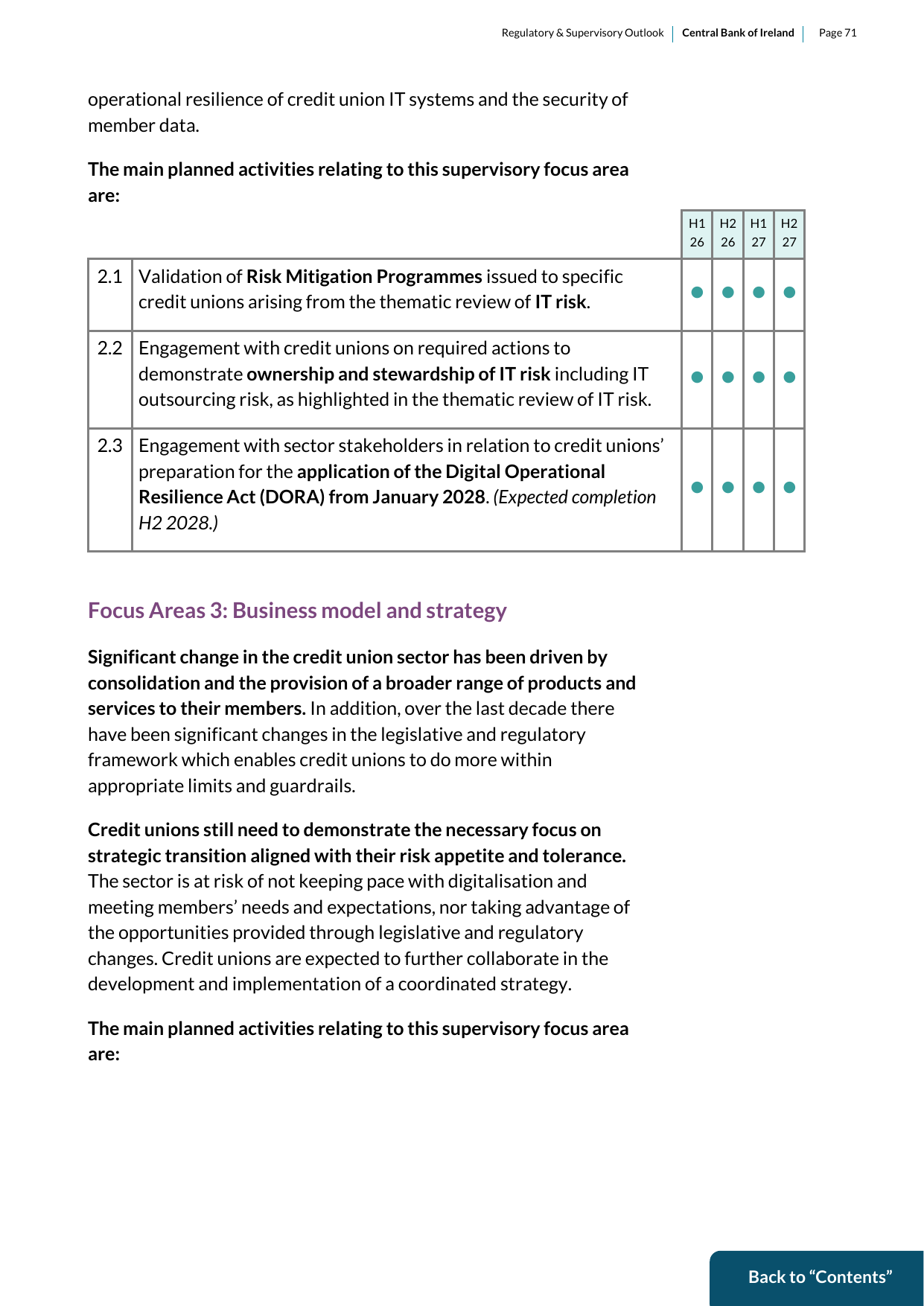
The Central Bank of Ireland’s February 2026 outlook scheduled IT-risk remediation checks and outsourcing oversight before the breach disclosures. Source: Central Bank of Ireland.
Wellington’s reported correspondence says its initial investigation into the October incident found no exposure. A credit union alerted it on the Friday before its Monday notification that extortion emails had been sent to Wellington and several credit unions. Wellington said the emails had gone to junk mail and had not previously been seen by the company. By Sunday morning, its engineers concluded that saved-payee data linked to members might have been retrieved.
Robert Troy, Ireland’s minister of state responsible for financial services and credit unions, has sought an immediate meeting with Wellington to explain the delay. Wellington says it alerted customers as soon as it confirmed the potential risk, engaged external cybersecurity experts and is cooperating with regulators and law enforcement. Its investigation remains ongoing.
The next account needs to reconcile the attack dates and request volumes, explain why the initial assessment missed potential data exposure, and establish how many people can be identified as affected. Those answers will determine how precisely credit unions can warn members and payment recipients. Closing the vulnerability does not settle the scope of the breach or the adequacy of its disclosure.
N-able says an intruder reached a server supporting Mail Assure and SpamExperts Hosted Cloud. Mail delivery and filtering continued, but customers lost management access as the company revoked tokens and worked to restore services securely.
Microsoft is testing an optional Edge mode that blocks WebGL and WebGPU to reduce opportunities for browser exploitation. An early hands-on test found that restoring graphics for a trusted site also removed its broader Enhanced Security protections.
A critical authentication bypass gave a suspected China-linked espionage group access to VMware's virtualization control plane. Mandiant says the campaign stole signing keys and virtual-machine data, making compromise checks essential alongside patching.
PHP’s November 19 security releases address seven critical flaws, including unauthenticated code execution through reused backend connections. Patching takes priority, but applications that retain session upload progress must also check shared storage and serialization settings.
TfL has shut its Oyster photocard website after a breach that may have exposed around 265,000 customers’ account details, including security answers. Existing cards still work, while the attack method and restoration timetable remain undisclosed.
JPMorganChase says it believes attackers accessed marketing data at outside service providers, potentially exposing customer names and email addresses. The bank says services are unaffected, but has not identified the vendors or disclosed the attack date.
Apache confirms exploitation of a Roller code-execution flaw that survives disabling XML-RPC in its administration panel. Attacks on the retired Axis 1.x library also expose enterprise applications, making product-specific mitigation and compromise checks urgent.
StepSecurity’s Elephant-led Series A will fund broader protection for developer machines, package downloads and build pipelines, alongside planned defenses for AI-agent sandboxes. Its challenge is turning open-source adoption into a larger commercial platform while proving the extra controls earn their place.
Nvidia says it has found no indication its own systems were affected after The Gentlemen ransomware group listed it on a leak site. The investigation concerns a possible incident at a partner, while the gang has supplied no public proof.
Senators from both parties plan to delay the CISA nomination of Palantir security chief Michael LoSapio after his Jan. 6 denial, adding a confirmation obstacle as the agency faces staffing losses and funding decisions.
Sean Cairncross is leaving as national cyber director, with Pentagon CIO Kirsten A. Davies reportedly selected to succeed him. The transition puts Senate confirmation at the center of a cybersecurity leadership reshuffle.
Windows baseline protection combines existing PC safeguards into a verifiable pass-or-fail result. Microsoft defines the standard; developers choose whether failure means a warning, fewer features or blocked access.
F5 lists fixed releases for a critical nginx HTTP/2 flaw, while the wider NGINX2Root disclosure covers five independent nginx attack paths and a separate Linux kernel bug. Remediation depends on configuration, supplier patch levels and replacing vulnerable running processes.
Tyler Robert Buchanan received six years in U.S. prison for a phishing and SIM-swapping conspiracy that stole at least $11.6 million from individuals. He is the last of five defendants sentenced; restitution remains pending.
The new Threat Disruption Center makes TRM Labs its main technology partner following a reported $94.66 million sole-source award for Homeland Security Task Force investigations. A rival lost its court challenge, but the launch leaves the center’s share of that spending and its performance benchmarks undisclosed.
Fandango says payment details from certain October 8–11 transactions may have been exposed. State disclosures provide only a partial affected count, while the company has not explained how the checkout page was compromised.
Norway’s state-controlled oil and gas group is working to neutralise an attack on some IT systems. Employee services may be disrupted, but Equinor says operations and production remain unaffected and it has found no indications of data theft.
Tor urges relay operators to install 0.4.9.17 as a continuing DDoS attack strains its privacy network. A post-upgrade operator account describes further disruption, while Bitcoin connectivity measurements show partial recovery with important limits.
Malicious code in Optimizely website-testing projects could swap cryptocurrency addresses and skim payment cards. Optimizely says it has fixed the vulnerability and removed the code, but visitor exposure and losses remain unquantified.