Editorial Team
6 min read
Tor urges relay operators to install 0.4.9.17 as a continuing DDoS attack strains its privacy network. A post-upgrade operator account describes further disruption, while Bitcoin connectivity measurements show partial recovery with important limits.
The Tor Project has released another emergency update to its relay software in response to a continuing distributed denial-of-service attack on its privacy network. Version 0.4.9.17, released November 13, changes IPv6 defenses; the project says most relay operators have been affected and further protections are being evaluated.
The Tor Project is a nonprofit developing privacy and anonymity tools for activists, journalists, other at-risk users and everyday users seeking protection from surveillance and censorship. Its network passes connections through relays to separate users’ identities from their online activity and depends on volunteers.
In its release announcement, Tor describes a flood of client circuits—the paths connections take through relays—overwhelming the network and urges operators to upgrade as soon as possible. It says no further action is required after upgrading. That installation guidance does not amount to a declaration that the attack has ended.
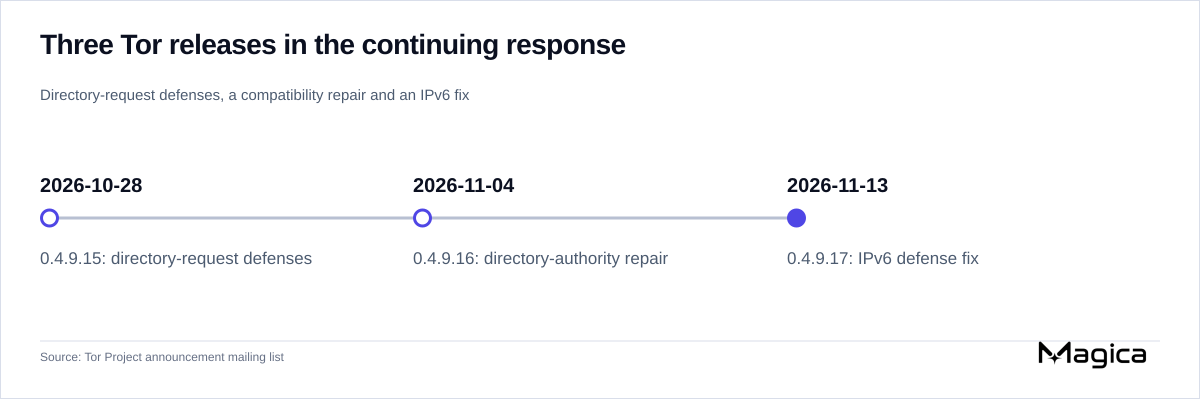
Tor’s releases added directory-request defenses, repaired directory-authority compatibility and fixed IPv6 defenses. The dates do not establish when the attack began or ended. Source: Tor Project announcement mailing list.
The November 13 changelog supplies the technical detail: denial-of-service defenses now track IPv6 clients by their /64 network prefix rather than individual addresses. Multiple addresses sharing that prefix are therefore grouped together for these defenses.
The change, tracked as TROVE-2026-031, corrects behavior dating to version 0.3.3.2-alpha. It also changes measurement: unique-client counts reported by relays and bridges now treat an IPv6 /64 as one client. Comparisons across the upgrade need to account for that counting change; a lower reported count alone would not establish that attack traffic had fallen.
The package also rejects invalid DNS hostname records in resolution responses, fixes a stream-isolation error that could let certain long HTTP tunnel stream-isolation header values share a circuit, and tightens circuit-handshake validation.
This is a continuing response rather than Tor’s first attempt to limit the load. The same announcement archive records that version 0.4.9.15, released October 28, added defenses against large volumes of directory requests. These included per-circuit rate limits and a restriction allowing only one onion-service descriptor fetch or upload per circuit from an authenticated relay. Onion services conceal their IP addresses; descriptors provide directory information used to reach them. The release also made the HSDir flag, which marks relays serving onion-service directory information, persist across restarts, subject to other eligibility requirements.
The rollout had a complication. Version 0.4.9.16 followed on November 4 with an emergency fix aimed at directory authorities after changes in the preceding release triggered a surge of requests and problems for older clients. Developers substituted dummy TAP keys in directory information and rolled back required protocol-version values after clients on 0.4.8.x or earlier were exiting. The sequence makes compatibility part of the deployment challenge alongside attack resistance.
Tor has also tried to change attackers’ economics at a different layer. In August 2023, it introduced proof-of-work defenses for onion services with Tor 0.4.8. Under stress, those services can prioritize connections according to computational work performed by clients. Tor presented this as a way to make flooding more costly while preserving privacy. Legitimate clients also bear computational costs: Tor said in that announcement that rising attack traffic could push the work to roughly a minute. That service-level mechanism has a different scope from the new change to relays’ IPv6 defenses.
A report citing a relay operator’s November 14 forum post describes continued problems after installation of 0.4.9.17. The operator said two relays had lost HSDir status before the update. Another was under attack when it was upgraded; about ten minutes later, its traffic plunged and it repeatedly became unresponsive, eventually losing its HSDir role as a directory for onion services. The operator said the attack stopped when that role was lost.
That account describes one operator’s experience, rather than a controlled, network-wide assessment. The operator also speculated about deanonymization and tracking of onion services. The release announcements contain no corresponding Tor Project warning, and the account does not establish that users or services were identified.
Separate measurements show both a sharp connectivity loss and partial recovery. ProbeLab, which measures the Bitcoin peer-to-peer network, reported in a network analysis that successful connections to Bitcoin peers through Tor fell from 13,627 in its October 28 18:00 crawl to 9,071 in the October 29 00:00 crawl—about one-third. Addresses attempted were nearly unchanged, at 28,845 and 28,733 respectively.
Its Nebula crawler collects peer addresses and dials them about every six hours, reaching onion addresses through local Tor proxies. It counts a peer as connected when dialing succeeds. ProbeLab said connections over IPv4, IPv6 and I2P stayed within a few percent during the drop.
ProbeLab also followed a broader baseline cohort of 14,525 onion peers connected before October 28 at 18:00. Of the 5,027 lost on October 29, 2,126, or 42%, had connected again on November 13–14. Another 2,898 were still being dialed without connecting, and three had disappeared from the crawl. These cohort figures use a different observation window from the two individual crawls above.
The team observed a step in recovery around November 5, before the latest patch. It could not determine whether remaining failures reflected the same problem, offline peers or changed onion addresses, nor which part of the onion-service connection path was the bottleneck. These measurements describe one crawler’s access to Bitcoin peers, not the share of all Tor users affected. They do not isolate the November 13 patch’s effect.
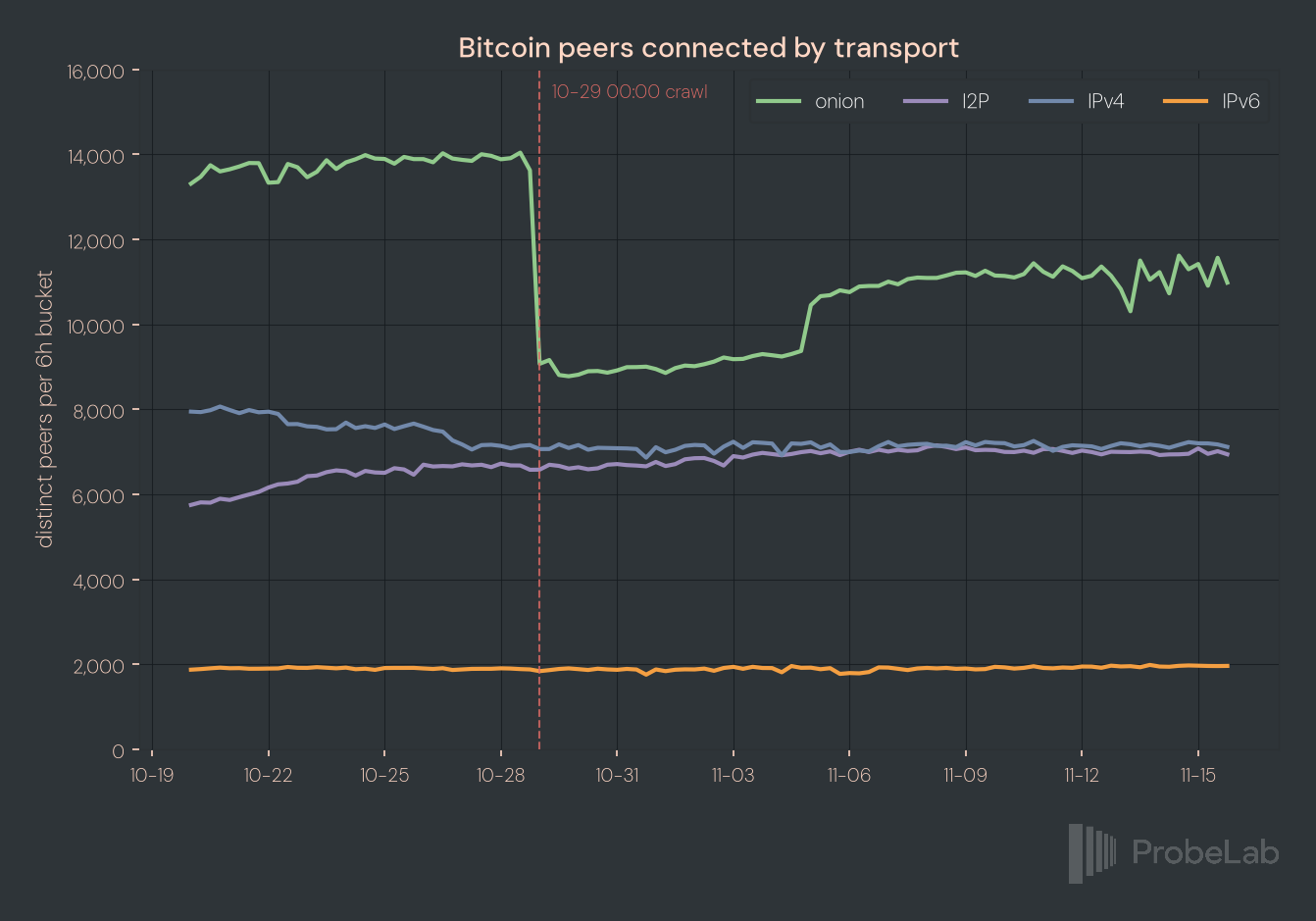
ProbeLab’s crawler recorded a sharp decline and partial recovery in Bitcoin connections through Tor, while other transports stayed comparatively steady. These measurements do not isolate the November 13 patch’s effect. Credit: ProbeLab. Source: ProbeLab network measurements.
The release also addresses a separate trust issue. Tor removed the keys for the directory authority called bastet because of a potential compromise, saying it could return with new keys. Directory authorities are trusted, volunteer-run servers whose details are built into Tor. They vote hourly to agree on which relays make up the network, giving them a different role from ordinary traffic-carrying relays. Tor added bastet in 2017 to increase the directory system’s diversity and stability. The changelog does not connect the potential compromise to the DDoS attack or establish that a compromise occurred.
The release coverage notes that the announcement identifies neither the attackers nor when the attack began. Tor expects further releases but supplies no timetable or network-wide recovery measurement in its announcement.
For operators, the immediate instruction is clear: upgrade. The outstanding evidence is whether relays remain responsive under continuing load and retain their network roles after deployment. Operator accounts and Bitcoin crawling can reveal continuing problems, but neither alone resolves that question—especially when the release also changes how clients are counted.
The management company supporting Japan's Shonan Beauty Clinic network disclosed stolen customer passwords stored without encryption and a separate booking-service incident. Treatment-related submissions were also exposed, while the affected population and financial impact remain under investigation.
N-able says an intruder reached a server supporting Mail Assure and SpamExperts Hosted Cloud. Mail delivery and filtering continued, but customers lost management access as the company revoked tokens and worked to restore services securely.
Microsoft is testing an optional Edge mode that blocks WebGL and WebGPU to reduce opportunities for browser exploitation. An early hands-on test found that restoring graphics for a trusted site also removed its broader Enhanced Security protections.
A critical authentication bypass gave a suspected China-linked espionage group access to VMware's virtualization control plane. Mandiant says the campaign stole signing keys and virtual-machine data, making compromise checks essential alongside patching.
PHP’s November 19 security releases address seven critical flaws, including unauthenticated code execution through reused backend connections. Patching takes priority, but applications that retain session upload progress must also check shared storage and serialization settings.
TfL has shut its Oyster photocard website after a breach that may have exposed around 265,000 customers’ account details, including security answers. Existing cards still work, while the attack method and restoration timetable remain undisclosed.
Around 40 Irish credit unions are implicated in a saved-payee data breach at software supplier Wellington IT. Missing logs leave the victim count unresolved, while a minister is seeking answers about the disclosure delay.
JPMorganChase says it believes attackers accessed marketing data at outside service providers, potentially exposing customer names and email addresses. The bank says services are unaffected, but has not identified the vendors or disclosed the attack date.
Apache confirms exploitation of a Roller code-execution flaw that survives disabling XML-RPC in its administration panel. Attacks on the retired Axis 1.x library also expose enterprise applications, making product-specific mitigation and compromise checks urgent.
StepSecurity’s Elephant-led Series A will fund broader protection for developer machines, package downloads and build pipelines, alongside planned defenses for AI-agent sandboxes. Its challenge is turning open-source adoption into a larger commercial platform while proving the extra controls earn their place.
Nvidia says it has found no indication its own systems were affected after The Gentlemen ransomware group listed it on a leak site. The investigation concerns a possible incident at a partner, while the gang has supplied no public proof.
Senators from both parties plan to delay the CISA nomination of Palantir security chief Michael LoSapio after his Jan. 6 denial, adding a confirmation obstacle as the agency faces staffing losses and funding decisions.
Sean Cairncross is leaving as national cyber director, with Pentagon CIO Kirsten A. Davies reportedly selected to succeed him. The transition puts Senate confirmation at the center of a cybersecurity leadership reshuffle.
Windows baseline protection combines existing PC safeguards into a verifiable pass-or-fail result. Microsoft defines the standard; developers choose whether failure means a warning, fewer features or blocked access.
F5 lists fixed releases for a critical nginx HTTP/2 flaw, while the wider NGINX2Root disclosure covers five independent nginx attack paths and a separate Linux kernel bug. Remediation depends on configuration, supplier patch levels and replacing vulnerable running processes.
Tyler Robert Buchanan received six years in U.S. prison for a phishing and SIM-swapping conspiracy that stole at least $11.6 million from individuals. He is the last of five defendants sentenced; restitution remains pending.
The new Threat Disruption Center makes TRM Labs its main technology partner following a reported $94.66 million sole-source award for Homeland Security Task Force investigations. A rival lost its court challenge, but the launch leaves the center’s share of that spending and its performance benchmarks undisclosed.
Fandango says payment details from certain October 8–11 transactions may have been exposed. State disclosures provide only a partial affected count, while the company has not explained how the checkout page was compromised.
Norway’s state-controlled oil and gas group is working to neutralise an attack on some IT systems. Employee services may be disrupted, but Equinor says operations and production remain unaffected and it has found no indications of data theft.
Malicious code in Optimizely website-testing projects could swap cryptocurrency addresses and skim payment cards. Optimizely says it has fixed the vulnerability and removed the code, but visitor exposure and losses remain unquantified.