Editorial Team
5 min read
TfL has shut its Oyster photocard website after a breach that may have exposed around 265,000 customers’ account details, including security answers. Existing cards still work, while the attack method and restoration timetable remain undisclosed.
Transport for London (TfL), the capital’s transport operator, has taken its Oyster photocard website offline after unauthorised access to customers’ personal information. The breach interrupts online services for schemes serving children, students, older Londoners and other groups. Exposed security answers could also put accounts elsewhere at risk if customers reused them.

TfL’s sample care-leaver photocard, one of the account categories potentially affected. Existing photocards remain usable. Image: Transport for London. Source: Transport for London.
TfL said it discovered suspicious activity on November 16, 2026, when existing photocard customers received emails asking them to create accounts. TfL confirmed that the messages came from its own systems and were generated as a result of the compromise, according to the account of its response.
The operator says around 265,000 customers may have been affected. A TfL notification email sent to some customers on November 18 was more definite about their individual exposure: it said their name, email address, phone number, home address, date of birth, and security question and answer had been compromised. The overall figure remains a potential affected population, while those notifications describe unauthorised access to account information.
TfL’s current assessment is that no passwords, bank or payment-card details, customer journey information, or names and dates of birth of children with Zip Oyster cards were compromised. A also excludes photographs from the understood scope of the breach. The assurance about children’s names and birthdates does not mean Zip-related accounts are outside the incident: TfL includes them among the potentially affected account categories.
The management company supporting Japan's Shonan Beauty Clinic network disclosed stolen customer passwords stored without encryption and a separate booking-service incident. Treatment-related submissions were also exposed, while the affected population and financial impact remain under investigation.
Those categories span 5–10, 11–15 and 16+ Zip cards, 18+ Student cards, 18–25 Care Leaver cards, 60+ London cards, Apprentice cards and Veterans cards. These schemes provide access to travel concessions. For example, TfL opened applications in February 2024 for eligible London care leavers aged 18–25 to receive half-price bus and tram travel, designed to help them move into independent living.
Customers can continue travelling with existing photocards and can top them up at ticket machines in London Underground and National Rail stations. They cannot access their online photocard accounts. Renewals and journey-history queries must go through TfL customer services while the site is unavailable.
TfL says it has contained the incident, contacted affected customers and notified the Information Commissioner’s Office, the data-protection regulator. It also says in reported comments on its response that it has found no evidence that the compromised information has been used. That is a limit on what has been observed, rather than proof that exposed details cannot be misused.
Despite its assessment that passwords were unaffected, TfL says it will ask all photocard customers to change their passwords and security questions and answers. It also advises changing passwords reused on other websites.
In expert comments on the breach, Muhammad Yahya Patel, a virtual chief information security officer and EMEA cyber-security adviser at security company Huntress, warned that reused security answers could expose other accounts. He urged customers to treat unexpected emails, calls or texts referencing their personal details with suspicion, even when they look official.
Brian Higgins, a security specialist at Comparitech, called for clear customer aftercare, particularly for potentially vulnerable users such as older people and young adults who have left care.
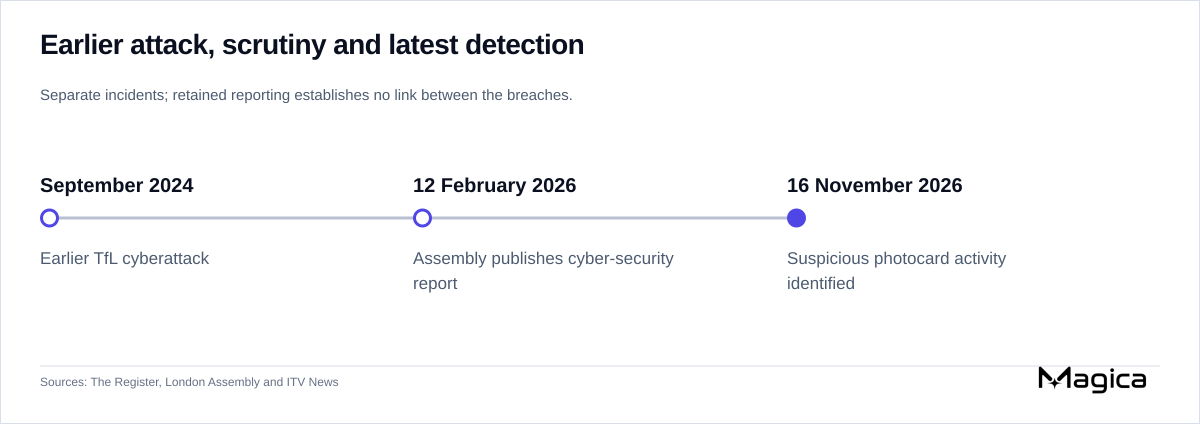
The Assembly’s preparedness report preceded the latest photocard incident. The reporting establishes no link between the two breaches. Source: The Register.
In reported comments on the incident, TfL’s director of technology strategy and revenue, Shashi Verma, said the compromised system underwent cyber-security testing within the past 12 months. He pointed to extensive work following its 2024 cyberattack and attributed a reduction in the potential number affected this time to its rapid response. Without a disclosed entry route or fuller account of the controls involved, those statements do not establish why the latest compromise succeeded.
The earlier incident provides a record against which to assess the response, but not evidence of a common attacker or vulnerability. According to the report on its breach history, TfL said in March that it had notified more than 7 million customers following the September 2024 attack; around 5,000 had been contacted as a priority because bank-account details might also have been compromised. Those are notification figures for a different incident, not a like-for-like measure of the latest breach’s severity.
Two men were jailed earlier this year over the 2024 attack, according to the report carrying Verma’s comments. The regulator investigated that incident but took no enforcement action against TfL, judging its response proportionate. The reporting identifies no evidence linking the two breaches.
Scrutiny of preparedness also predates this week’s disclosure. The London Assembly’s GLA Oversight Committee investigated cyber security at the Greater London Authority (GLA). Its February 12, 2026 London Assembly report recommended measuring and benchmarking cyber-security investment and pay across the GLA and its functional bodies. The authority shares some TfL IT systems.
The report also called for tested contingency arrangements if GLA staff lost access to emails and files, and a cyber-security exercise with TfL by the end of the 2025–26 financial year. These recommendations concern preparedness across connected public bodies; they do not establish the cause of the photocard breach. The publication page does not say whether those measures were completed.
TfL has not disclosed how the attackers gained access or when the website will return. Its investigation still needs to establish the entry route and final scope of exposure, while restoration must address customers’ access to accounts and renewals.
For now, TfL says customers needing renewals or journey-history assistance should contact customer services; the reported telephone number for imminent renewals is 0343 222 1234. Restoring the website will resolve the immediate access problem. Explaining the entry route and the protections added will be needed to assess what changed after another breach.
N-able says an intruder reached a server supporting Mail Assure and SpamExperts Hosted Cloud. Mail delivery and filtering continued, but customers lost management access as the company revoked tokens and worked to restore services securely.
Microsoft is testing an optional Edge mode that blocks WebGL and WebGPU to reduce opportunities for browser exploitation. An early hands-on test found that restoring graphics for a trusted site also removed its broader Enhanced Security protections.
A critical authentication bypass gave a suspected China-linked espionage group access to VMware's virtualization control plane. Mandiant says the campaign stole signing keys and virtual-machine data, making compromise checks essential alongside patching.
PHP’s November 19 security releases address seven critical flaws, including unauthenticated code execution through reused backend connections. Patching takes priority, but applications that retain session upload progress must also check shared storage and serialization settings.
Around 40 Irish credit unions are implicated in a saved-payee data breach at software supplier Wellington IT. Missing logs leave the victim count unresolved, while a minister is seeking answers about the disclosure delay.
JPMorganChase says it believes attackers accessed marketing data at outside service providers, potentially exposing customer names and email addresses. The bank says services are unaffected, but has not identified the vendors or disclosed the attack date.
Apache confirms exploitation of a Roller code-execution flaw that survives disabling XML-RPC in its administration panel. Attacks on the retired Axis 1.x library also expose enterprise applications, making product-specific mitigation and compromise checks urgent.
StepSecurity’s Elephant-led Series A will fund broader protection for developer machines, package downloads and build pipelines, alongside planned defenses for AI-agent sandboxes. Its challenge is turning open-source adoption into a larger commercial platform while proving the extra controls earn their place.
Nvidia says it has found no indication its own systems were affected after The Gentlemen ransomware group listed it on a leak site. The investigation concerns a possible incident at a partner, while the gang has supplied no public proof.
Senators from both parties plan to delay the CISA nomination of Palantir security chief Michael LoSapio after his Jan. 6 denial, adding a confirmation obstacle as the agency faces staffing losses and funding decisions.
Sean Cairncross is leaving as national cyber director, with Pentagon CIO Kirsten A. Davies reportedly selected to succeed him. The transition puts Senate confirmation at the center of a cybersecurity leadership reshuffle.
Windows baseline protection combines existing PC safeguards into a verifiable pass-or-fail result. Microsoft defines the standard; developers choose whether failure means a warning, fewer features or blocked access.
F5 lists fixed releases for a critical nginx HTTP/2 flaw, while the wider NGINX2Root disclosure covers five independent nginx attack paths and a separate Linux kernel bug. Remediation depends on configuration, supplier patch levels and replacing vulnerable running processes.
Tyler Robert Buchanan received six years in U.S. prison for a phishing and SIM-swapping conspiracy that stole at least $11.6 million from individuals. He is the last of five defendants sentenced; restitution remains pending.
The new Threat Disruption Center makes TRM Labs its main technology partner following a reported $94.66 million sole-source award for Homeland Security Task Force investigations. A rival lost its court challenge, but the launch leaves the center’s share of that spending and its performance benchmarks undisclosed.
Fandango says payment details from certain October 8–11 transactions may have been exposed. State disclosures provide only a partial affected count, while the company has not explained how the checkout page was compromised.
Norway’s state-controlled oil and gas group is working to neutralise an attack on some IT systems. Employee services may be disrupted, but Equinor says operations and production remain unaffected and it has found no indications of data theft.
Tor urges relay operators to install 0.4.9.17 as a continuing DDoS attack strains its privacy network. A post-upgrade operator account describes further disruption, while Bitcoin connectivity measurements show partial recovery with important limits.
Malicious code in Optimizely website-testing projects could swap cryptocurrency addresses and skim payment cards. Optimizely says it has fixed the vulnerability and removed the code, but visitor exposure and losses remain unquantified.