Editorial Team
6 min read
Windows baseline protection combines existing PC safeguards into a verifiable pass-or-fail result. Microsoft defines the standard; developers choose whether failure means a warning, fewer features or blocked access.
Microsoft has put Windows baseline protection into preview, giving applications on its Windows 11 PC operating system a shared security check they can use to restrict access. Announced on November 17, the feature bundles existing safeguards into one verifiable result. A failed check can lead to a warning, reduced functionality or a block, depending on the developer’s policy.
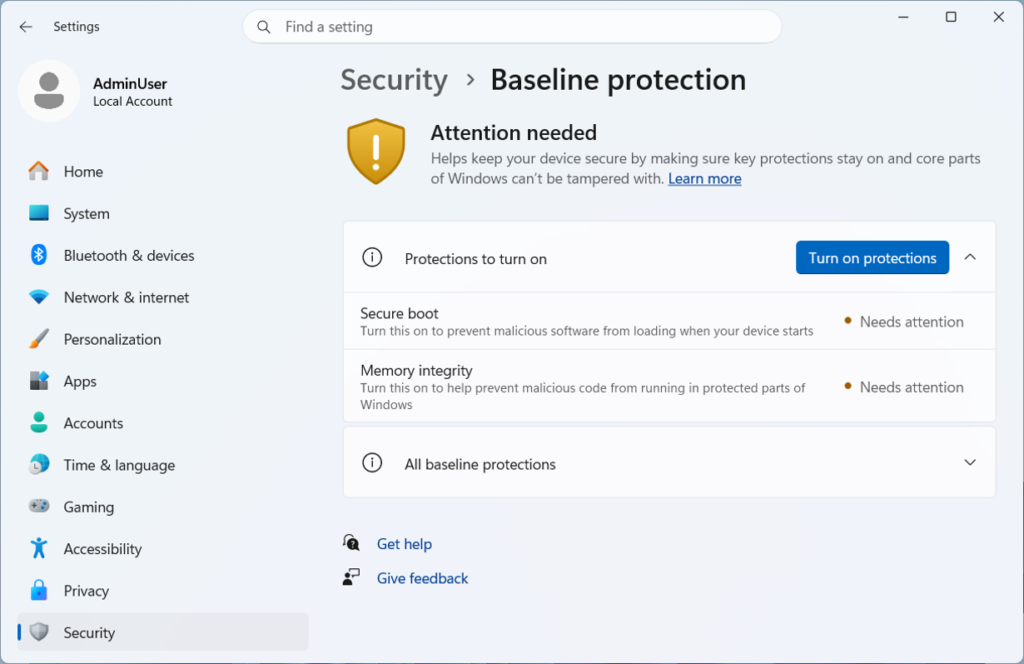
Microsoft’s preview identifies missing protections and offers a button to enable supported safeguards. Image: Microsoft. Source: Windows Experience Blog — Security.
Windows baseline protection is a Microsoft-maintained security standard for the company’s PC operating system. It combines hardware and system integrity protections into a versioned result that users, IT administrators and applications can inspect. Microsoft says in its technical announcement that developers may allow an application to run, display a warning, gate a feature, reduce functionality, record the result or block access.
The practical change is who maintains the check. Microsoft describes banks, game anti-cheat systems and exam services as applications that have historically tested device protections themselves. A common result could spare vendors separate implementations for security processors, Secure Boot and driver signing, while putting Microsoft in charge of the shared criteria.
That makes restrictions easier to implement, but does not establish a Windows-wide rule preventing applications from running on PCs that fail. Microsoft leaves that decision to each developer.
The initiative follows security principles Microsoft outlined in February. At Ignite this week, the company positioned the preview as part of making Windows more secure and resilient. Its separate security announcement emphasizes making device protections measurable and verifiable as organizations adopt AI agents. Baseline protection’s immediate function, however, is checking the PC’s security state.
Microsoft’s technical announcement lists eight criteria. Every protection already exists in Windows; the new element is evaluating them together.
| Requirement | Purpose described by Microsoft |
|---|---|
| Security processor | Protect sensitive data with dedicated hardware. |
| Secure Boot | Help prevent malicious software from loading at startup. |
| Virtualization-based security (VBS) | Isolate critical processes using hardware virtualization. |
| Memory integrity | Help prevent malicious code from running in protected areas of Windows. |
| Signed drivers only | Restrict loading to signed drivers. |
| Windows-certified drivers | Require drivers that meet Windows hardware signing requirements. |
| Kernel debugger protection | Help prevent debugging tools from bypassing protections. |
| Vulnerable driver protection | Help block known vulnerable drivers. |
A device passes only when all requirements are enforced. The result is binary, rather than a graduated security score. Windows measures the state at startup using the security processor, and disabling a required protection needs a reboot. Microsoft says this lets apps check once rather than repeatedly query each setting.
Applications can request a simple answer, a detailed account of missing protections or a hardware-backed attestation token that a service verifies remotely. The last option supplies cryptographic evidence for situations requiring stronger assurance than a local status query.
Passing establishes that the listed protections are enforced; it is not proof that a PC is free of malware. A technical account of the preview also distinguishes the feature from Smart App Control: that Windows capability assesses whether an application is trustworthy, whereas baseline protection lets an application assess the device’s security configuration.
Security requirements already affect access to some games. A report on the preview notes that Battlefield 6 requires Secure Boot through its anti-cheat system. It also recalls Microsoft’s 2022 advice that disabling memory integrity could improve gaming performance. A PC with that protection disabled would fail the new baseline. That history does not establish how much enabling the full baseline would affect performance.
Microsoft is asking developers both to adopt the signal and to test that their software works with every required protection enabled. That second request matters: an application that relies on a protection being disabled creates a compatibility problem even before its developer considers blocking other PCs.
Microsoft identifies creative software maker Adobe and Blizzard Entertainment’s Battle.net game distribution platform among its early partners. In statements supplied with Microsoft’s announcement, Adobe connects the work to detecting counterfeit and malicious software, while Battle.net emphasizes stronger security with less friction for players.
Exam software maker Schoolyear describes a more specific use in the same announcement: verifying whether a student’s device meets the standard before an exam begins. Its stated benefit is relying on Windows for device integrity so its own software can concentrate on the exam.
None of those statements commits the companies to blocking PCs that fail. Their participation demonstrates interest in the check without establishing a common enforcement policy.
For organizations, Microsoft describes monitoring through Intune, its device management service, the Microsoft 365 admin center’s Baseline Security Mode and third-party management tools. Administrators can identify missing protections and use compliance policies to make baseline requirements a condition of access.
The implementation still needs careful reading. The technical account describes VBS, Secure Boot and the security processor as marked “Reporting only” in the admin-center panel, and notes its warning that enabling VBS does not itself enable memory integrity or Credential Guard. The ability to report a setting does not mean the panel automatically fixes it.
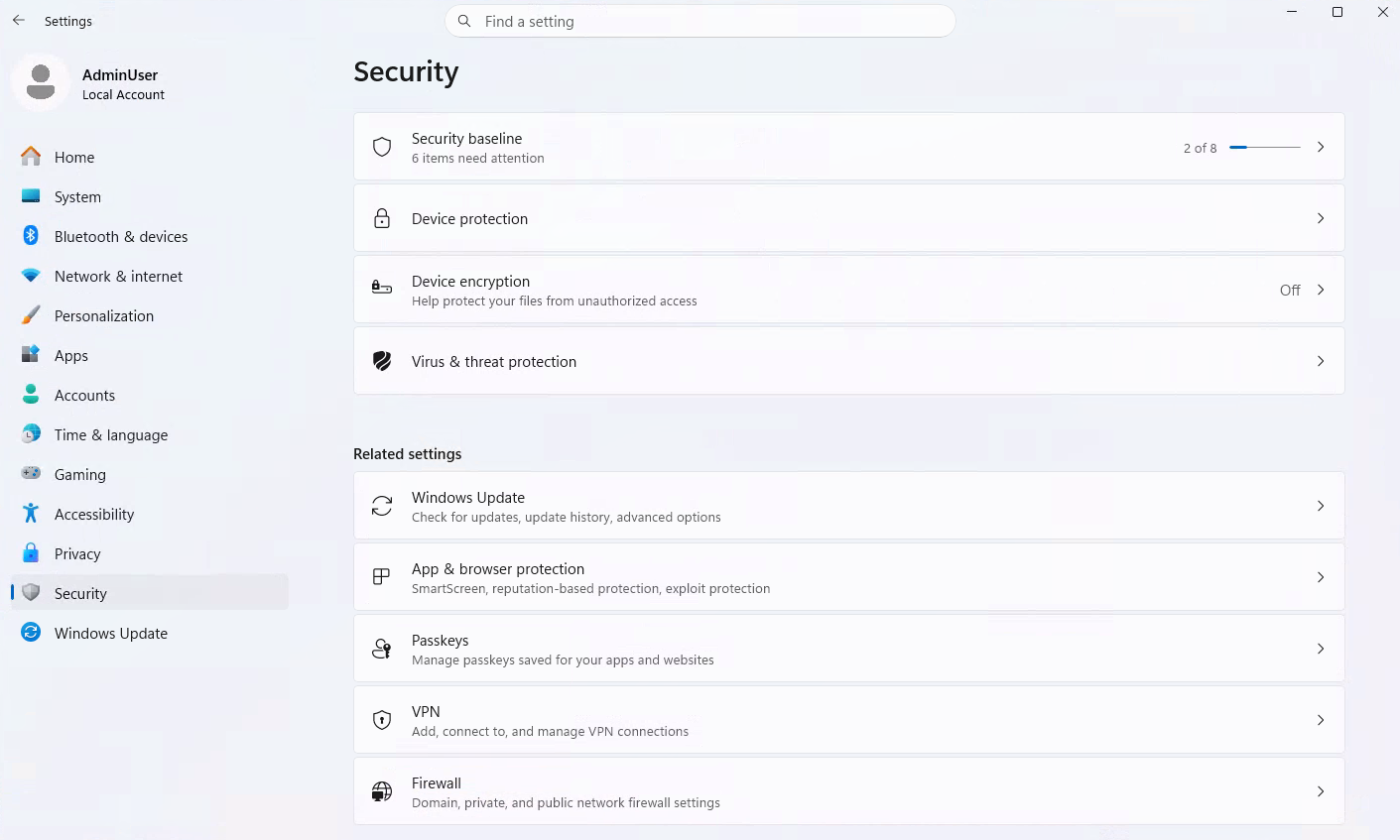
The preview’s dedicated Security page brings the baseline entry and other device protection controls together. Image: Microsoft. Source: Microsoft Learn.
The preview adds a page at Settings > Security > Baseline protection that identifies missing safeguards. On personal or unmanaged PCs, Microsoft says a button enables supported missing protections and restarts the device. Firmware changes, such as enabling Secure Boot or the security processor in UEFI, require additional steps for which Windows provides guidance. On managed PCs, an administrator may control the settings.
The release notes for Experimental Preview Build 26340.10013, released November 16 and updated November 17, say baseline protection is rolling out gradually. Even participating Windows Insiders may not see it immediately. General availability is planned for 2027, without a specific final release date.
Microsoft plans to increase the requirements over time and says it will explain future versioning in a forthcoming post. As an analysis of the rollout points out, meeting today’s baseline does not guarantee meeting a later version. The unresolved issue is how future requirements will affect older hardware.
The announcements do not quantify how many PCs would fail the initial check or how many applications will require a passing result. The decisions to watch before the planned 2027 release are which functions vendors make conditional on passing, whether failure produces a warning or a block, and which baseline version they require. Those policies will determine the practical consequences for existing customers.
The management company supporting Japan's Shonan Beauty Clinic network disclosed stolen customer passwords stored without encryption and a separate booking-service incident. Treatment-related submissions were also exposed, while the affected population and financial impact remain under investigation.
N-able says an intruder reached a server supporting Mail Assure and SpamExperts Hosted Cloud. Mail delivery and filtering continued, but customers lost management access as the company revoked tokens and worked to restore services securely.
Microsoft is testing an optional Edge mode that blocks WebGL and WebGPU to reduce opportunities for browser exploitation. An early hands-on test found that restoring graphics for a trusted site also removed its broader Enhanced Security protections.
A critical authentication bypass gave a suspected China-linked espionage group access to VMware's virtualization control plane. Mandiant says the campaign stole signing keys and virtual-machine data, making compromise checks essential alongside patching.
PHP’s November 19 security releases address seven critical flaws, including unauthenticated code execution through reused backend connections. Patching takes priority, but applications that retain session upload progress must also check shared storage and serialization settings.
TfL has shut its Oyster photocard website after a breach that may have exposed around 265,000 customers’ account details, including security answers. Existing cards still work, while the attack method and restoration timetable remain undisclosed.
Around 40 Irish credit unions are implicated in a saved-payee data breach at software supplier Wellington IT. Missing logs leave the victim count unresolved, while a minister is seeking answers about the disclosure delay.
JPMorganChase says it believes attackers accessed marketing data at outside service providers, potentially exposing customer names and email addresses. The bank says services are unaffected, but has not identified the vendors or disclosed the attack date.
Apache confirms exploitation of a Roller code-execution flaw that survives disabling XML-RPC in its administration panel. Attacks on the retired Axis 1.x library also expose enterprise applications, making product-specific mitigation and compromise checks urgent.
StepSecurity’s Elephant-led Series A will fund broader protection for developer machines, package downloads and build pipelines, alongside planned defenses for AI-agent sandboxes. Its challenge is turning open-source adoption into a larger commercial platform while proving the extra controls earn their place.
Nvidia says it has found no indication its own systems were affected after The Gentlemen ransomware group listed it on a leak site. The investigation concerns a possible incident at a partner, while the gang has supplied no public proof.
Senators from both parties plan to delay the CISA nomination of Palantir security chief Michael LoSapio after his Jan. 6 denial, adding a confirmation obstacle as the agency faces staffing losses and funding decisions.
Sean Cairncross is leaving as national cyber director, with Pentagon CIO Kirsten A. Davies reportedly selected to succeed him. The transition puts Senate confirmation at the center of a cybersecurity leadership reshuffle.
F5 lists fixed releases for a critical nginx HTTP/2 flaw, while the wider NGINX2Root disclosure covers five independent nginx attack paths and a separate Linux kernel bug. Remediation depends on configuration, supplier patch levels and replacing vulnerable running processes.
Tyler Robert Buchanan received six years in U.S. prison for a phishing and SIM-swapping conspiracy that stole at least $11.6 million from individuals. He is the last of five defendants sentenced; restitution remains pending.
The new Threat Disruption Center makes TRM Labs its main technology partner following a reported $94.66 million sole-source award for Homeland Security Task Force investigations. A rival lost its court challenge, but the launch leaves the center’s share of that spending and its performance benchmarks undisclosed.
Fandango says payment details from certain October 8–11 transactions may have been exposed. State disclosures provide only a partial affected count, while the company has not explained how the checkout page was compromised.
Norway’s state-controlled oil and gas group is working to neutralise an attack on some IT systems. Employee services may be disrupted, but Equinor says operations and production remain unaffected and it has found no indications of data theft.
Tor urges relay operators to install 0.4.9.17 as a continuing DDoS attack strains its privacy network. A post-upgrade operator account describes further disruption, while Bitcoin connectivity measurements show partial recovery with important limits.
Malicious code in Optimizely website-testing projects could swap cryptocurrency addresses and skim payment cards. Optimizely says it has fixed the vulnerability and removed the code, but visitor exposure and losses remain unquantified.