Editorial Team
8 min read
F5 lists fixed releases for a critical nginx HTTP/2 flaw, while the wider NGINX2Root disclosure covers five independent nginx attack paths and a separate Linux kernel bug. Remediation depends on configuration, supplier patch levels and replacing vulnerable running processes.
NGINX, the open-source web server and reverse proxy that receives and routes traffic for websites and APIs, has fixes listed for a critical HTTP/2 flaw that can let an unauthenticated attacker execute code. Disclosed on November 18, 2026, the wider NGINX2Root findings cover five independent nginx flaws affecting different configurations, plus a separate Linux kernel flaw that researchers say can turn access to a traffic-handling nginx worker process into control of a susceptible host.

Xint’s announcement graphic for its NGINX2Root disclosure. Source: Xint. Source: Xint.
One nginx deployment can serve several websites or APIs, so compromise can reach services whose own application code has no vulnerability. F5, the application delivery and security company that acquired NGINX in 2019, is coordinating the fixes.
Its advisory for CVE-2026-123007 identifies nginx Open Source 1.30.7 and 1.31.9 as fixed releases. For NGINX Plus, it lists 37.0.8.1 and 37.3.0.1. F5 rates this flaw 9.2 under CVSS 4.0 and 8.1 under CVSS 3.1; those are different scoring systems for the same vulnerability.
Release timing differs across the disclosure documents. Xint, an autonomous penetration-testing platform vendor, describes a scheduled November 18 release and repeatedly says to update when available; security-response team CERT Polska’s November 18 notice says 1.31.9 is planned for November 19. By contrast, the vendor advisory lists fixed versions, and a same-day disclosure report describes 1.31.9 as just released. Operators should check the actual package or product channel rather than treat every forward-looking sentence in the notices as current release status.
The patch distinction is especially important for commercial users. Wiz’s security research team says earlier NGINX Plus fixes, 37.0.7.1 and 37.2.0.1, address CVE-2026-123633, but its remediation table identifies the newer 37.0.8.1 and 37.3.0.1 releases for CVE-2026-123007. A patch for one HTTP/2 flaw is not evidence that both are fixed.
F5 describes CVE-2026-123007 as a data-plane issue—the processing of traffic—with no control-plane exposure. Its advisory lists BIG-IP as unaffected, while the status of F5 Distributed Cloud services and NGINX One Console remains under investigation.
Xint groups the five nginx flaws and the separate kernel flaw under the NGINX2Root name. It reports that each nginx flaw can independently lead to remote code execution with worker privileges. Xint’s demonstrated route to root adds the kernel exploit. The research findings distinguish the configurations below; the first affected releases describe these paths, not a blanket verdict on every installation of those versions.
| Vulnerability | Relevant configuration | First affected release | Blocked by disabling HTTP/2? |
|---|---|---|---|
| CVE-2026-123007 | HTTP/2 enabled | 1.9.5 | Yes |
| CVE-2026-123633 | HTTP/2 with requests forwarded upstream | 1.19.7 | Yes |
| CVE-2026-123634 | Request-time DNS resolution with request-derived proxy_pass and mirroring using mirror_request_body off in Xint’s tested setup | 1.13.4 | No |
| CVE-2026-121810 | HTTP/3 with requests forwarded upstream | 1.25.0 | No |
| CVE-2026-113425 | Mail proxy using proxy on and auth_http | 0.5.15 | No |
The broadest HTTP/2 flaw by configuration, CVE-2026-123007, dates to the protocol’s introduction in nginx in 2015. Xint says every official release from 1.9.5 through 1.31.8 contains the vulnerable code. Incorrect flow-control accounting can produce an invalid memory copy. Wiz’s cloud-security research team says it demonstrated code execution on official 1.31.7 and 1.31.8 builds serving ordinary static files over HTTPS on 64-bit systems, without an application backend or third-party module. Restricting the search to reverse proxies would therefore miss affected servers.
CVE-2026-123633 instead involves an active HTTP/2 connection incorrectly remaining eligible for closure when connection slots run low. Upstream processing can continue using freed memory. Both research teams describe memory disclosure that can defeat address-space randomization, but Wiz cautions that exploitation still depends on builds, configurations and memory manipulation. Demonstrations establish feasibility; they do not establish successful attacks against every deployment. Wiz is withholding its exploit code, and Xint omits the final steps needed to reproduce its full nginx exploits.
The three other paths make a blanket “HTTP/2 disabled” response inadequate. Xint recommends removing request-time DNS lookups through fixed upstream destinations for the resolver path; merely switching off mirroring is insufficient because other subrequest mechanisms may reach the bug. Its temporary HTTP/3 measures remove QUIC listeners, disable HTTP/3 and clear its advertisement. For affected mail proxies, it recommends restricting access to trusted clients. These are configuration-specific stopgaps pending patching.
The tested configurations also matter. Xint’s resolver demonstration required its recursive resolver to reach an attacker-controlled authoritative DNS server. Its HTTP/2 and HTTP/3 proxy use-after-free demonstrations required nginx to open a TCP connection to the attacker. The mail flaw could be triggered during login without valid credentials. Those conditions should accompany the version and feature checks when assessing a deployment.
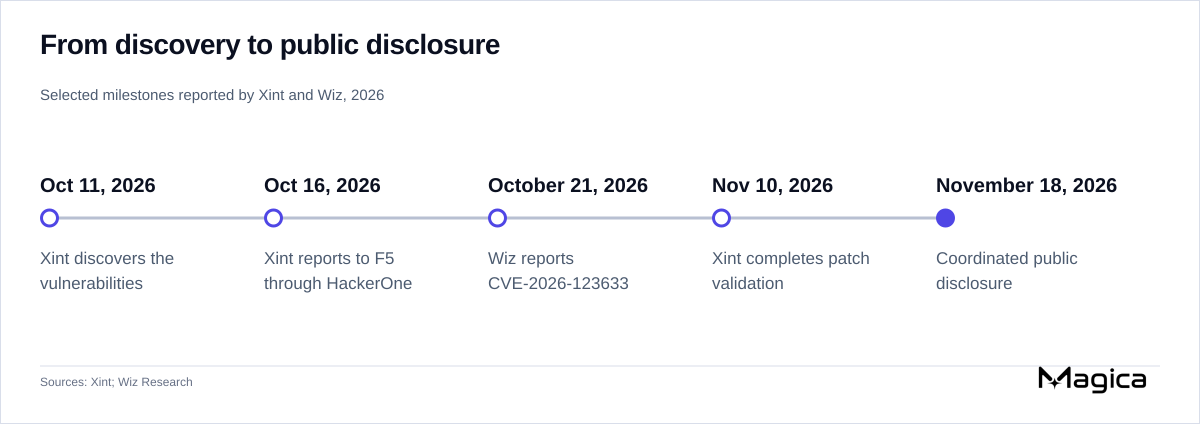
Company-reported milestones from Xint and Wiz trace discovery, independent reporting and patch validation before public disclosure. Graphic: Magica. Source: Xint.
Xint’s disclosure timeline dates its discovery to October 11 and its report to F5 through HackerOne to October 16. It says the reports reached F5’s nginx development team on October 27 and that it completed patch validation on November 10.
The HTTP/2 findings were not exclusive to Xint. Wiz says in its research account that it and four other teams independently uncovered the two HTTP/2 flaws; F5 also credits multiple researchers in its advisory. Wiz says it reported CVE-2026-123633 on October 21, when F5 confirmed an earlier report from another team, and reported CVE-2026-123007 on November 16.
Both companies connect the discoveries to tools they market. Xint says a researcher found CVE-2026-123007 while preparing for ZeroDay Cloud 2026, then an automated scan found the other four nginx flaws without human guidance. Wiz says it used the research harness behind its AI code-scanning product to find the HTTP/2 flaws and AI models to validate their impact. These are the companies’ accounts of their research methods; the demonstrated exploits establish technical feasibility, rather than a measured comparison of AI and conventional research productivity.
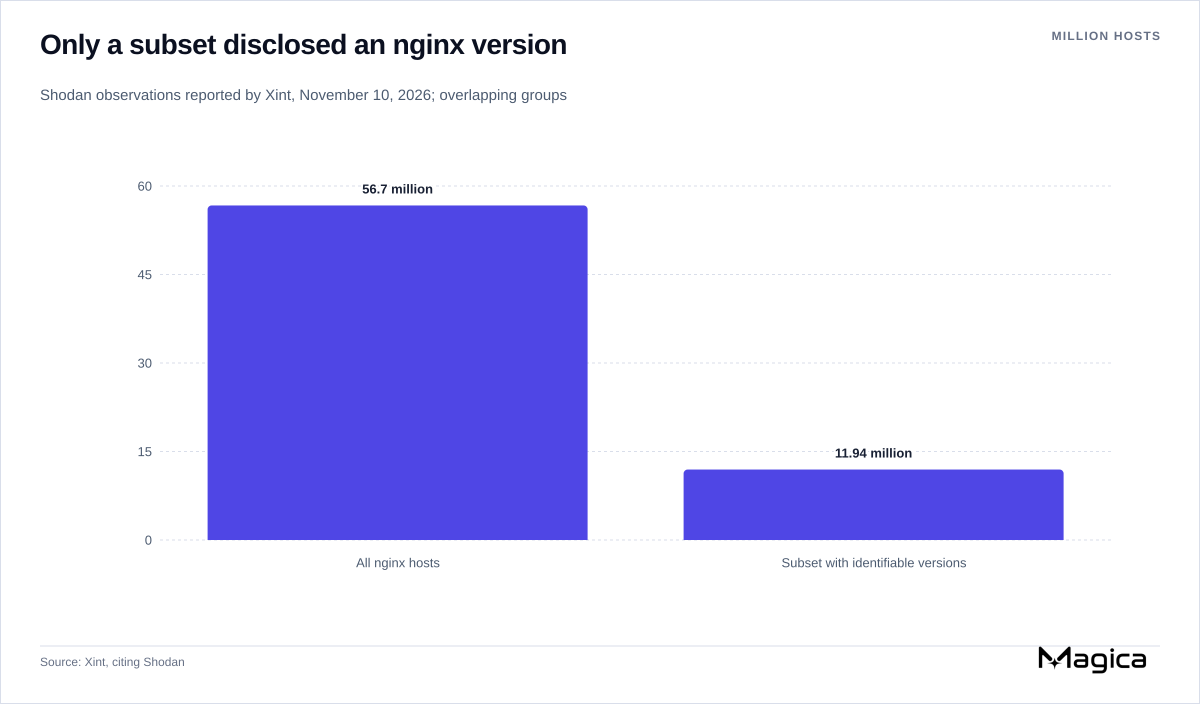
Company-reported Shodan observations from Xint: 11.94 million of 56.7 million nginx hosts disclosed identifiable versions. The bars overlap in membership and do not count exploitable servers. Graphic: Magica. Source: Xint.
Xint says a November 10, 2026 query of the Shodan internet search service returned 56.7 million nginx hosts. Only 11.94 million, or 21.1%, reported an identifiable version; 98.9% of that identifiable subset fell within the affected CVE-2026-123007 version range. These are version-banner observations, not a count of exploitable machines. HTTP/2 must be enabled, and distribution backports may fix older version numbers.
That distinction changes the inventory task. Both Xint and CERT Polska’s guidance say to compare the full installed package version with the distribution’s security advisory. The short version from nginx -v cannot settle patch status. Appliances and containerized applications also depend on their suppliers’ updated packages or images.
Network checks have a similar boundary. A TLS negotiation test against a public hostname may reach a CDN rather than the underlying nginx server. Wiz says intermediaries that terminate HTTP/2 may interrupt parts of an exploit, depending on implementation. That is a reason to examine the actual route to the origin, rather than assume the intermediary provides complete protection.
Disabling HTTP/2 also has an availability cost: clients supporting HTTP/1.1 can continue, but native gRPC services requiring HTTP/2 can stop working. F5’s advisory lists no mitigation; the temporary configuration measures come from the researchers and CERT Polska, and should not be confused with installing the vendor’s fix.
The nginx findings initially give code execution with the worker process’s permissions. Xint says it chained that access with a separate flaw in Linux’s SCTP transport subsystem, introduced in kernel version 4.15 in 2018, to gain root. It also demonstrated escape from an nginx Docker container to the host.
That result is conditional. Xint says access to SCTP depends on the kernel, available modules and container restrictions. Containers share the host kernel, so a reachable kernel flaw can undermine that boundary, but the demonstration does not mean every containerized nginx installation permits the chain.
A same-day disclosure report said a kernel patch was not yet available. Xint recommends blocking SCTP module loading on hosts that do not need it, while warning that a module-loading restriction neither unloads an already loaded module nor disables SCTP built into the kernel. Updating nginx and resolving the kernel exposure are separate parts of the response.
The next operational test is whether the protected build and configuration are actually running. Xint says installing the nginx update requires a restart or a supported live binary upgrade: a configuration reload alone does not replace the executable. For configuration mitigations, existing HTTP/2 and mail sessions can remain with old workers after a reload. CERT Polska recommends restarting the service to terminate those sessions; Xint warns that doing so interrupts active clients.
Investigation also needs evidence beyond access logs. Xint says the HTTP/2 control frames used in CVE-2026-123007 are not logged as requests. Unexpected programs launched by workers, abnormal exits and unusual connection traffic merit investigation, but crashes or traffic anomalies alone do not prove exploitation. Monitoring installed after the event cannot rule out an earlier compromise.
For operators, the remaining decision is how to deploy the supplier-confirmed fixes and retire old workers while managing the interruption to active clients. For the separate kernel exposure, the next evidence needed is an applicable kernel fix or confirmation that the vulnerable SCTP path cannot be reached. Neither conclusion follows from changing nginx’s version banner.
The management company supporting Japan's Shonan Beauty Clinic network disclosed stolen customer passwords stored without encryption and a separate booking-service incident. Treatment-related submissions were also exposed, while the affected population and financial impact remain under investigation.
N-able says an intruder reached a server supporting Mail Assure and SpamExperts Hosted Cloud. Mail delivery and filtering continued, but customers lost management access as the company revoked tokens and worked to restore services securely.
Microsoft is testing an optional Edge mode that blocks WebGL and WebGPU to reduce opportunities for browser exploitation. An early hands-on test found that restoring graphics for a trusted site also removed its broader Enhanced Security protections.
A critical authentication bypass gave a suspected China-linked espionage group access to VMware's virtualization control plane. Mandiant says the campaign stole signing keys and virtual-machine data, making compromise checks essential alongside patching.
PHP’s November 19 security releases address seven critical flaws, including unauthenticated code execution through reused backend connections. Patching takes priority, but applications that retain session upload progress must also check shared storage and serialization settings.
TfL has shut its Oyster photocard website after a breach that may have exposed around 265,000 customers’ account details, including security answers. Existing cards still work, while the attack method and restoration timetable remain undisclosed.
Around 40 Irish credit unions are implicated in a saved-payee data breach at software supplier Wellington IT. Missing logs leave the victim count unresolved, while a minister is seeking answers about the disclosure delay.
JPMorganChase says it believes attackers accessed marketing data at outside service providers, potentially exposing customer names and email addresses. The bank says services are unaffected, but has not identified the vendors or disclosed the attack date.
Apache confirms exploitation of a Roller code-execution flaw that survives disabling XML-RPC in its administration panel. Attacks on the retired Axis 1.x library also expose enterprise applications, making product-specific mitigation and compromise checks urgent.
StepSecurity’s Elephant-led Series A will fund broader protection for developer machines, package downloads and build pipelines, alongside planned defenses for AI-agent sandboxes. Its challenge is turning open-source adoption into a larger commercial platform while proving the extra controls earn their place.
Nvidia says it has found no indication its own systems were affected after The Gentlemen ransomware group listed it on a leak site. The investigation concerns a possible incident at a partner, while the gang has supplied no public proof.
Senators from both parties plan to delay the CISA nomination of Palantir security chief Michael LoSapio after his Jan. 6 denial, adding a confirmation obstacle as the agency faces staffing losses and funding decisions.
Sean Cairncross is leaving as national cyber director, with Pentagon CIO Kirsten A. Davies reportedly selected to succeed him. The transition puts Senate confirmation at the center of a cybersecurity leadership reshuffle.
Windows baseline protection combines existing PC safeguards into a verifiable pass-or-fail result. Microsoft defines the standard; developers choose whether failure means a warning, fewer features or blocked access.
Tyler Robert Buchanan received six years in U.S. prison for a phishing and SIM-swapping conspiracy that stole at least $11.6 million from individuals. He is the last of five defendants sentenced; restitution remains pending.
The new Threat Disruption Center makes TRM Labs its main technology partner following a reported $94.66 million sole-source award for Homeland Security Task Force investigations. A rival lost its court challenge, but the launch leaves the center’s share of that spending and its performance benchmarks undisclosed.
Fandango says payment details from certain October 8–11 transactions may have been exposed. State disclosures provide only a partial affected count, while the company has not explained how the checkout page was compromised.
Norway’s state-controlled oil and gas group is working to neutralise an attack on some IT systems. Employee services may be disrupted, but Equinor says operations and production remain unaffected and it has found no indications of data theft.
Tor urges relay operators to install 0.4.9.17 as a continuing DDoS attack strains its privacy network. A post-upgrade operator account describes further disruption, while Bitcoin connectivity measurements show partial recovery with important limits.
Malicious code in Optimizely website-testing projects could swap cryptocurrency addresses and skim payment cards. Optimizely says it has fixed the vulnerability and removed the code, but visitor exposure and losses remain unquantified.