Editorial Team
7 min read
Google plans $15 billion of Malaysian investment in 2027–2028, expanding data centres alongside power, water and workforce projects. Its next cloud region faces an established rival, while the resource balance and employment benefits remain projections.
Google, the Alphabet subsidiary behind Search and the Google Cloud computing business, announced on November 4 that it plans to invest US$15 billion in Malaysia in 2027 and 2028. The company says the spending will cover data centre campuses, clean energy, water security and worker training, according to the investment report.
The expansion puts new computing capacity into a country already attracting a large share of the region’s data centre construction. It also makes delivery of power and water infrastructure central to judging the investment: Malaysia’s government has said it will approve projects only after ensuring sufficient supplies of both.
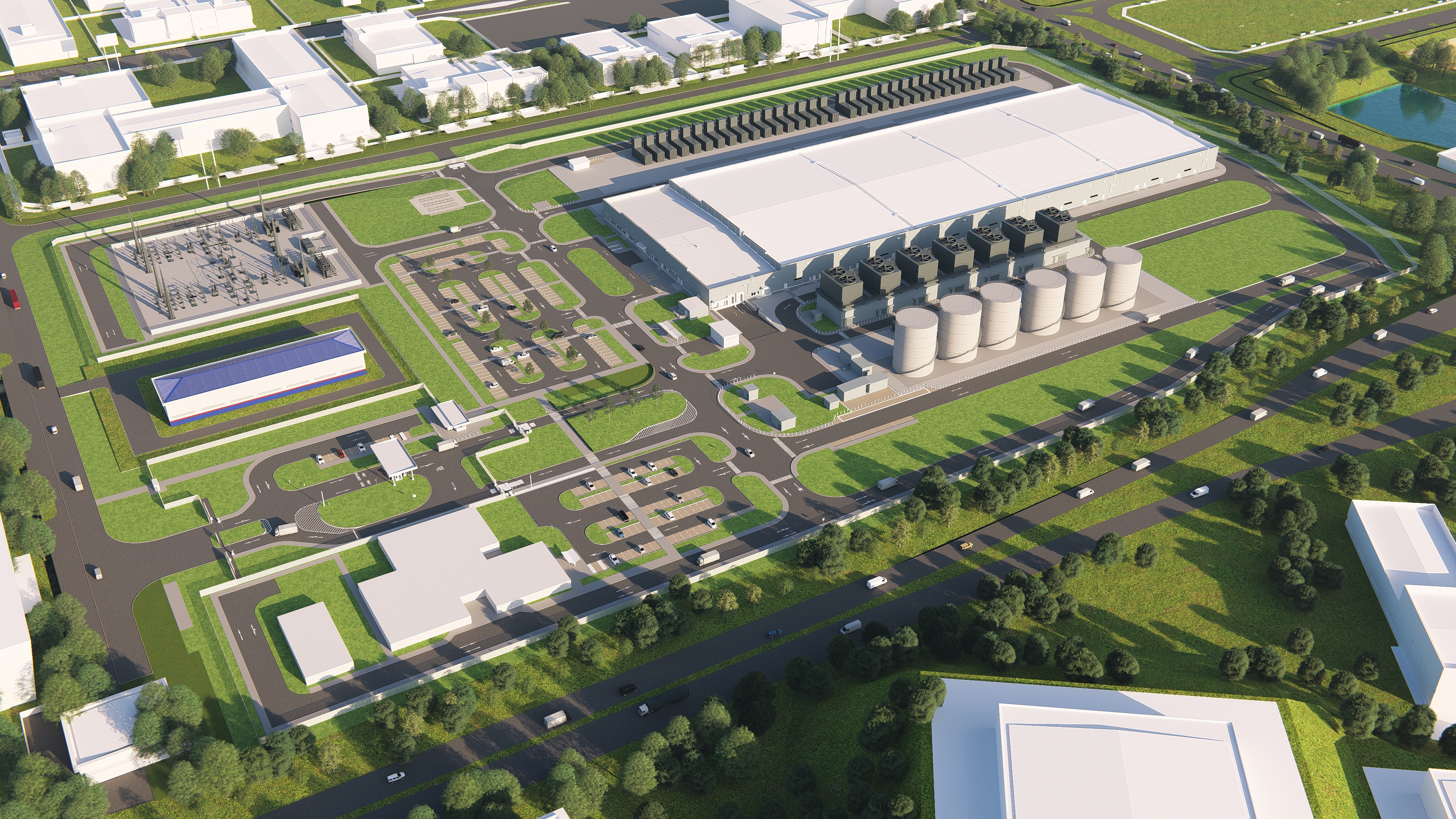
Google’s May 2024 artist’s impression of its first Malaysian data centre and planned cloud region at Elmina Business Park. Image: Google. Source: Google.
Google says it will build new campuses in Selangor and Negeri Sembilan, alongside its first campus at Elmina Business Park in Selangor, which the investment report describes as operational. The US$15 billion is planned spending for two future years, rather than money already deployed.
The commitment expands on Google’s US$2 billion investment announced in May 2024. That earlier plan included its first Malaysian data centre and Google Cloud region at Elmina, following a strategic collaboration agreed with the Malaysian government in November 2023.
The data centre and cloud region serve different purposes. Google said the data centre would support its own services, including Search, Maps and Workspace. The cloud region would supply computing services to enterprises, startups and public-sector organizations, with controls for requirements such as where data is stored.
An operational campus therefore does not establish that the customer-facing cloud region has launched. Google’s Malaysian cloud region is described as upcoming in the expansion coverage, which says the new investment will support it.
Microsoft, a rival cloud provider, has moved beyond an investment announcement. It announced general availability of Malaysia West, its first Malaysian cloud region, on May 28, 2025. For organizations seeking locally hosted cloud services, that provides a concrete competitive alternative to Google’s forthcoming region.
Microsoft’s US$2.2 billion commitment in May 2024 covered four years and included cloud and AI infrastructure, skills programmes, cybersecurity and government partnerships. It built on a 2021 initiative that included plans for its first Malaysian data centre region. These differing periods and categories make the headline investment amounts unsuitable for a comparison of computing capacity or customer prices.
Google says it will add more than 1 gigawatt of clean energy capacity to Malaysia’s national grid. It also pledges to pay for all electricity its campuses consume and the direct infrastructure costs of connecting them to the grid, according to the report of its commitments.
The mechanism extends beyond paying an electricity bill. In its separate water and energy infrastructure announcement, Google says it has been partnering with consortiums led by Shizen Energy–Solarvest and TotalEnergies through power-purchase agreements. These contracts guarantee future revenue, helping developers obtain financing to build new generation, including solar farms.
New generating capacity is not a measure of electricity delivered throughout the day, nor does the announced gigawatt figure establish how much of Google’s demand it will cover. The reports do not provide the campuses’ expected electricity consumption. Google’s promises of energy-efficient facilities will need operating results to substantiate them.
The national context makes those gaps consequential. Market intelligence firm DC Byte puts Malaysia at more than half of Southeast Asia’s under-construction data centre capacity, according to the report on the announcement. The same report says Malaysia’s deputy prime minister told parliament in July that data centres were forecast to account for one-third of the country’s total energy consumption by 2035. That is a national forecast, rather than a measurement of Google’s demand.
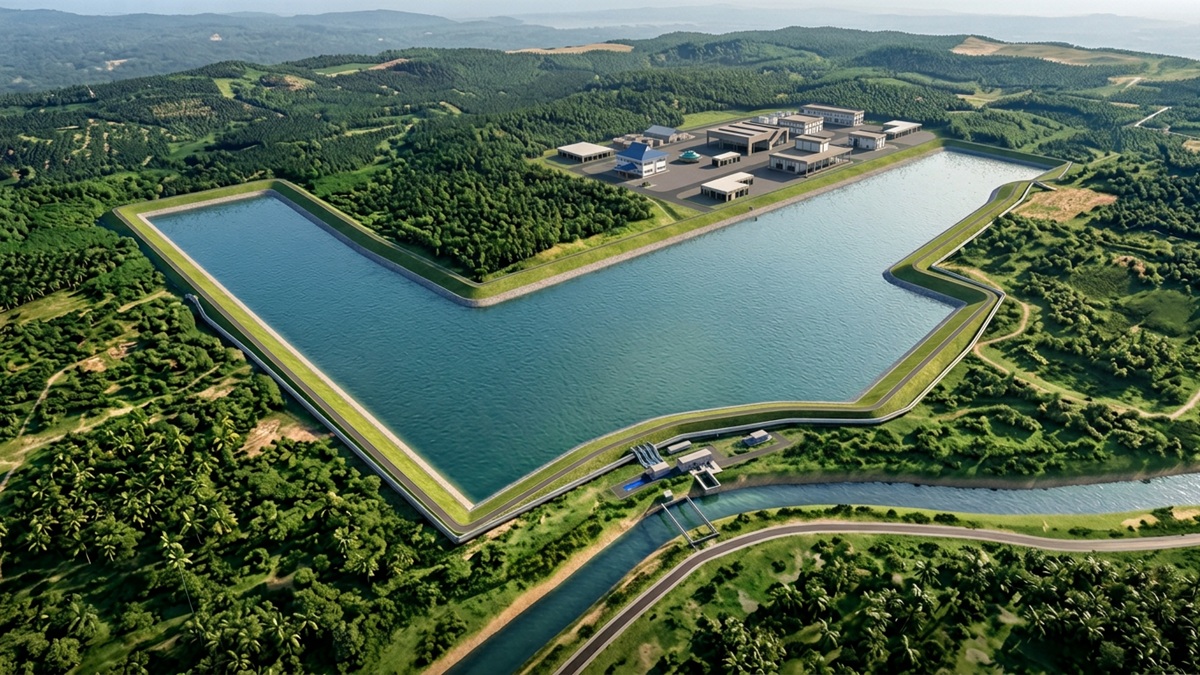
Google’s artist’s impression of the planned shared reservoir and water treatment plant in Negeri Sembilan. Image: Google. Source: Google Cloud.
Google’s separate water plan commits US$160 million to an off-river storage reservoir and treatment plant in Negeri Sembilan. The company says it appointed Gamuda Berhad to build them in coordination with the state government and state water utility Syarikat Air Negeri Sembilan, or SAINS.
Gamuda brings an existing construction relationship: in a partner statement carried in Google’s release, its engineering division says it has been delivering Google’s Elmina campus and will also develop the planned campus at Springhill Industrial Park in Port Dickson.
Google says the new water plant will have capacity to deliver 65 million litres of potable water a day for its Port Dickson campus and public use. On completion, the facilities will be owned by Menteri Besar Negeri Sembilan (Incorporated), the state government’s statutory body responsible for managing state assets. Google supplies funding; the planned ownership is public.
The reservoir along the Linggi River is designed to capture excess river flow and rainfall during wetter periods and hold reserves for drier ones. Google says this will also help mitigate flooding. Its own water-risk assessment found local sources were not at high risk of scarcity or depletion, according to an executive statement in the release. The plan therefore should not be presented as evidence of an existing local water crisis.
The 65-million-litre figure describes total treatment capacity. The release does not establish Google’s projected consumption or the share reserved for residents, so it cannot yet show the net improvement in water available to the public.
Google also outlines river-basin work at Sungai Buloh and Sungai Selangor, and rainwater harvesting and storage at four Selangor schools, in the expansion report. These are additional interventions, rather than measurements of the campuses’ total water footprint.
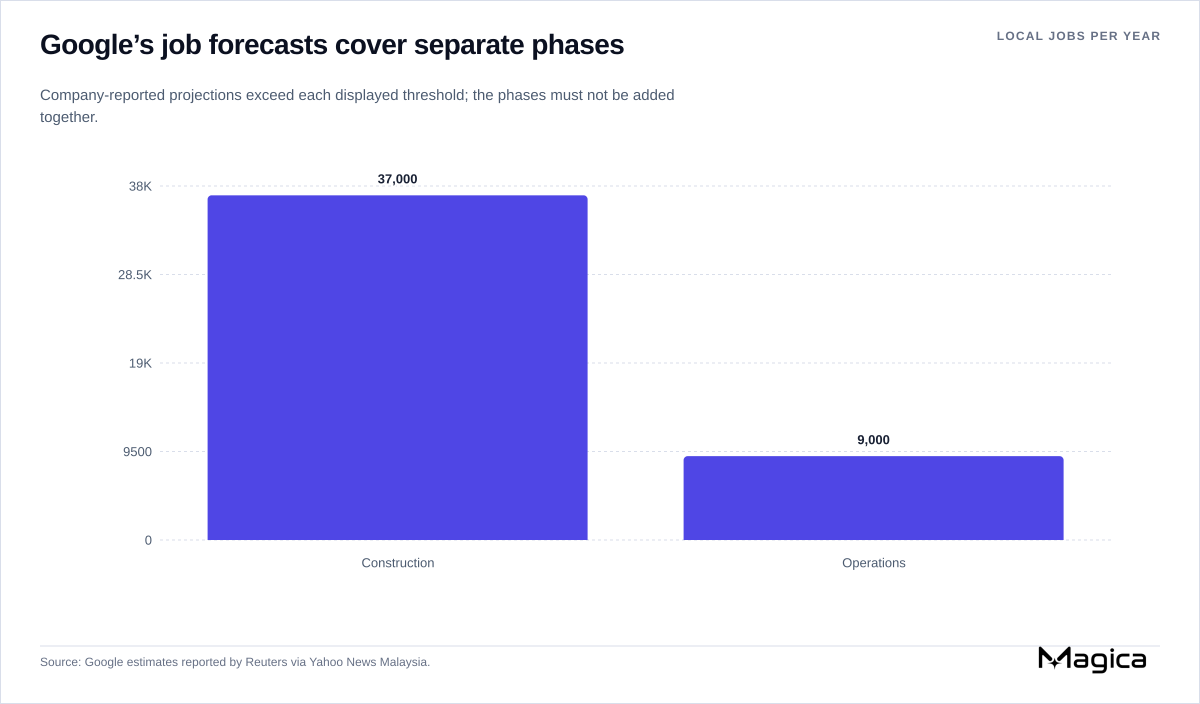
Company-reported forecasts anticipate more than 37,000 local jobs annually during construction and more than 9,000 during operations. The separate phases must not be added together. Source: Reuters via Yahoo News Malaysia.
Google estimates that campus construction will contribute an annual average of US$1.1 billion to Malaysian GDP and support more than 37,000 local jobs per year. Once operational, the facilities are projected to sustain more than 9,000 local jobs annually, with wages averaging 45% above the national median, according to the report of Google’s estimates.
The construction and operational figures cover different phases and should not be added together or read as a count of permanent Google employees. Google says it is working with more than 80 Malaysian entities to develop and operate its infrastructure, spanning construction, engineering, networking, power, cooling, logistics and legal services. Some operational jobs would be long-term specialist roles, such as data centre technicians and mechanical and electrical engineers.
Separately, four new programmes target skills training for 800,000 Malaysians over five years. This is a training goal, distinct from the employment projections. Google’s water and energy release also describes school solar labs and a digital-skills track for clean energy trades, rolling out in Negeri Sembilan in early 2027.
The next test is how campus approvals and construction align with new power and water supplies. Malaysia’s government said in July that sufficient energy and water capacity would be a condition for approving data centre projects, according to the report describing that requirement.
Google’s own recent experience illustrates the distinction between announcing investment and securing permission to build: the same report says a Finnish authority halted work at two Google sites in October pending mandatory environmental impact assessments. That does not establish the status of any Malaysian approval.
For the Malaysian expansion, campus delivery dates, expected electricity demand, water allocations and measured operating performance would allow a firmer assessment of the bargain. Until those details are available, the announced generation and treatment capacity show planned additions to supply, but cannot establish whether public resources will grow faster than the new facilities’ needs.
A national exit poll found broad opposition to new local data centers and a Democratic tilt among voters who prioritized AI. But the issue ranked below four other tested concerns, industry-backed candidates also won, and the next fight is over siting and power costs.
Oracle reportedly canceled a five-year Tencent lease estimated at $7 billion after US government pressure. The arrangement promised access to about 100,000 advanced AI chips in Southeast Asia; termination, payments and replacement capacity remain unconfirmed.
The iOS 27.3 developer beta opens Apple's AI tools to mainland China with optional Alibaba Qianwen integration. A December public release is planned, but newer Siri capabilities remain absent and early testers report battery and stability problems.
Tencent has launched Hy4 with visual reasoning and computer operation across its AI applications and cloud services, keeping standard API prices unchanged. The new version’s weights remain pending, while Tencent acknowledges a substantial gap with leading closed models.
Early results put all 11 proposed charter amendments restricting hyperscale data centers on course for approval, despite industry-funded opposition. Trenton and Piqua show how the votes could reshape projects and local political control.
OpenAI says ChatGPT handles search-like queries equal to roughly 20% of Google’s volume. The claim signals a growing competitor for information queries, but undisclosed counting methods prevent a clean market-share comparison.
Xiaomi says its humanoid robot sorted car parts for a full shift and corrected errors autonomously. The result extends its factory trials, but published evidence does not yet establish deployment costs or reliability across repeated shifts.
Railway’s CEO apologized after an engineer’s AI agents targeted rival Primcloud during testing. Primcloud says attempts to obtain customer secrets failed, leaving questions about the agents’ instructions and Railway’s controls.
Cortex Training gives developers custom training APIs on managed GPUs. Snowflake is extending its existing model-customization tools, with enterprise-data integration and a cost claim limited to LoRA fine-tuning.
Apple’s developer preview extends Siri AI beyond predefined app categories and adds guidance for complex tasks. Testing is limited to development builds and internal testers, with App Store submissions planned for spring 2027.
Jill Hazelbaker will join OpenAI as chief corporate affairs officer after a decade at Uber, bringing experience in technology communications and political campaigns to a role focused on reputation, positioning and public trust.
The watchOS 27.3 developer beta brings Live Rewind and Siri Recap to Apple Watch Series 12 and Ultra 4. The opt-in tools offer brief transcripts and conversation summaries, but require a compatible iPhone and carry Apple warnings about accuracy and sensitive information.
Traders reportedly extract Samsung and SK hynix memory from processor packages shipped into China, selling it mainly to Huawei customers. The account highlights the memory constraint behind Huawei’s AI chip rollout, but leaves trade volumes, recovery yields and transaction legality unresolved.
Creative-industry groups are challenging OpenAI and Microsoft’s arguments against licensing AI training material, as a New York court weighs fair use. Their briefs share an emphasis on licensing but differ over what the judge should decide.
Traversal's Series B backs its expansion from diagnosing software outages toward autonomous production operations. Company-reported adoption, cloud competition and unfinished access controls frame the next tests.
The startup formerly called TesterArmy is replacing its testing agent with an open-source framework, betting that adoption will generate demand for paid infrastructure and enterprise services.
Fal has announced Sequoia-led and Bessemer-led funding rounds for its 2027 expansion, adding post-trained media models to an established inference business. The announcements leave the new rounds’ size and comparative serving economics undisclosed.
SK hynix bought existing Penguin Solutions preferred shares from an SK Telecom investment vehicle. The deal brings director nomination rights and a convertible stake in an existing AI infrastructure partner, while sending the purchase price to the seller.
Google plans to switch off Gemini and Search for school-managed K–12 student accounts unless administrators enable them. Schools will gain control over access, but Google says keeping Search without its AI features will not be an option.
Anthropic is expected to exceed 3.5 GW of computing capacity in 2026 and aims to double it in 2027. Its filing shows $895.4 billion in commitments, substantial financial resources and an immediate cost from scarce capacity.