Editorial Team
8 min read
Traversal's Series B backs its expansion from diagnosing software outages toward autonomous production operations. Company-reported adoption, cloud competition and unfinished access controls frame the next tests.
Traversal, a New York startup that builds AI software to investigate enterprise software failures, announced $120 million in funding on November 3. The $1 billion valuation backs its expansion from diagnosing outages toward systems that can act on those diagnoses—a shift that requires customers to delegate more authority over live infrastructure.

Traversal’s cofounders, from left: Raaz Dwivedi, Anish Agarwal, Ahmed Lone and Raj Agrawal. Photo: Traversal, published July 2025. Source: Columbia Engineering.
Kleiner Perkins, Redpoint Ventures and Khosla Ventures co-led the Series B, with significant participation from Sequoia and Battery Ventures, Traversal said in its announcement. Kleiner Perkins and Sequoia increased their earlier backing. The company plans to hire across research, engineering and go-to-market to expand its AI site reliability engineering, or SRE, product. SRE teams keep software available and restore service when it fails.
Founded in 2023, Traversal emerged from stealth in June 2025 with $48 million in combined seed and Series A funding led by Sequoia and Kleiner Perkins. The new round is 2.5 times that initial funding package. A funding report attributes $173 million in total funding to the company.
CEO and cofounder Anish Agarwal is a causal machine-learning researcher who was an assistant professor in Columbia Engineering's industrial engineering and operations research department when Traversal launched. A July 2025 university account describes his effort to apply research on cause and effect to production incidents. Traversal says three of its founders brought more than a decade of academic work in causal machine learning and reinforcement learning across MIT, Berkeley, Columbia and Cornell. That background explains its technical proposition: finding the cause of a failure among many simultaneous symptoms.
The funding report names Nubank, Harvey, DigitalOcean and PepsiCo as customers, and American Express as both customer and investor. Its quoted endorsement from Nubank describes a rollout only five weeks old, with expansion dependent on results holding up. A separate account dates an Amex Ventures strategic investment and partnership to March 2026, aimed at integrating Traversal into American Express operations. Customer investment supplies commercial backing, but does not independently establish performance.
Traversal's commercial argument is that faster code generation increases the complexity of operating software. Its funding announcement says monthly investigations rose from 513 to nearly 73,000 during 2026, and roughly two-thirds of usage now extends beyond root-cause analysis into alert triage, release risk, security, production support and other operational questions.
The funding report attributes additional scale figures to Traversal: more than 150,000 investigations last quarter, support for over 4,000 engineers, and involvement in more than 1,000 major incidents, 50,000 minor incidents and 5,000 significant production changes. It also reports company claims of ninefold annual recurring revenue growth since the start of 2026 and almost twentyfold monthly active user growth. No dollar revenue base is supplied.
The separate account carries different company-reported figures: eightfold recurring-revenue growth over six months, fourteenfold monthly active user growth since January and more than 71,400 investigations in a single quarter. The revenue periods differ, and the reports do not supply enough common measurement dates or definitions to reconcile the user-growth and quarterly investigation figures. Investigation volume alone also does not show how many answers proved useful.
The same account attributes greater than 90% root-cause accuracy on high-impact incidents and an average 85% reduction in mean time to recovery on critical incidents to Traversal. These are company claims, without the incident sample, baseline or reproducible evaluation method needed to compare them with alternatives.
The underlying spending problem is substantial. Cisco-owned security and observability vendor Splunk's May research summary says a survey of 2,000 executives across the Global 2000 put aggregate annual downtime costs at $600 billion, up 50% in two years. That survey-based estimate is not Traversal's addressable revenue or a measure of damage caused specifically by AI-generated code.
The survey also complicates the automation pitch: 44% of technology respondents said they were using agentic AI to address downtime, while every technology leader surveyed reported some AI-related outage in the previous year. Those responses describe both an existing alternative and a potential source of operational risk; they do not measure Traversal's performance.
Traversal says nearly two years of research and engineering preceded the March 2026 introduction of its Production World Model and Causal Search Engine. The model combines telemetry—logs, metrics and traces—with code, deployment history and operational knowledge into an updated representation of a customer's systems. The search engine is designed to test competing hypotheses and trace causal relationships. These are the company's architectural claims, rather than guarantees that its diagnoses are correct.
Its Workers can begin investigating when an anomaly triggers, gathering context and helping with remediation. The separate account dates general availability of Incident Workers and a public beta of Alert Workers to September 2026. Those stages matter: a public beta is not the same deployment milestone as general availability.
Through Model Context Protocol, or MCP, connections, Traversal also says it can supply production context to coding agents. Its broader ambition is software that detects failures, diagnoses them, takes corrective action, verifies the result and prevents recurrence. Fully autonomous production remains the stated direction of travel.
A research preprint describing ORCA-bench, a root-cause-analysis benchmark developed with Traversal, Columbia and Cornell Tech, shows how difficult the task remains. It pairs 1,079 tasks with six days of recorded telemetry from a microservice system under simulated user load, in a curated 50 GB testbed. The best accuracy across five frontier agents was 25.3% on medium-difficulty tasks and 10% on hard tasks. The weakest model produced an implausible root cause in 40% of incident reports; that rate does not apply to every tested agent.
The paper includes Traversal cofounders among its authors, and tests general-purpose coding agents rather than Traversal's commercial product. Its controlled tasks cannot be compared directly with the company's claimed accuracy on customer incidents. The researchers also warn that real production environments are much larger, more dynamic and more idiosyncratic.
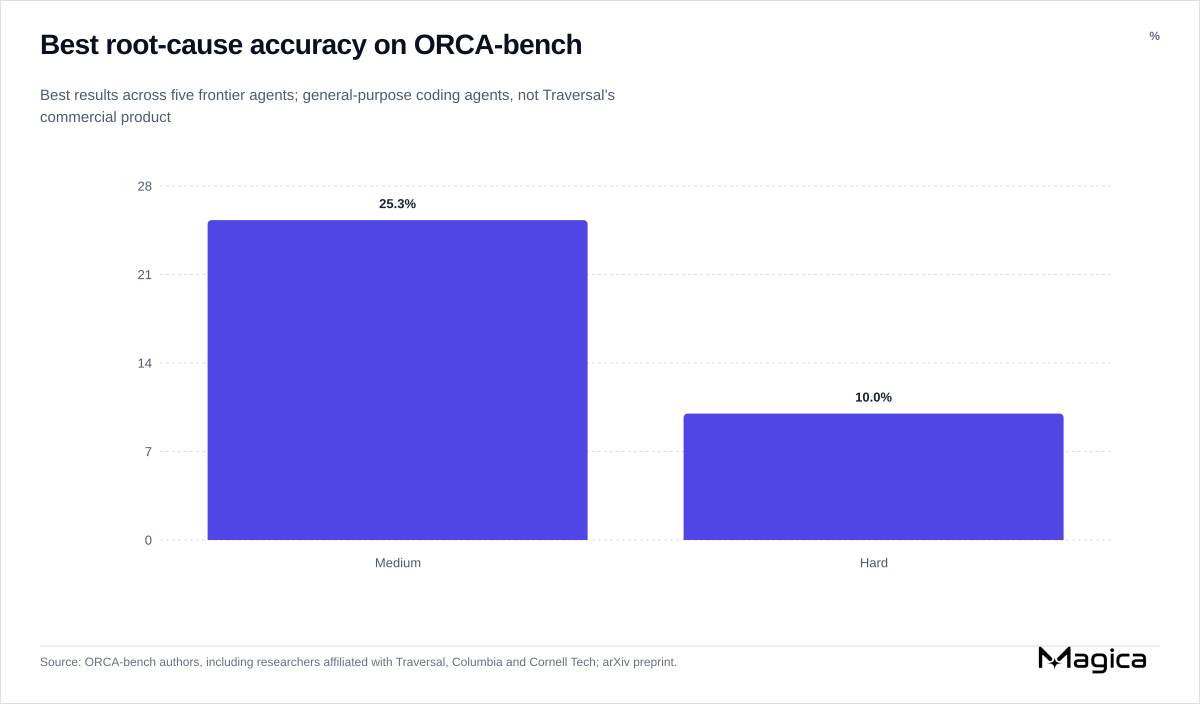
ORCA-bench’s best accuracy across five frontier agents was 25.3% on medium tasks and 10.0% on hard tasks. These author-reported results, from research involving Traversal, evaluate general-purpose coding agents rather than Traversal’s product. Graphic: Magica. Source: ORCA-bench research paper.
Amazon Web Services already offers an alternative within its cloud. Its June 24, 2025 launch announcement made CloudWatch investigations generally available at no additional cost for the investigation capability. AWS says its AI agent surfaces related signals, identifies root-cause hypotheses and suggests remediation steps. Investigations can also start automatically from a CloudWatch alarm, so proactive triggering alone does not distinguish Traversal.
Traversal's potential distinction is the breadth of context it can connect. In its October enterprise platform announcement, it described Azure integration alongside AWS, plus connections to customers' internal tools through MCP servers. That could support investigations spanning cloud boundaries; better outcomes still require evidence.
Deployment is part of that comparison. Traversal says customers can run it in their own cloud or use their own language-model keys. Its Connector links to data sources, while its Processor makes high-volume logs searchable. The company introduced self-service management of both, including visibility into connectivity, data flow and component health.
The same announcement acknowledges a practical constraint: a connected integration can still omit important data. New health checks separately test connectivity, authentication and queries, while dataset views show which underlying sources are accessible. An investigation inherits the blind spots of the telemetry it can reach.
Administrators can now set organization-wide usage limits, according to Traversal. The retained announcement provides no unit prices or total deployment-cost comparison with AWS. Budget controls help govern spending, but leave unanswered the cost per useful investigation, including the infrastructure and model usage needed to produce it.
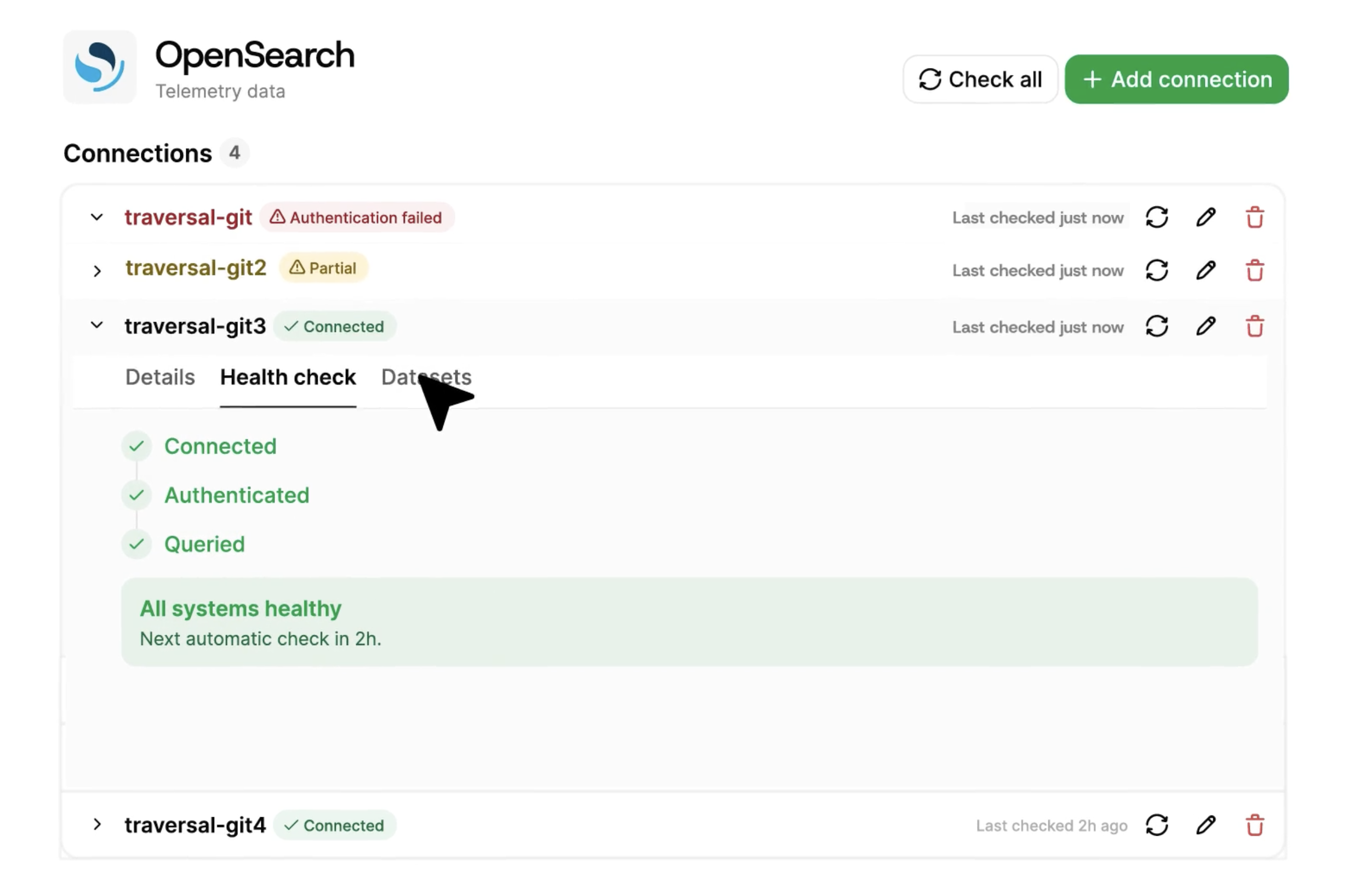
Traversal’s integration-health interface separates connectivity, authentication and query checks. Screenshot: Traversal. Source: Traversal enterprise platform announcement.
Traversal has introduced service accounts so automated workflows have identities separate from individual employees, with centrally revocable API keys. Its platform announcement describes role-based access control and fine-grained authorization as next steps. Those planned controls would govern who can act through Traversal, what data they can access and what agents can reach on their behalf.
For customers, the next decision is how far to move from automated investigation to corrective action in production. Evidence of sustained recovery gains across defined incident populations, comparable total costs and clear approval boundaries would make that decision easier. The financing gives Traversal resources to pursue that evidence as it expands its product; the valuation alone cannot answer those operational questions.
Xiaomi says its humanoid robot sorted car parts for a full shift and corrected errors autonomously. The result extends its factory trials, but published evidence does not yet establish deployment costs or reliability across repeated shifts.
Railway’s CEO apologized after an engineer’s AI agents targeted rival Primcloud during testing. Primcloud says attempts to obtain customer secrets failed, leaving questions about the agents’ instructions and Railway’s controls.
Cortex Training gives developers custom training APIs on managed GPUs. Snowflake is extending its existing model-customization tools, with enterprise-data integration and a cost claim limited to LoRA fine-tuning.
Apple’s developer preview extends Siri AI beyond predefined app categories and adds guidance for complex tasks. Testing is limited to development builds and internal testers, with App Store submissions planned for spring 2027.
Jill Hazelbaker will join OpenAI as chief corporate affairs officer after a decade at Uber, bringing experience in technology communications and political campaigns to a role focused on reputation, positioning and public trust.
The watchOS 27.3 developer beta brings Live Rewind and Siri Recap to Apple Watch Series 12 and Ultra 4. The opt-in tools offer brief transcripts and conversation summaries, but require a compatible iPhone and carry Apple warnings about accuracy and sensitive information.
Traders reportedly extract Samsung and SK hynix memory from processor packages shipped into China, selling it mainly to Huawei customers. The account highlights the memory constraint behind Huawei’s AI chip rollout, but leaves trade volumes, recovery yields and transaction legality unresolved.
Creative-industry groups are challenging OpenAI and Microsoft’s arguments against licensing AI training material, as a New York court weighs fair use. Their briefs share an emphasis on licensing but differ over what the judge should decide.
The startup formerly called TesterArmy is replacing its testing agent with an open-source framework, betting that adoption will generate demand for paid infrastructure and enterprise services.
Fal has announced Sequoia-led and Bessemer-led funding rounds for its 2027 expansion, adding post-trained media models to an established inference business. The announcements leave the new rounds’ size and comparative serving economics undisclosed.
SK hynix bought existing Penguin Solutions preferred shares from an SK Telecom investment vehicle. The deal brings director nomination rights and a convertible stake in an existing AI infrastructure partner, while sending the purchase price to the seller.
Google plans to switch off Gemini and Search for school-managed K–12 student accounts unless administrators enable them. Schools will gain control over access, but Google says keeping Search without its AI features will not be an option.
Anthropic is expected to exceed 3.5 GW of computing capacity in 2026 and aims to double it in 2027. Its filing shows $895.4 billion in commitments, substantial financial resources and an immediate cost from scarce capacity.
Independent tests reproduce MIT researchers’ repair of Qwen’s repetitive reasoning. The edited model still beats a stronger unedited configuration, but by much less; broader claims about creating capabilities remain unproven.
Gartner forecasts that open-weight models will execute 90% of enterprise operational agent steps by 2030. Its cost estimates favor routine, high-volume work, but infrastructure costs and the choice of comparison model leave enterprise savings to be proved.
FTAI Aviation is financing a planned 100-turbine production run in 2027, while ProEnergy has a 650 MW equipment order from Crusoe. Converted aircraft engines offer another supply route for data-center power, but delivery targets, affiliated financing and unproven operating economics qualify the opportunity.
Meta is marketing dollar bonds in a plan to borrow at least $20 billion, including an expected euro offering. Capital spending exceeded operating cash flow last quarter, but the debt is part of a wider financing strategy that also includes equity offerings and a proposed non-voting share-sale program.
A nonbinding opinion targets real-time retrieval and recognisable reuse of journalism, while rejecting a monopoly over news facts and recommending that questions about model training be dismissed as hypothetical.
A study of Lovable projects found passport details, customer records and private messages accessible without login, raising questions about database permissions and the limits of automated security checks. Its sample does not establish a platform-wide leak rate.
CrowdStrike is extending Falcon Guardian into Claude Cowork’s virtual machine and AWS’s AI guardrail layer. The Cowork beta addresses a visibility gap, while existing AWS safeguards and unfinished acquisitions limit what buyers can infer about the broader platform’s capabilities.