Editorial Team
7 min read
Hong Kong officials say financial firms and their human overseers remain responsible for AI agents. With 36 projects selected for sandbox testing, the unresolved task is turning that principle into reliable identity checks, delegated authority and human intervention.
Hong Kong financial institutions will remain responsible for the AI agents they deploy, Financial Secretary Paul Chan, appointed in January 2017 after joining the government as a principal official in July 2012, told the Bloomberg Global Regulatory Forum on November 16. With 36 agent projects selected for regulatory sandbox testing, the practical question is how to verify an agent’s authority to act and ensure a person can intervene when needed.
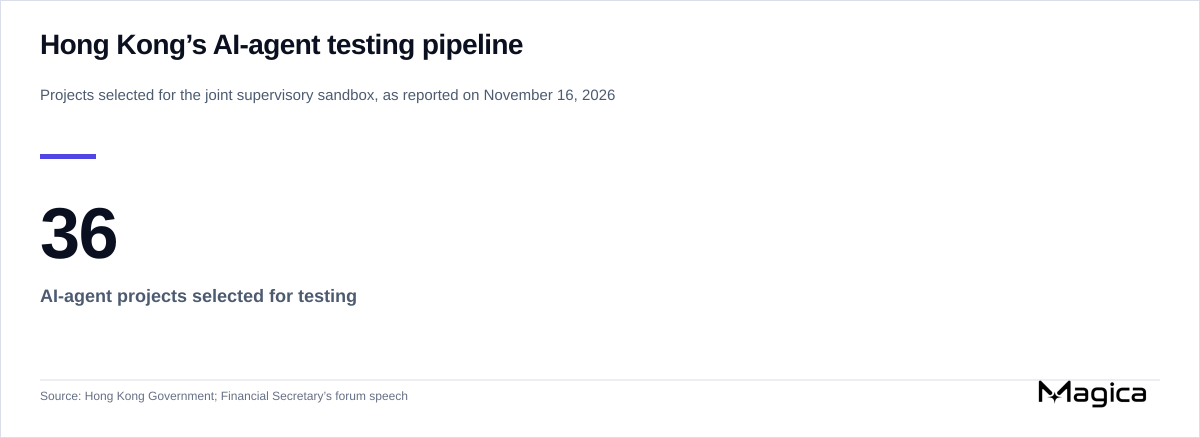
Paul Chan said 36 AI-agent projects had been selected for sandbox testing. Source: Hong Kong Government. Source: Hong Kong Government.
In his forum speech, Chan reaffirmed a dual mandate of prudent regulation and market development that he said he had outlined at the forum three years earlier. His intervention therefore addresses both oversight and Hong Kong’s ambitions as a financial centre. On AI accountability, he said:
An algorithm has no licence to lose and no reputation to protect. The institution has both.
The issue is software acting on delegated tasks. The emerging uses under discussion extend from everyday payments to procurement and treasury management. Chan said banks would need to know an agent’s identity, its authorised activities and how a human could step in. That makes permissions and intervention central to oversight as financial services move beyond using AI only for analysis or assistance.
There is already adoption to supervise. Citing a recent survey of large financial firms by Hong Kong’s Securities and Futures Commission, Chan said three in 10 respondents used AI agents and 95 per cent expected their use of AI to accelerate within a year. The speech supplies neither the sample size nor the survey’s definition of an agent. The 95 per cent figure concerns AI broadly, and a survey of large firms does not establish adoption across the entire sector.
The forum’s discussions extended to market volatility and cybersecurity. Allan Song, Standard Chartered Bank’s head of data and digital for financing and securities services, called for cross-sector and international cooperation rather than competition over fraud detection, according to the event report.
Chan said 36 AI-agent projects had been selected for testing in the joint supervisory sandbox of Hong Kong’s four financial regulators. Separately, the Hong Kong Monetary Authority (HKMA), a financial regulator developing supervisory requirements through industry engagement, launched Project SAGE on November 2. Its name stands for Securing Agentic Finance with Governance and Enablement.
SAGE’s proposed uses include consumer commerce and payments, business procurement and treasury management, and machine-to-machine payments for digital services. Its agenda includes verifying agents’ identities and delegated authority, interoperability standards, and legal questions including liability and consumer protection. An expert group brings together financial institutions, technology providers, professional services firms and academia, giving prospective users and suppliers a role in exploring applications and governance.
The programme treats those controls and legal responsibilities as matters for exploration and discussion. Selecting projects for sandbox testing establishes a work programme; it does not demonstrate that the controls have proved effective.
In its forum address, the HKMA described expert groups and sandboxes covering tokenisation, generative AI and agentic AI as ways to learn about uses, risks and possible solutions before developing proportionate rules. This builds on existing supervision: the authority said it already uses supervisory technology and data analytics to identify early warning signals.
Hong Kong also has a commercial stake in getting that balance right. The HKMA described banking assets, stock-market capitalisation and assets under management in the asset and wealth management sector as each 10 times domestic GDP or more. Those are separate measures, not amounts to add together. They explain why officials couple ambitions for financial innovation with concern about an outsized financial system’s exposure to shocks.
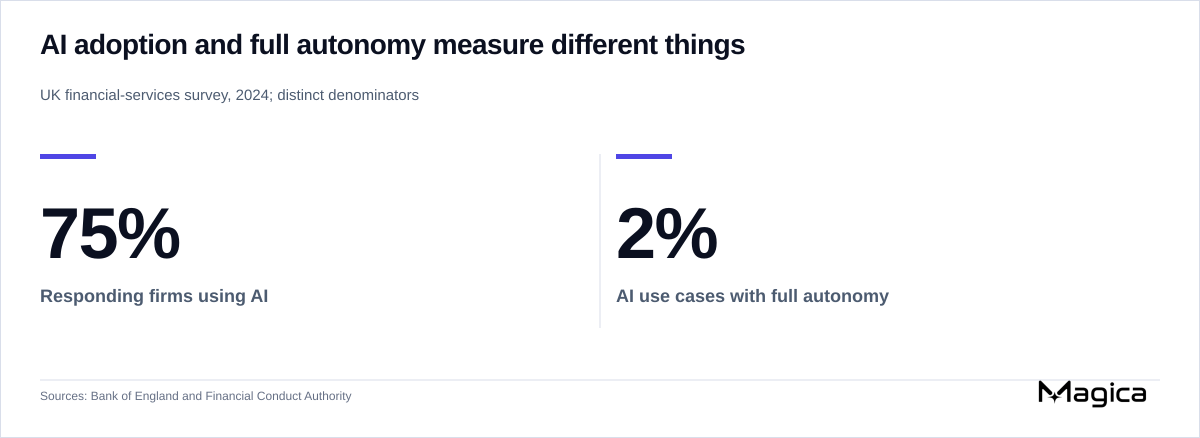
The Bank of England and FCA’s 2024 UK survey measured adoption among firms and full autonomy among use cases separately. Source: Bank of England and Financial Conduct Authority.
An earlier 2024 survey by UK financial authorities, the Bank of England and Financial Conduct Authority, provides a useful distinction. Among 118 responding firms, 75 per cent said they used AI. But only 2 per cent of reported AI use cases involved fully autonomous decision-making. These are different denominators—firms and use cases—and neither measures Hong Kong’s current agent adoption.
The same survey shows that accountability arrangements can coexist with limited understanding. Among firms already using AI, 84 per cent reported an accountable person or persons responsible for their AI framework. Among firms using or planning to use AI over the next three years, 46 per cent described their understanding of their AI technologies as partial, compared with 34 per cent reporting complete understanding. Respondents noted less complete understanding of third-party models than of internally developed ones.
The commercial attraction is also clear, though the survey measures perceptions rather than realised returns. Firms rated data and analytical insights, anti-money-laundering and fraud work, and cybersecurity as the leading current benefits. Operational efficiency, productivity and costs were the areas where they expected the largest increase in benefits over three years. Safety, security and robustness, access to skills, and transparency and explainability were the leading non-regulatory constraints.
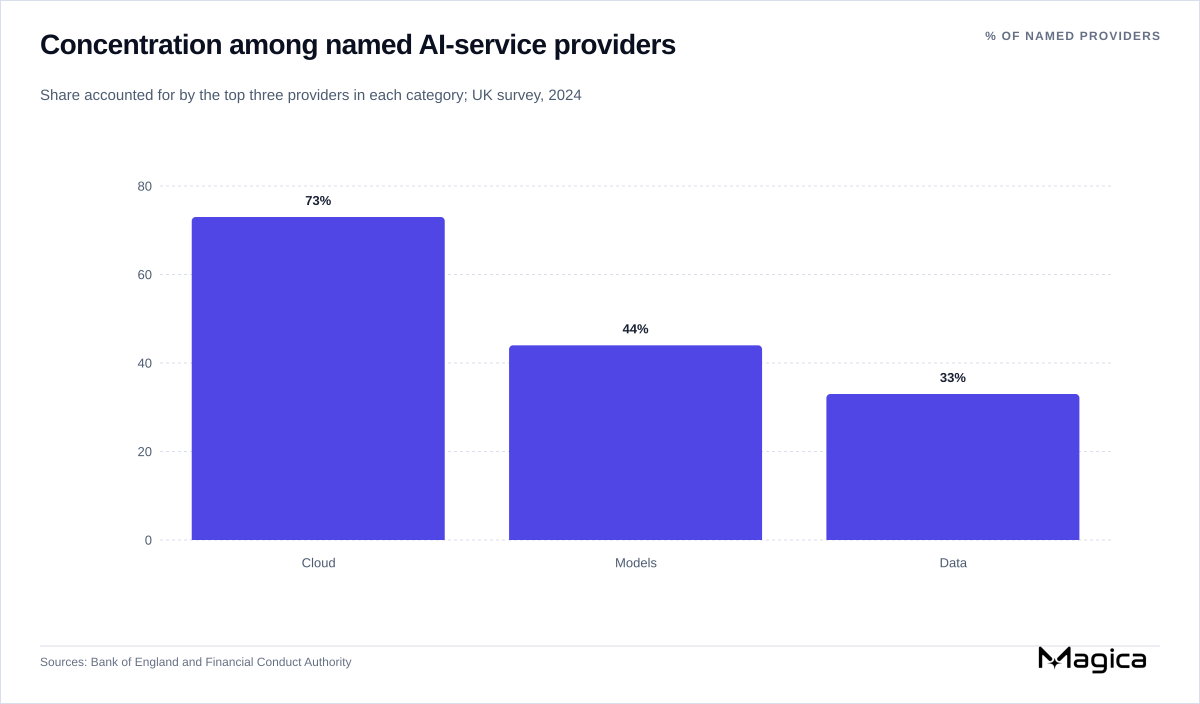
Bank of England and FCA survey, 2024: top-three shares of named providers by category. These measure reported provider relationships, not revenue or Hong Kong market shares. Source: Bank of England and Financial Conduct Authority.
Keeping responsibility with a licensed institution does not eliminate dependencies outside it. A third of current AI use cases deployed by respondents to the UK survey were third-party implementations—meaning a third party carried out most development or deployment processes.
The survey asked firms to list their top three providers in each of cloud, models and data. The three leading providers accounted for 73 per cent of all named cloud providers and 44 per cent of named model providers. These measure concentration in reported provider relationships, not revenue, computing capacity or transactions handled by agents. They do not describe Hong Kong’s supplier market.
Institutions can therefore retain individual responsibility while relying on a concentrated set of external services. A 2024 Financial Stability Board review of risks to the global financial system, revisiting its work from 2017, identified third-party dependencies, provider concentration, market correlations, cyber risks and model and data governance as potential sources of systemic risk. The concerns predate the current agentic-finance programmes. The review also said existing regulatory and supervisory frameworks address many AI vulnerabilities, while calling for assessment of whether they are sufficient.
The risks also run in both directions. Chan said the model that helps a bank detect fraud could help a criminal find weaknesses. Regulators had asked firms to review their defences assuming attacks would become faster, more frequent, automated and simultaneous across multiple fronts. The HKMA, meanwhile, warned that fragmented regulatory responses could leave gaps and amplify shocks across an integrated financial system.
The next supervisory decision is how the testing and industry discussions should shape practical requirements. Project SAGE leaves legal and regulatory questions open for discussion, including liability and consumer protection; the HKMA says its engagement is intended to produce proportionate, practical rules.
The keynotes and SAGE announcement provide no test results showing how reliably agents respect delegated permissions or how effectively humans can interrupt their actions. Evidence on those controls, together with the handling of external-provider failures, would help determine whether institutional responsibility is backed by operational capability. Selection for a sandbox is the start of that inquiry.
New Street Research has initiated Anthropic at Buy ahead of its planned IPO. Its $105 target bets on expanding AI demand, while the filing shows surging revenue and improved customer-serving economics alongside volatile operating results and vast infrastructure commitments.
The Alphabet-backed drug developer has announced $7.1 billion in funding in six months. Its new capital will expand proprietary AI models and clinical infrastructure as company-reported preclinical progress awaits testing in patients.
Microsoft enters Ignite with a previously announced Copilot redesign that combines office applications and autonomous agents. Availability, usage-based charges and reliability will determine what that expansion means for customers, while October's missing paid-seat update leaves adoption harder to assess.
A proposed Equity–Pact agreement would give UK film and TV performers consent and payment rights over digital replicas. Members must approve the package, which leaves explicit protections against AI training unresolved.
The French cloud provider plans to release Olala mini 7A1B on November 19, backed by acquired expertise and European public computing support. Its first deployment offers cost claims, but no published benchmarks yet establish its competitive quality.
US stock futures fell before Nvidia's first earnings report since Jensen Huang's departure, with cash generation, tighter export controls and rate-hike expectations clouding the AI trade ahead of Anthropic's expected market debut.
Nvidia has created a standing board committee to oversee national security and export compliance after co-founder Jensen Huang’s departure. Investigation findings and operational changes remain unresolved.
Microsoft's CEO says team sizes, workflows and skills will change as AI reshapes engineering. About 60,000 employees are eligible for voluntary exits, but uptake and the prospect of later layoffs remain unresolved.

Meta says stronger AI checks and India-specific tuning keep more suggestive and violent content out of Instagram recommendations. Its reporting metric leaves exposure unmeasured, while a government request to change ranking systems drew objections over the ministry’s authority.
OpenAI says NATO has used up to 300 billion raw input and output tokens a month for cyber defence. Access through NATO’s technology agency and an AI-agent exercise shows uptake, while costs, comparative performance and NATO-specific security results remain undisclosed.
Numa’s Series C finances a move from customer conversations into sales and service operations. Automaker distribution gives it reach, but vendor approvals and company-reported savings leave the broader operating-system pitch to prove.
Google’s research tool can turn uploaded sources into interactive dashboards, study aids and trackers. Shared links require full notebook access, personal inputs stay separate, and generation draws on compute-based usage limits.
Records detail Chinese data-center investments linked to Hexi founder Kang Wei, husband of former Megaspeed chief Alice Huang. Filings document financing and Huawei business, but do not establish a route for restricted Nvidia chips.
ElevenLabs plans to acquire Kotoba, the startup behind Japanese speech technology used in Salesforce’s Agentforce Voice. The deal adds a 15-person team and deployed products to its existing Japanese operation, but financial terms and integration plans remain undisclosed.
Tesla plans €3 billion of expansion at its profitable Grünheide factory to build Cybercabs from 2029, eventually targeting up to one million annually. The driverless taxi still lacks German and EU approval, and its capacity target differs from an older plan for the whole site.
Our World in Data’s comparison finds negative views of AI exceed positive ones across five probability-based surveys. The primary results also reveal substantial mixed views, acceptance of some applications and a sharper divide over who controls development and bears its local costs.
NVIDIA's Nemotron for Science pairs an existing open model with nearly 50,000 chemistry questions and scientific post-training recipes. Partner results suggest scope for specialized agents, but the reported accuracy and inference savings do not establish the full cost of adapting them.
AMD says the Lux AI supercomputer is open to scientific users at Oak Ridge. Half its annual capacity supports the Genesis Mission and half is reserved for paid access, including AMD development, while workload limits and undisclosed rates shape its practical value.
Apple is adding app-by-app and folder-specific permissions, repeat approval requests and clearer warnings in macOS 27.3 beta 2. Existing permissions remain intact, limiting the immediate reach of the privacy changes.
OpenAI reportedly discussed buying Goodfire for more than $5 billion, over four times its February financing valuation. No deal resulted. A disclosed paid assessment agreement offers cooperation without ownership, while the technology’s safety benefits remain to be demonstrated.