Editorial Team
7 min read
Microsoft enters Ignite with a previously announced Copilot redesign that combines office applications and autonomous agents. Availability, usage-based charges and reliability will determine what that expansion means for customers, while October's missing paid-seat update leaves adoption harder to assess.
Microsoft enters Ignite 2026 with its Copilot AI assistant already redesigned to combine office applications, software creation and autonomous work. Before the opening keynote, the unresolved issue is how broadly customers can use that package—and how to assess its cost alongside the subscription they already buy.
The distinction matters for a company seeking to make Copilot a common interface across its productivity software. The expansion reaches beyond answering questions into carrying out work, where Microsoft charges by usage and customers must assess spending, permissions and service reliability together.
Microsoft's event page sets the opening for November 17 at 10 a.m. Pacific, after the November 17, 14:10 UTC reporting cutoff. The conference runs through November 20 in San Francisco and online.
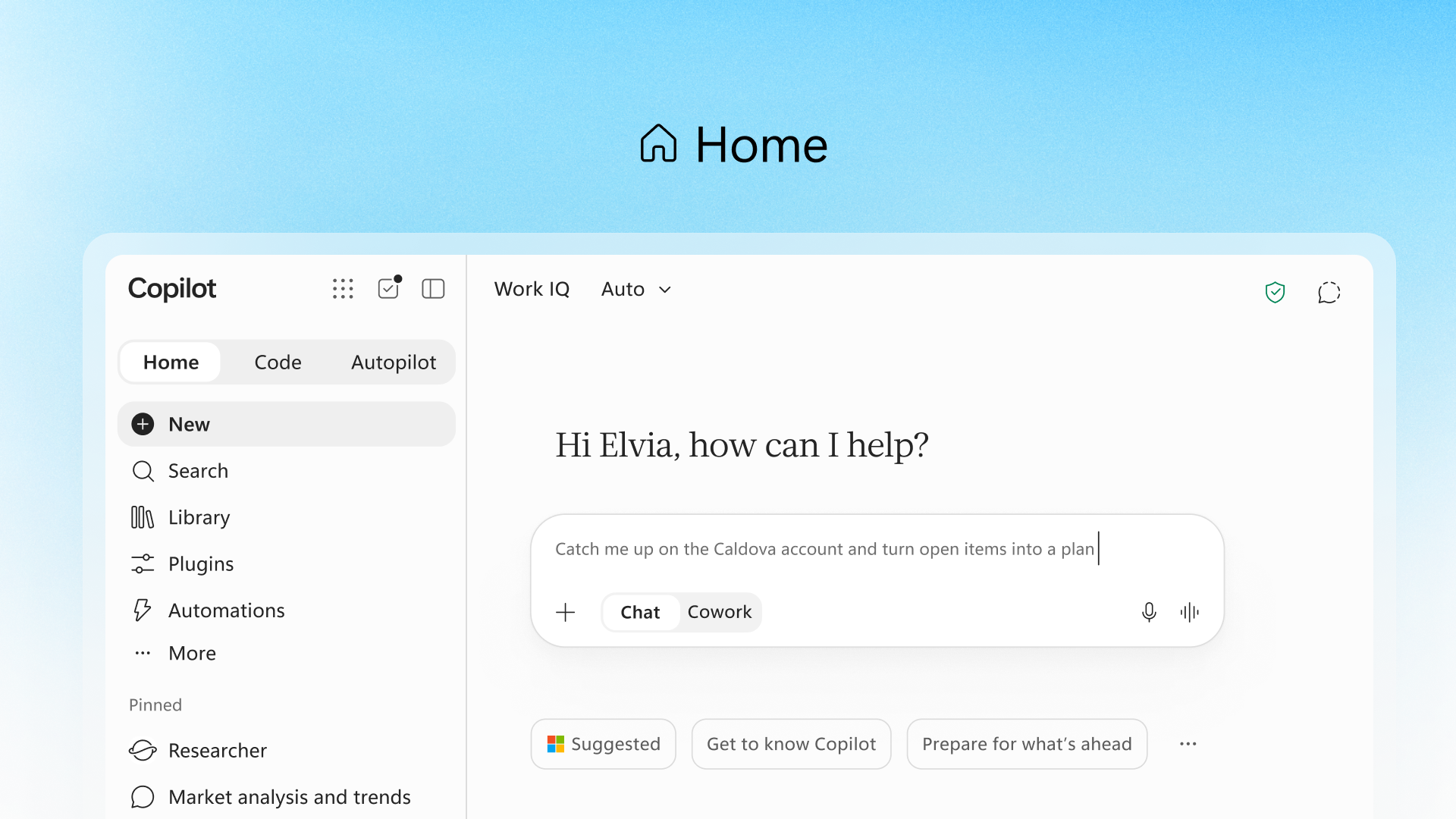
Microsoft's September 25 announcement illustration shows Home bringing Chat and Cowork together. Company-reported design. Image: Microsoft. Source: Microsoft Copilot announcement.
Satya Nadella, Microsoft's chief executive, previously led its Cloud and Enterprise group before his appointment as CEO in February 2014. He is scheduled to open Ignite, where Copilot, agents, cloud and security are on the agenda.
In its September 25 announcement, Microsoft described three capabilities in the redesigned Copilot:
Those descriptions are company claims about capabilities, rather than independent measurements of successful work. Their availability also differs. Microsoft said Home and Code would begin rolling out through its Frontier program; the more detailed Code description anticipated broad availability in the following weeks. Autopilot was expanding to private preview at September's end, while the Copilot Managed Runtime hosting infrastructure was in preview.
The announcement was not entirely a preview roadmap. Microsoft said Fabric IQ, which supplies business-data context, was already generally available in Chat and Cowork, with Code integration still to come. It described Microsoft IQ as the platform connecting business knowledge and operations to Copilot and agents. A keynote demonstration must therefore be judged against each feature's prior status, rather than treated as a launch of the whole package.
The pre-keynote coverage describes the redesign as combining the consumer chatbot and Microsoft 365 Copilot app. It also reports the retirement of consumer features including Podcasts, Group Chats and Deep Research. That is a shift in priorities as well as an expansion of functions. The coverage's author disclosed that Microsoft paid for travel and accommodation.
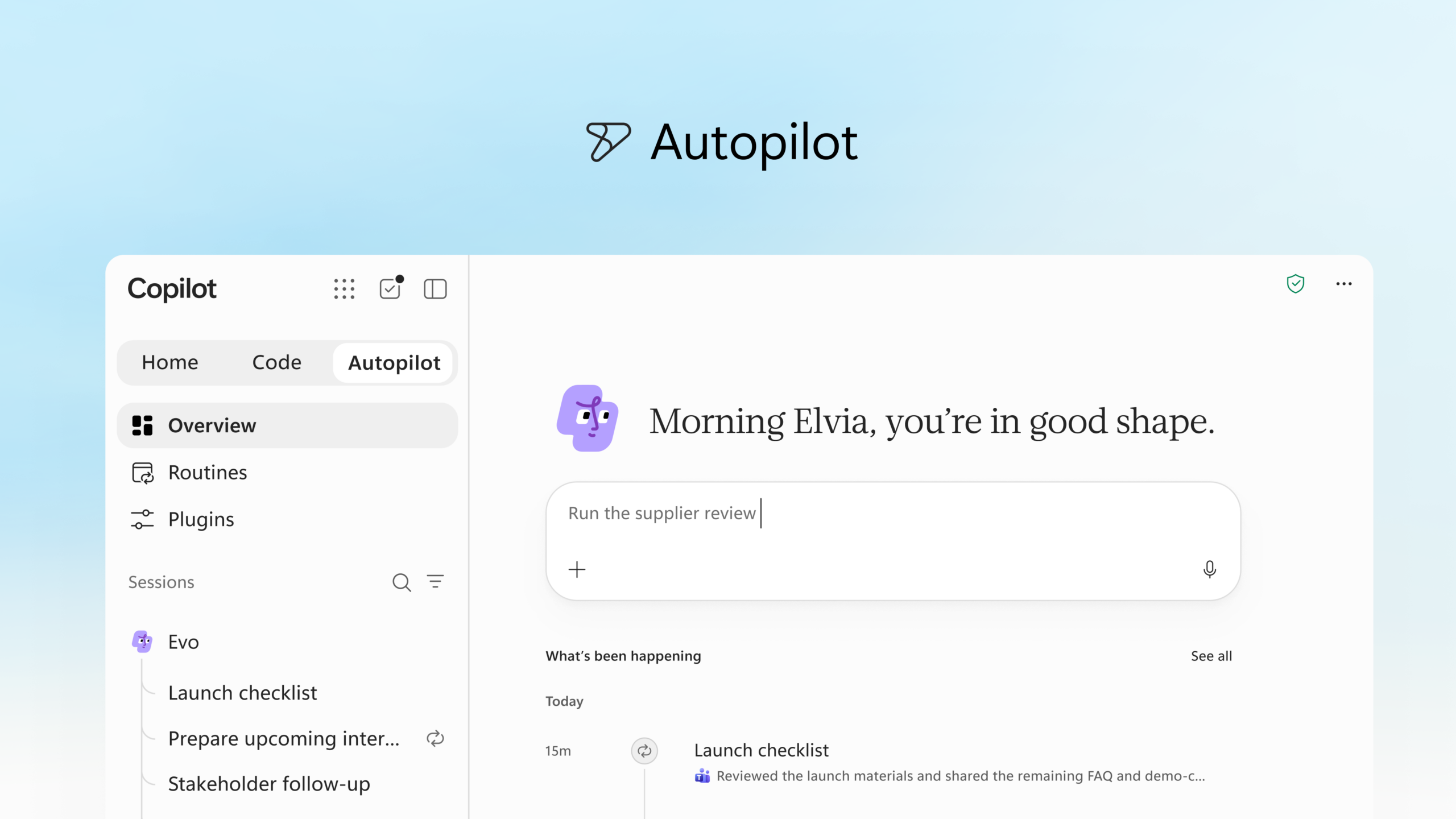
Microsoft's Autopilot illustration shows a supplier-review request and recurring work. Company-reported capabilities; September's announcement described an expanding private preview. Image: Microsoft. Source: Microsoft Copilot announcement.
Microsoft's September billing explanation draws an explicit boundary. It says a user subscription covers everyday assistance in Chat and Office applications, while Cowork, Code, Autopilot, other long-running agent capabilities and certain frontier models run on usage-based billing.
That makes the cost of delegated work a separate purchasing question from the price of a seat. Microsoft also announced tools intended to keep that spending manageable: administrators can set spending policies and model-family access, route credit requests through approval workflows, and give users visibility into credit consumption and remaining balances. Its Agent 365 management tools were expanding cost coverage to Code and Copilot Managed Runtime.
Governance is likewise part of the announced design. Microsoft says Autopilot operates with permissions and auditing, while a plugin registry allows IT teams to approve and manage extensions centrally. The question for customers is how those controls perform in deployment, including when an agent takes an incorrect action or consumes more resources than expected.
The event preview lists the enterprise Microsoft 365 Copilot add-on at $30 per user per month and Copilot Business at $21 for firms with fewer than 300 users. It dates the Business offering, Agent 365 and Work IQ—the system providing context about a user's work and organization—to Ignite 2025. Agent management and a lower-priced small-business offering therefore predate this conference too.
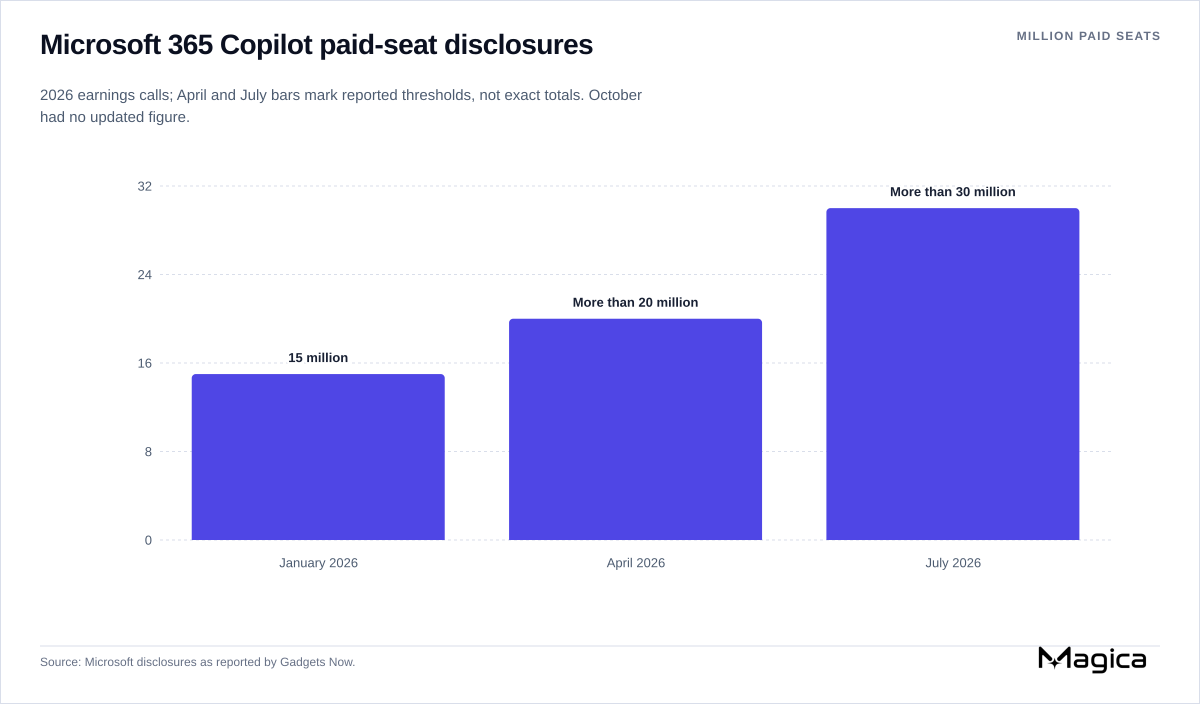
Company-reported Microsoft 365 Copilot paid-seat disclosures. April and July bars mark reported thresholds, not exact totals; October had no updated figure. Chart: Magica. Source: Gadgets Now.
The event preview reports that Microsoft disclosed 15 million paid Microsoft 365 Copilot seats in January, more than 20 million in April and more than 30 million in July. It supplied no updated seat figure in October's results.
Instead, the report relays Nadella's October 28 statement that daily Copilot users had increased almost 50% from the preceding quarter and more than fivefold from a year earlier. The report also describes his claim of growth in customers paying through usage-based Copilot credits, without giving a comparison period for that measure.
These measures answer different questions. Paid seats indicate subscription scale; daily users indicate activity; the number of customers consuming credits does not reveal their total spending or the value of completed tasks. None alone establishes savings per employee.
The pre-keynote coverage puts Microsoft's broader commercial base at roughly 450 million seats, illustrating the distribution opportunity behind the strategy. That broader base and the dated Copilot disclosures do not establish a current adoption percentage.
The competitive alternative is unusually close to Microsoft's own product. The event preview reports that Anthropic, the AI model developer whose technology Microsoft uses in Copilot Cowork, launched Claude Sheets, Whiteboards and Data on November 10. Sheets creates spreadsheet tabs, formulas and dropdowns inside Anthropic's assistant.
That is evidence of an alternative place to do spreadsheet work, rather than proof of feature or performance equivalence with Excel. It also means a supplier to Microsoft's delegated-work assistant is seeking users for its own office functions.
The same report says Microsoft launched seven in-house MAI models at Build on June 2 and has moved some Copilot work in Excel and Outlook onto them. The pre-keynote coverage describes a wider specialized-model portfolio and says Microsoft completed pre-training on MAI-Base-2, a foundation model it plans to offer enterprise customers through Foundry, its platform for building AI applications and agents. The reports do not quantify the share of Copilot work now handled by Microsoft's own models.
Deployment need not be entirely cloud-based. The coverage describes Microsoft's Hybrid Intelligence approach, introduced in October, as combining local and cloud AI on Windows devices. Microsoft's stated aim is to handle suitable tasks locally and reserve cloud tokens for more demanding work. That is a cost-management proposition, without measured customer savings in that reporting; it also does not change Microsoft's description of Autopilot as cloud-hosted.
Service reliability gives customers an immediate reason to scrutinize the proposed integration. The live-blog coverage describes a major Microsoft 365 outage days before Ignite and relays the explanation of Charles Lamanna, Microsoft's executive vice president of Copilot. In his account, a networking-gateway bug became disruptive when Teams traffic moved through the gateway while some servers were already unavailable. Automatic redirection then overloaded working servers and spread the failure.
That account concerns shared service infrastructure; it does not establish that Copilot's redesign caused the outage. It does make recovery and continuity relevant when more tasks depend on connected Microsoft services.
The next useful evidence is specific: updated availability for the September capabilities, a paid-seat disclosure that can be read alongside usage measures, and customer results showing the cost and reliability of completed agent tasks. Microsoft has already outlined billing and governance mechanisms. Customers now need to know which features they can deploy, how those mechanisms behave in practice and whether the work delivered justifies the combined subscription and consumption bill.
New Street Research has initiated Anthropic at Buy ahead of its planned IPO. Its $105 target bets on expanding AI demand, while the filing shows surging revenue and improved customer-serving economics alongside volatile operating results and vast infrastructure commitments.
The Alphabet-backed drug developer has announced $7.1 billion in funding in six months. Its new capital will expand proprietary AI models and clinical infrastructure as company-reported preclinical progress awaits testing in patients.
A proposed Equity–Pact agreement would give UK film and TV performers consent and payment rights over digital replicas. Members must approve the package, which leaves explicit protections against AI training unresolved.
The French cloud provider plans to release Olala mini 7A1B on November 19, backed by acquired expertise and European public computing support. Its first deployment offers cost claims, but no published benchmarks yet establish its competitive quality.
US stock futures fell before Nvidia's first earnings report since Jensen Huang's departure, with cash generation, tighter export controls and rate-hike expectations clouding the AI trade ahead of Anthropic's expected market debut.
Nvidia has created a standing board committee to oversee national security and export compliance after co-founder Jensen Huang’s departure. Investigation findings and operational changes remain unresolved.
Microsoft's CEO says team sizes, workflows and skills will change as AI reshapes engineering. About 60,000 employees are eligible for voluntary exits, but uptake and the prospect of later layoffs remain unresolved.
Hong Kong officials say financial firms and their human overseers remain responsible for AI agents. With 36 projects selected for sandbox testing, the unresolved task is turning that principle into reliable identity checks, delegated authority and human intervention.

Meta says stronger AI checks and India-specific tuning keep more suggestive and violent content out of Instagram recommendations. Its reporting metric leaves exposure unmeasured, while a government request to change ranking systems drew objections over the ministry’s authority.
OpenAI says NATO has used up to 300 billion raw input and output tokens a month for cyber defence. Access through NATO’s technology agency and an AI-agent exercise shows uptake, while costs, comparative performance and NATO-specific security results remain undisclosed.
Numa’s Series C finances a move from customer conversations into sales and service operations. Automaker distribution gives it reach, but vendor approvals and company-reported savings leave the broader operating-system pitch to prove.
Google’s research tool can turn uploaded sources into interactive dashboards, study aids and trackers. Shared links require full notebook access, personal inputs stay separate, and generation draws on compute-based usage limits.
Records detail Chinese data-center investments linked to Hexi founder Kang Wei, husband of former Megaspeed chief Alice Huang. Filings document financing and Huawei business, but do not establish a route for restricted Nvidia chips.
ElevenLabs plans to acquire Kotoba, the startup behind Japanese speech technology used in Salesforce’s Agentforce Voice. The deal adds a 15-person team and deployed products to its existing Japanese operation, but financial terms and integration plans remain undisclosed.
Tesla plans €3 billion of expansion at its profitable Grünheide factory to build Cybercabs from 2029, eventually targeting up to one million annually. The driverless taxi still lacks German and EU approval, and its capacity target differs from an older plan for the whole site.
Our World in Data’s comparison finds negative views of AI exceed positive ones across five probability-based surveys. The primary results also reveal substantial mixed views, acceptance of some applications and a sharper divide over who controls development and bears its local costs.
NVIDIA's Nemotron for Science pairs an existing open model with nearly 50,000 chemistry questions and scientific post-training recipes. Partner results suggest scope for specialized agents, but the reported accuracy and inference savings do not establish the full cost of adapting them.
AMD says the Lux AI supercomputer is open to scientific users at Oak Ridge. Half its annual capacity supports the Genesis Mission and half is reserved for paid access, including AMD development, while workload limits and undisclosed rates shape its practical value.
Apple is adding app-by-app and folder-specific permissions, repeat approval requests and clearer warnings in macOS 27.3 beta 2. Existing permissions remain intact, limiting the immediate reach of the privacy changes.
OpenAI reportedly discussed buying Goodfire for more than $5 billion, over four times its February financing valuation. No deal resulted. A disclosed paid assessment agreement offers cooperation without ownership, while the technology’s safety benefits remain to be demonstrated.