Editorial Team
7 min read
US stock futures fell before Nvidia's first earnings report since Jensen Huang's departure, with cash generation, tighter export controls and rate-hike expectations clouding the AI trade ahead of Anthropic's expected market debut.
US stock futures declined on November 17 as investors prepared for Nvidia's first earnings report since founder Jensen Huang stepped down as chief executive. The AI chip supplier faces questions about leadership, customer spending and access to China just before Anthropic, the AI lab behind the Claude chatbot, is expected to enter the public market.
At 5:23 a.m. Eastern time, Dow futures were down 0.45%, while S&P 500 and Nasdaq 100 futures each fell 0.34%, according to the premarket report. Nvidia shares slipped 0.4%; the company had lost about $410 billion in market value following Huang's resignation last week.
The two corporate events test different parts of the AI investment case: whether an established infrastructure supplier can sustain growth, and what public investors will pay for an AI model developer. Both arrive as expectations of higher US interest rates add pressure to the sector.

Colette Kress in the portrait accompanying NVIDIA's September 2013 announcement of her appointment as chief financial officer. Image: NVIDIA. Source: NVIDIA CFO appointment.
Interim chief executive Colette Kress, Nvidia's finance chief since 2013, will face investors after the closing bell Tuesday. Before joining Nvidia, she was chief financial officer of Cisco's Business Technology and Operations Finance organization and previously held the same role in Microsoft's Server and Tools division. Nvidia described those roles in its September 2013 appointment announcement. Her tenure offers experience of the business, but the results will also test confidence in partnerships and product plans after Huang's departure.
The leadership change follows a broader stock retreat. Nvidia had lost more than a quarter of its value over three weeks, according to the earlier market report. A separate market snapshot put the Nasdaq 100's loss over the preceding two days at 6%, showing that the retreat extends beyond one company. That report also said HSBC sold a roughly $300 million portion of a loan for a troubled New Mexico data-center project at a steep discount, a financing setback alongside the stock-market retreat.
Huang resigned last week following revelations of extramarital affairs, including one involving a businesswoman suspected by the US of being a Chinese spy, according to the premarket report. That reported suspicion remains an allegation. The security concerns add a governance dimension to the transition at a company whose overseas sales are already subject to export controls.
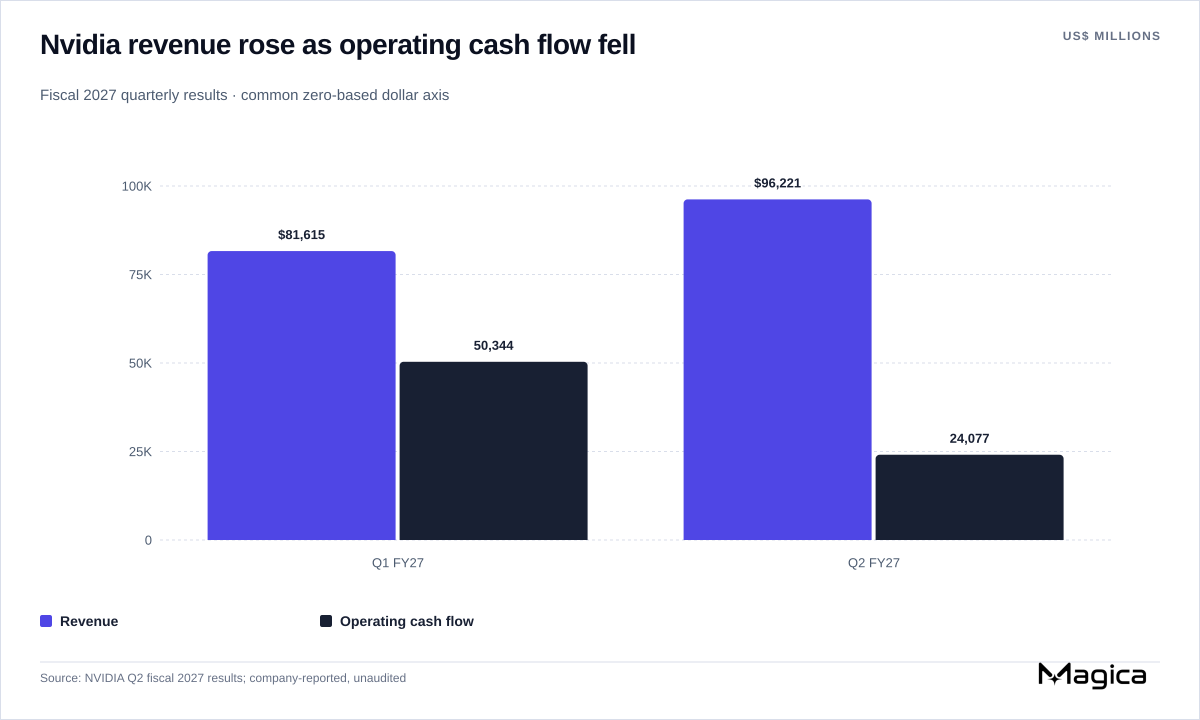
Company-reported revenue rose between Q1 and Q2 fiscal 2027, while GAAP operating cash flow fell. Figures are in millions of US dollars. Source: NVIDIA quarterly results.
In its August results announcement, Nvidia reported $96.2 billion in revenue for the quarter ended July 26, 2026, up 18% from the preceding quarter and 106% from a year earlier. Data Center revenue was $89.0 billion, up 117%, or roughly 93% of total revenue using the company's rounded figures. That concentration explains why the durability of customers' infrastructure budgets matters so much to its outlook.
For the following quarter, Nvidia forecast revenue of $108 billion, plus or minus 2%, and GAAP and non-GAAP gross margins of 74%, plus or minus half a percentage point. Those were company forecasts, not reported results. The margin midpoint was one percentage point below the 75% reported under both measures in the second quarter. The forecast provides a benchmark against which investors can assess Tuesday's numbers and any change in expectations.
The cash-flow figures add a different caution. Nvidia's second-quarter operating cash flow was $24.1 billion, down from $50.3 billion in the preceding quarter, although above $15.4 billion a year earlier. In the second-quarter cash-flow statement, increases in accounts receivable and inventories absorbed $22.3 billion and $5.8 billion respectively. Faster sales did not translate into sequentially higher operating cash generation.
Nvidia also participates in financing the ecosystem that buys its equipment. In August, it announced partnerships with major investment firms to establish independent compute-financing platforms intended to mobilize more than $500 billion of third-party capital over time, subject to definitive agreements. That was a financing ambition, not capital already raised or revenue booked by Nvidia.
The company said its Vera Rubin computing platform was ramping into full production, with racks running at cloud partners. It also reported securing land, power and shell capacity through an Ohio infrastructure partnership. The financial and physical commitments behind the buildout make customer spending and investment returns central to the outlook.
The US tightened restrictions on China's access to advanced AI chips on Monday. Saxo chief investment strategist Charu Chanana said in the market report that the immediate revenue exposure was difficult to quantify, while warning that tighter rules could shrink the future addressable market for AI infrastructure.
There is a significant qualification: Nvidia's August forecast already assumed no Data Center compute revenue from China. The new restrictions therefore cannot simply be treated as the loss of a China sales contribution embedded in that forecast. Investors still need an explanation of their broader effects on customers, distribution and future market access.
Nvidia has formed a board committee to oversee national security and export controls, according to the market update. Meanwhile, its board was not considering Huang's return as CEO, a report citing three people said. The immediate task is therefore to establish how the company will operate under its new leadership.
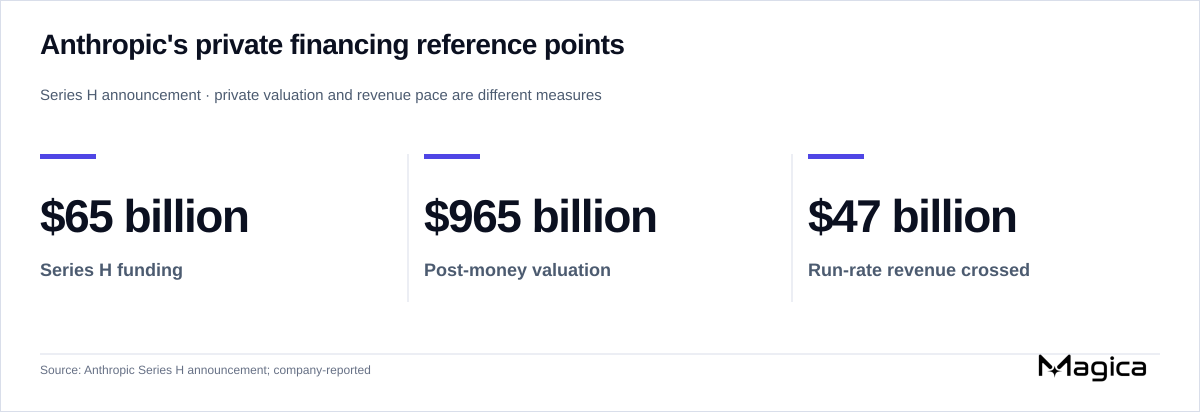
Company-reported private financing figures, not IPO pricing or completed annual sales. The funding total included $15 billion in previously committed investments. Source: Anthropic financing announcement.
Anthropic is expected to price its initial public offering Wednesday and begin trading Thursday, according to the premarket report. Those remain scheduled events rather than completed transactions.
The company enters that test with substantial private financing behind it. In a May 28 announcement, Anthropic said it had raised $65 billion at a $965 billion post-money valuation. That private-round valuation is a historical reference, not an indicated IPO price. The round was led by Altimeter Capital, Dragoneer, Greenoaks and Sequoia Capital. Its total included $15 billion of previously committed investments from large cloud companies, including $5 billion from Amazon; it was not entirely new commitments. Anthropic said the funding would support safety and interpretability research, compute expansion and products.
At the time, Anthropic said its run-rate revenue had crossed $47 billion earlier in May. That gives a measure of commercial scale, but a revenue run rate is a pace measure rather than completed full-year sales. The announcement did not establish profitability or returns on the planned infrastructure.
Its infrastructure arrangements spread spending across suppliers. In the same announcement, Anthropic described agreements with Amazon for up to five gigawatts of new capacity, Google and Broadcom for five gigawatts of next-generation tensor processing unit, or TPU, capacity, and SpaceX for access to graphics processing unit, or GPU, capacity. These were capacity agreements, not a statement that all of it was already operating. Anthropic identified Amazon Web Services as its primary cloud provider and training partner and said Claude was available on AWS, Google Cloud and Microsoft Azure. Its use of both TPU and GPU infrastructure means a major model developer's computing demand cannot automatically be treated as demand for Nvidia chips alone.
Nvidia's results will show whether revenue meets its $108 billion forecast range, how margins compare with its 74% midpoint and whether cash generation keeps pace with sales. Its outlook and customer commitments will help test the sustainability of data-center spending. Anthropic's pricing and subsequent debut will test public investors' appetite for a model developer amid the infrastructure selloff.
Monetary policy is an additional pressure. The morning report cited CME FedWatch pricing of a 97.4% probability of a quarter-percentage-point December rate increase by the Federal Reserve, the US central bank. That was market pricing at the time, not a policy decision. Investors also awaited officials' remarks Tuesday and meeting minutes Wednesday.
The evidence still needed goes beyond strong sales: cash conversion at the chip supplier, durable customer commitments and the public price placed on a model developer's growth. This week's announcements can clarify those questions without, by themselves, proving the long-term returns on the AI buildout.
New Street Research has initiated Anthropic at Buy ahead of its planned IPO. Its $105 target bets on expanding AI demand, while the filing shows surging revenue and improved customer-serving economics alongside volatile operating results and vast infrastructure commitments.
The Alphabet-backed drug developer has announced $7.1 billion in funding in six months. Its new capital will expand proprietary AI models and clinical infrastructure as company-reported preclinical progress awaits testing in patients.
Microsoft enters Ignite with a previously announced Copilot redesign that combines office applications and autonomous agents. Availability, usage-based charges and reliability will determine what that expansion means for customers, while October's missing paid-seat update leaves adoption harder to assess.
A proposed Equity–Pact agreement would give UK film and TV performers consent and payment rights over digital replicas. Members must approve the package, which leaves explicit protections against AI training unresolved.
The French cloud provider plans to release Olala mini 7A1B on November 19, backed by acquired expertise and European public computing support. Its first deployment offers cost claims, but no published benchmarks yet establish its competitive quality.
Nvidia has created a standing board committee to oversee national security and export compliance after co-founder Jensen Huang’s departure. Investigation findings and operational changes remain unresolved.
Microsoft's CEO says team sizes, workflows and skills will change as AI reshapes engineering. About 60,000 employees are eligible for voluntary exits, but uptake and the prospect of later layoffs remain unresolved.
Hong Kong officials say financial firms and their human overseers remain responsible for AI agents. With 36 projects selected for sandbox testing, the unresolved task is turning that principle into reliable identity checks, delegated authority and human intervention.

Meta says stronger AI checks and India-specific tuning keep more suggestive and violent content out of Instagram recommendations. Its reporting metric leaves exposure unmeasured, while a government request to change ranking systems drew objections over the ministry’s authority.
OpenAI says NATO has used up to 300 billion raw input and output tokens a month for cyber defence. Access through NATO’s technology agency and an AI-agent exercise shows uptake, while costs, comparative performance and NATO-specific security results remain undisclosed.
Numa’s Series C finances a move from customer conversations into sales and service operations. Automaker distribution gives it reach, but vendor approvals and company-reported savings leave the broader operating-system pitch to prove.
Google’s research tool can turn uploaded sources into interactive dashboards, study aids and trackers. Shared links require full notebook access, personal inputs stay separate, and generation draws on compute-based usage limits.
Records detail Chinese data-center investments linked to Hexi founder Kang Wei, husband of former Megaspeed chief Alice Huang. Filings document financing and Huawei business, but do not establish a route for restricted Nvidia chips.
ElevenLabs plans to acquire Kotoba, the startup behind Japanese speech technology used in Salesforce’s Agentforce Voice. The deal adds a 15-person team and deployed products to its existing Japanese operation, but financial terms and integration plans remain undisclosed.
Tesla plans €3 billion of expansion at its profitable Grünheide factory to build Cybercabs from 2029, eventually targeting up to one million annually. The driverless taxi still lacks German and EU approval, and its capacity target differs from an older plan for the whole site.
Our World in Data’s comparison finds negative views of AI exceed positive ones across five probability-based surveys. The primary results also reveal substantial mixed views, acceptance of some applications and a sharper divide over who controls development and bears its local costs.
NVIDIA's Nemotron for Science pairs an existing open model with nearly 50,000 chemistry questions and scientific post-training recipes. Partner results suggest scope for specialized agents, but the reported accuracy and inference savings do not establish the full cost of adapting them.
AMD says the Lux AI supercomputer is open to scientific users at Oak Ridge. Half its annual capacity supports the Genesis Mission and half is reserved for paid access, including AMD development, while workload limits and undisclosed rates shape its practical value.
Apple is adding app-by-app and folder-specific permissions, repeat approval requests and clearer warnings in macOS 27.3 beta 2. Existing permissions remain intact, limiting the immediate reach of the privacy changes.
OpenAI reportedly discussed buying Goodfire for more than $5 billion, over four times its February financing valuation. No deal resulted. A disclosed paid assessment agreement offers cooperation without ownership, while the technology’s safety benefits remain to be demonstrated.