Editorial Team
8 min read
OpenRouter disclosed provider removals after investigations into inference data handling. Separate notices describe forwarded requests, a compromised deployment and stolen prompt samples, exposing different weaknesses behind privacy assurances.
OpenRouter, a managed gateway that routes customers’ AI requests to models and the providers running them, said on November 22 that it had removed three providers and stripped 125 endpoints of Zero Data Retention (ZDR) eligibility following investigations into provider data handling. It said the findings showed no breach or unauthorized access of OpenRouter itself.
ZDR is a promise that prompts and responses will not be stored. The distinction matters for customers buying access through an intermediary: the service accepting a request and the infrastructure processing it can be separate organizations. The disclosures show that stored samples, compromised servers and forwarding configurations can each expose prompt contents through a different path.
In its announcement, OpenRouter said it had notified all potentially affected customers. The 125 endpoints include both providers flagged by researchers and additional endpoints removed as a precaution. That figure is therefore a measure of restricted routing eligibility, not a count of proven breaches, affected customers or exposed requests.
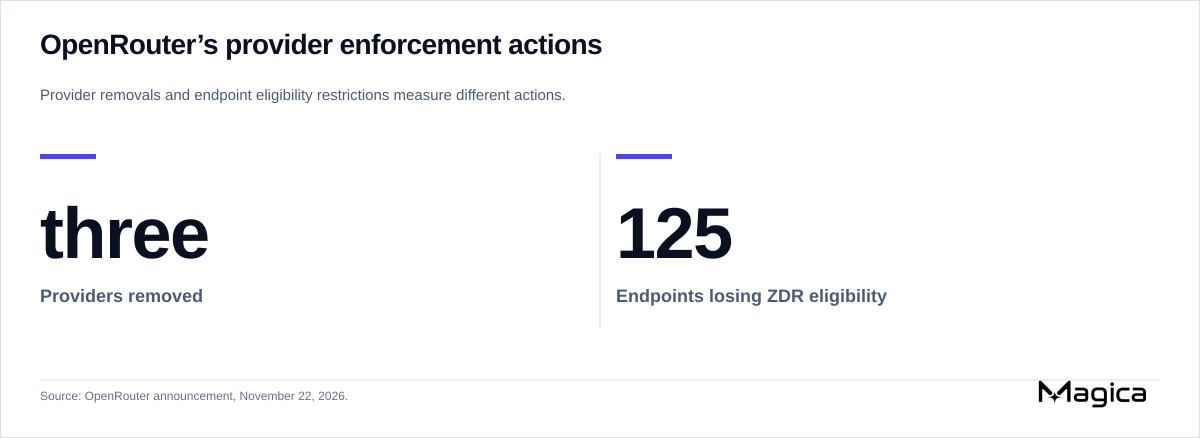
Company-reported enforcement actions from OpenRouter. The 125 endpoints include precautionary restrictions, not just confirmed policy failures. Source: OpenRouter.
OpenRouter’s existing business separates choosing an AI model from choosing the provider that runs it. Its routing guide, published in June and updated in September, describes a service spanning more than 70 providers and more than 400 models. It says standard routing favors the cheapest reliable provider, weighting selection by the inverse square of price. Customers can override routing, restrict providers and require ZDR endpoints. Tool-calling requests have a separate quality-based default, so price weighting is not universal.
That arrangement makes provider eligibility consequential: a privacy requirement must hold across the processing path, even as traffic can move among competing hosts. Removing an endpoint’s ZDR status restricts its eligibility for that requirement; it does not necessarily remove the provider from the platform.
The investigation’s underlying evidence came from Dragos, a cybersecurity company whose research team is led by chief research officer HD Moore, creator of the Metasploit security-testing software. In a November 19 study, the researchers said they submitted approximately two million prompts containing unique URLs and canary credentials to AI services from July through November 2026, then monitored activity after inference. The deliberately planted secrets were intended to reveal access to prompt contents. Dragos reported evidence of data exposure at at least three providers.
The researchers reported that some stolen requests at two compromised providers had been marked ZDR. They also described marketplace sellers accessing prompts through ordinary logging, without an exploit, and separate cases of secret URLs being fetched despite privacy restrictions. In one case, the researchers said a secret link from a ZDR-marked prompt sent to a U.S.-based provider appeared in a company chat in China 24 days later. The research did not name that provider. These are different failure modes: a no-storage policy cannot prevent an intruder from reading a request during processing.
The method has limits. Dragos said canaries reveal that a prompt was exposed but do not, by themselves, identify where in a multi-provider chain it happened. The researchers supplemented them with image fetches and error-response analysis to trace routes. Their roughly two million test prompts are not an estimate of ordinary customers’ losses or a denominator for a market-wide breach rate.
The provider notices offer more specific—and materially different—accounts of what happened. They do not identify every provider discussed in the research.
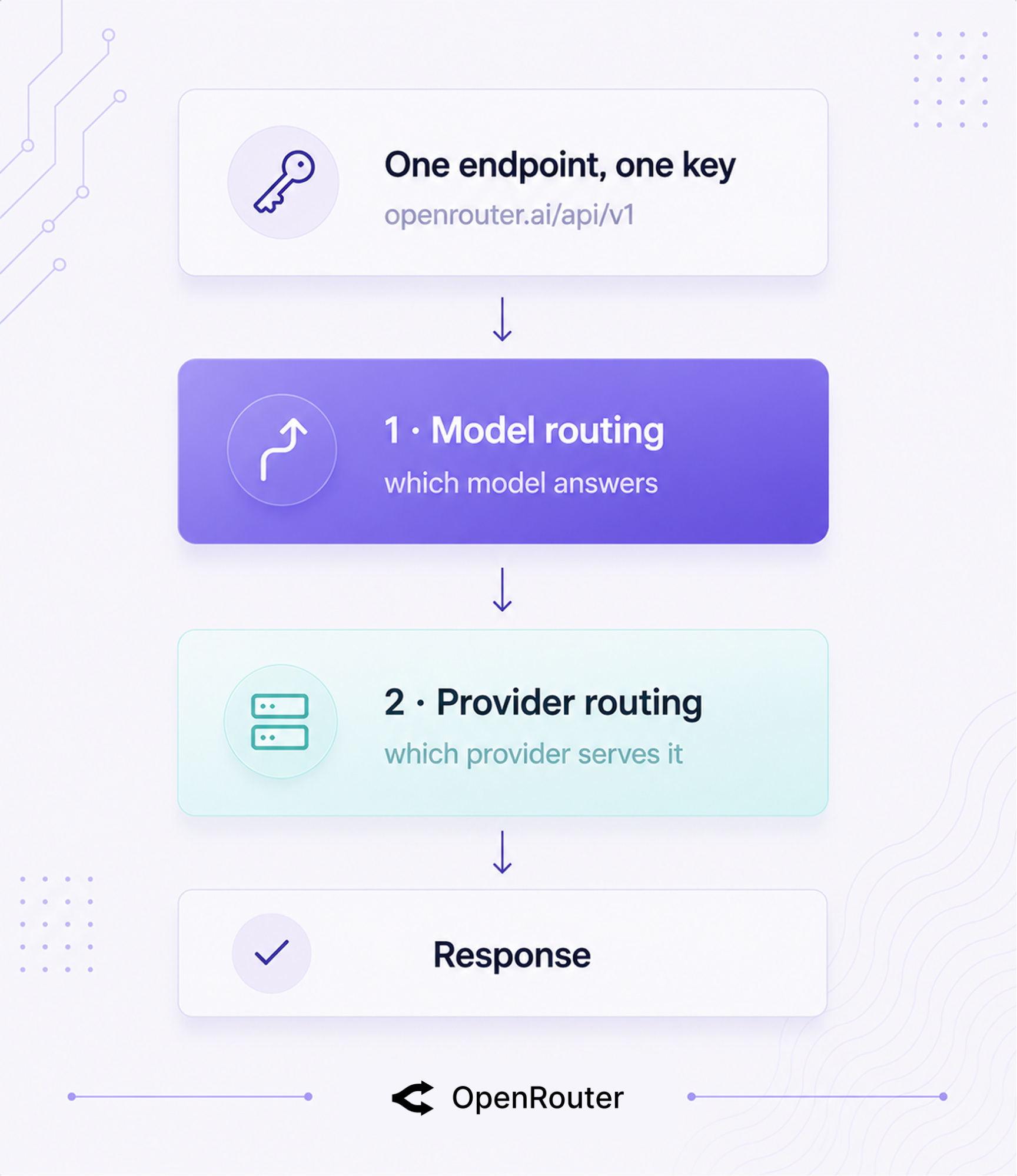
OpenRouter’s diagram separates choosing a model from choosing the provider that serves it. Source: OpenRouter routing guide.
Novita, an inference provider offering MiniMax’s AI models to direct customers and through OpenRouter, said a routing configuration caused a forwarding path intended for specific customers to apply more broadly. Some requests went to MiniMax’s official API instead of Novita-hosted infrastructure. Novita suspended the affected models.
Its privacy notice warns that contents of MiniMax requests made through Novita between May 28 and November 11, 2026, may have been accessed or retained by a third party. That warning covers direct customers and requests routed through OpenRouter.
The researcher observed access to URLs and hostnames embedded in test requests, but no use of the AWS test key markers was observed. Novita said automated review appeared to be a possible explanation and that it was verifying MiniMax’s handling of the data. It did not establish that explanation as a completed finding. Novita also said it does not itself retain prompts or generated outputs or use them for model training—a statement that leaves the downstream processing question unresolved.
Phala, which operates inference services and confidential virtual machines (CVMs), said in its preliminary report that the compromised inference deployment was on a new GPU server serving production traffic without its full production security hardening. It described an intrusion involving a legacy internet-facing service and management interfaces that trusted loopback access without independent authentication. The attacker inserted malware and obtained application credentials; secrets derived from Phala’s key management system may also have been exposed.
Phala told users whose DeepSeek V4 Flash 0731 requests were routed to it by OpenRouter between October 21 at 00:00 UTC and November 8 at 05:35 UTC to treat their contents as exposed. Canary evidence confirmed exposure of requests sent on October 21–22, but Phala said sampling could not bound the attacker’s access to those two days.
Phala detected unauthorized activity on November 5, completed a key-management root-key rotation on November 6 and took the compromised inference deployment offline on November 8 after receiving researcher evidence. It said containment was complete that morning and the model service had since been restored with additional protections. Its timeline lists the latest observed misuse of previously obtained data on November 9—distinct from fresh access to its systems.
The company also confirmed misuse of stolen credentials belonging to one CVM tenant, whom it contacted directly. It said it found no evidence of compromise affecting other models or products in a platform audit. Its investigation and comprehensive remediation verification remain in progress.
Together AI, whose serverless inference service runs customer requests against AI models, said an unauthorized party downloaded prompt samples stored in a private Hugging Face repository after an access credential appeared in public code.
Together said in its incident notice that the samples were authorized for routine software testing and came from MiniMax M3, GLM-5.2 and Kimi K2.6 requests, primarily on June 24, July 4, July 8 and July 14, 2026. An AI coding agent committed the credential during development of Together’s public xorl repository. Automated scanning detected it and the commit was reverted, but the credential was used during the exposure window.
The downloader searched the samples for other credentials and tested them; five tested credentials were canaries associated with the Dragos experiment. Together said it had no reason to believe the data had been leaked further and understood it had been deleted. Those are the company’s assessments, rather than an independently established limit on dissemination.
Together said it was working with an external forensic firm and law enforcement and had found no evidence of additional prompt leakage beyond this incident. Its review of sensitive information and affected customers remains open. It has made ZDR the default for new accounts, strengthened credential checks and changed development processes governing AI coding agents.
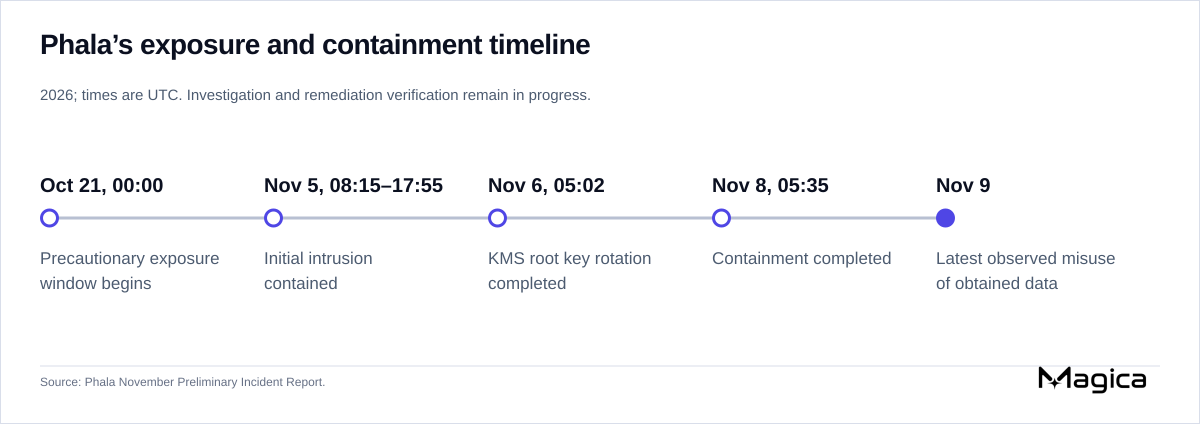
Phala’s company-reported timeline distinguishes containment from later misuse of previously obtained data. Times are UTC; investigation remains ongoing. Source: Phala.
Customers already have alternatives to automatic provider selection. OpenRouter’s guide describes pinning approved providers and disabling fallback to others. Dragos recommends direct provider contracts to reduce intermediary exposure, while warning that direct providers can still suffer breaches or share data. Self-hosting gives customers more control over who processes prompts, but requires them to supply the computing infrastructure. None of those options makes a privacy setting proof of secure execution.
OpenRouter said it is adapting the researchers’ tests for ongoing checks and technically verifying network paths to detect third-party forwarding. Restoring removed endpoints’ ZDR eligibility will require assurances and validation.
The public record remains incomplete. OpenRouter said not all affected providers have published notices, and its announcement does not identify which three it removed. The three linked notices should not be treated as that list. Nor does the announcement provide the total endpoint population needed to calculate the share losing eligibility.
Novita is checking processing paths, seeking clarity on retained data and deletion, and improving Partner API labeling and policy disclosures. Phala plans a full root cause analysis after its investigation and verification work. Together is still reviewing exposed contents to determine customer-specific notifications.
For customers, the notices make the immediate task concrete: Novita recommends rotating live credentials or secrets included in affected requests; Phala gives the same instruction for its stated exposure window. Together advises customers handling sensitive prompts to enable ZDR in account settings. The unresolved test for the providers and OpenRouter is whether their next verification establishes where requests went, what was retained and which customers need further action.
Employee equity at Anthropic’s IPO price is reportedly worth $232 billion, while book rightsholders await a first settlement installment estimated at $2,203.56 per work. Vesting, shared copyrights and founder voting rights complicate the comparison.
Moore Threads is preparing a December 29 reveal for Lushan, a desktop GPU pitched at gaming and local AI inference. Its claimed memory record remains unquantified, and capacity alone will not establish performance or value.

Amazon is in advanced talks to buy Decart, whose software helps AI models run efficiently across chips. The reported deal could strengthen AWS’s Trainium business, with conditional payments and five-year founder commitments making execution central to its value.
The University of California is expanding ChatGPT and Codex access across 10 campuses, with extra charges for advanced models and an unresolved dispute over faculty authority.
Ray-Ban’s US store cuts the Gen 2 Wayfarer by 25% to $284.25. Buyers still face separate prescription-lens prices, a cheaper Gen 1 option and newer glasses outside Meta’s frame sale.
Ubisoft has made the team behind its Teammates experiment a dedicated subsidiary targeting AI characters with memory and outside game creators. Earlier playtests show both progress and limitations, while commercial plans remain undisclosed amid group cost cuts and refinancing.
Neuralink has shown a trial participant controlling GTA VI through intended movements. Earlier gaming use and company-reported trial results put the demonstration in context, while its reliability across users remains unmeasured in the reports.
SoftBank founder Masayoshi Son reportedly explored financing a $1 trillion acquisition of memory-chip maker SK hynix, but the company says the deal is no longer under active consideration. The target brings surging earnings, existing shareholders and customer commitments that complicate any simple equation between ownership and access to AI-memory supply.
Nvidia reported $115.8 billion in quarterly revenue, but its shares fell 14% Friday amid a wider technology selloff, a leadership transition and a reported accounting investigation. Strong cash generation offers a counterweight to concerns about the durability of AI spending.
The Nasdaq 100 fell 5.6% on November 20 and closed 19.8% below its record after an intraday bear-market breach. Nvidia’s revenue surge and Anthropic’s huge IPO did not halt the rout; infrastructure bills and resilience elsewhere in the market complicate the picture.
Together AI says an intruder downloaded stored samples of June and July API prompts and searched them for credentials. Zero data retention is now the default for new accounts, but the number of affected customers remains undisclosed.
Users describe grief and physical distress when AI relationships end, whether they choose to leave or the service changes. Research on attachment and farewell tactics raises questions about how providers measure engagement, manage updates and protect intimate data.
UN-backed talks agreed on two more years of work toward an autonomous-weapons instrument, without committing to a treaty. Consensus kept major military powers involved while allowing opponents to weaken the mandate.
Tesla is sending FSD v15 to its first customers, adding a visualization of planned driving and changes to navigation and hazard detection. The software remains supervised, and its claimed 25-fold intervention improvement lacks a disclosed baseline.
OpenAI reports sharply lower reasoning-extraction rates in internal GPT-6.2 tests and backs sanctions against illicit foreign distillation. Its own research and rival Anthropic’s experience show why protecting hidden reasoning leaves capability transfer and customer costs unresolved.
Alberta proposes 600-metre setbacks for large data centres and expanded utility oversight, but exemptions and rules still to be written will determine how much protection communities receive.
President Donald Trump backed Commerce Secretary Howard Lutnick as lawmakers scrutinize alleged delays in restricting a suspected route for AI chips to China. A new congressional inquiry also questions Nvidia’s influence on an existing investigation.

Amazon’s month-old Echo Time is $50 off for Black Friday. Its touchscreen, home hub and optional sleep-aware alarm cost $90 more than the reported Echo Spot price, while Alexa+ access and evidence of better waking remain key buying questions.
Merck will pair its experimental data with Isomorphic Labs’ AI to seek small-molecule cancer drug candidates. The deal follows Isomorphic’s $5 billion financing, but its payments, target and development timetable remain undisclosed.
Thinking Machines Lab released a roughly 20GB open-weights model that reuses its middle layers for reasoning. It brings the Inkling family to local hardware, with competitive coding results but workload-dependent costs and preliminary evidence on oversight.