Editorial Team
5 min read
Together AI says an intruder downloaded stored samples of June and July API prompts and searched them for credentials. Zero data retention is now the default for new accounts, but the number of affected customers remains undisclosed.
Together AI, a cloud provider for running and customizing open-source AI models, disclosed on November 21, 2026, that an unauthorized party downloaded customer prompt samples collected for software testing. The party then searched those prompts for credentials to other services and tested whether they worked, according to its security notice.
The incident links two controls that customers depend on: how a provider protects access to its systems and whether it keeps copies of their requests. Together says its scanner detected the exposed credential and it reverted the commit, but the download occurred during the exposure window. Detection did not prevent access to the retained data.
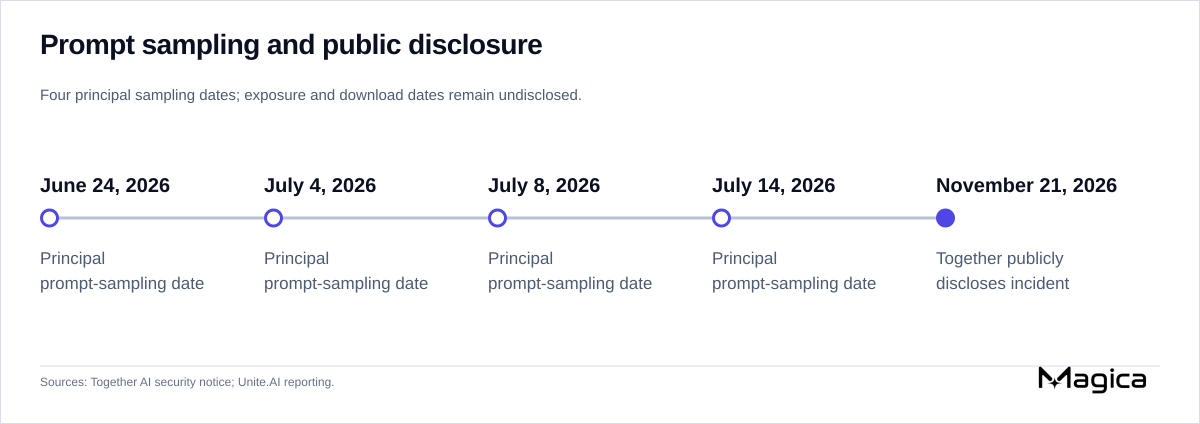
Company-reported sampling dates and the November 21 disclosure. Exposure and download dates remain undisclosed. Markers show sequence, not elapsed time. Source: Unite.AI.
In its security notice, Together says it collected prompts authorized for routine software testing and stored the samples in a private Hugging Face repository. The prompts came from requests to MiniMax M3, GLM-5.2 and Kimi K2.6 on its serverless inference service, which runs models in response to customers’ API requests.
The samples were primarily from June 24, July 4, July 8 and July 14, 2026. Those are dates of sampled requests, not a disclosed timeline for the credential exposure or download.
During development of xorl, Together’s public GitHub repository, an AI coding agent committed a credential granting access to the private sample store. A report on the disclosure identifies xorl as the company’s distributed training framework for large language models. The compromised material, however, was stored inference prompts; the notice does not describe a theft of model training data or a flaw in the three named models.
Together does not identify the coding agent or the unauthorized party. Its account establishes that a secret crossed from a private data workflow into public code, but does not explain what review preceded the commit or how long the secret remained exposed.
Together says five of the credentials the party tested were canary credentials associated with an experiment by cybersecurity company Dragos. Canary credentials are decoys used to reveal access when someone tries to use them. The figure is a count of tested decoys, not a count of affected customers, stolen prompts or working customer secrets.
In its November 19 account of the experiment, Dragos said it submitted approximately two million prompts containing trackable URLs and credentials to AI services from July through November 2026. It reported evidence that data from at least three providers had been exposed. That is the experiment’s scope across services, not Together’s breach count. The study did not name Together, and Together’s notice does not establish whether it was one of those three providers.
The subsequent credential searches create a risk beyond disclosure of the prompt text: a retained request containing a usable secret can provide a route into another service. The disclosure does not establish how many real credentials were present or whether any were successfully used.
Together says it worked with an external forensic investigation firm and law enforcement. It reports no evidence of additional prompt leakage beyond this incident, no reason to believe the downloaded data was leaked further, and an understanding that it has now been deleted. Those are company assessments; the notice supplies no independent confirmation of deletion.
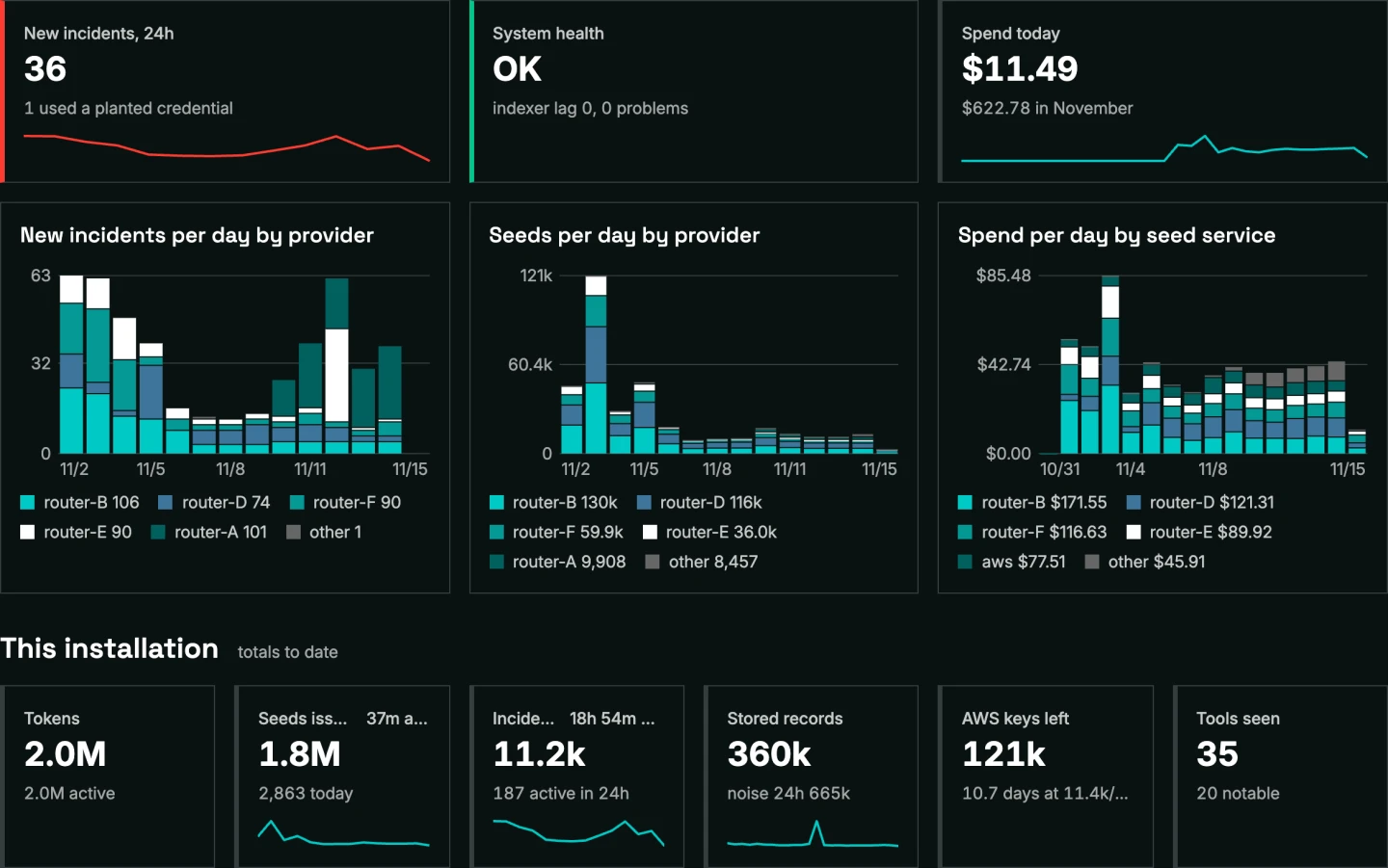
Dragos’s canary-monitoring console. These company-reported research totals cover its broader experiment, not Together’s incident; the study does not name Together. Source: Dragos.
Together says it has introduced scoped or short-lived credentials, keyless access where supported, credential checks on all pull requests, and changes to development processes governing AI coding agents. A separate account of the incident also details those measures and the continuing customer-data review.
The company has made zero data retention, or ZDR, the default for new accounts. Its instruction to customers handling sensitive prompts is to enable ZDR in account settings. The notice does not say that existing accounts were all switched over.
There is a functional tradeoff. The report on the disclosure, citing Together’s documentation, says that ZDR applies to requests sent after it is enabled, and that disabling prompt storage also disables passthrough models, which forward requests to a third-party provider. Enabling it is therefore a change to future handling, rather than evidence that previously retained samples have been removed.
Together’s business extends beyond the affected serverless service. In its February 20, 2025 funding announcement, it described a cloud offering inference, model training and fine-tuning, and announced a $305 million Series B led by General Catalyst and co-led by Prosperity7. On July 1, 2026, it announced an $800 million Series C.
That financing history puts the disclosure in the context of an established infrastructure supplier selling to developers and enterprises. It does not establish how many customers were affected.
Together says it is still examining the samples to determine whether sensitive personal information or other customer data was exposed, and will contact affected customers directly as needed. It directs incident questions to [email protected].
The next consequential findings are the number of prompts and customers involved, what sensitive material they contained, and the timing of exposure, discovery and notification. Until those are disclosed, the four principal sampling dates and the five tested canaries cannot establish the scale of customer harm.
OpenRouter disclosed provider removals after investigations into inference data handling. Separate notices describe forwarded requests, a compromised deployment and stolen prompt samples, exposing different weaknesses behind privacy assurances.
Employee equity at Anthropic’s IPO price is reportedly worth $232 billion, while book rightsholders await a first settlement installment estimated at $2,203.56 per work. Vesting, shared copyrights and founder voting rights complicate the comparison.
Moore Threads is preparing a December 29 reveal for Lushan, a desktop GPU pitched at gaming and local AI inference. Its claimed memory record remains unquantified, and capacity alone will not establish performance or value.

Amazon is in advanced talks to buy Decart, whose software helps AI models run efficiently across chips. The reported deal could strengthen AWS’s Trainium business, with conditional payments and five-year founder commitments making execution central to its value.
The University of California is expanding ChatGPT and Codex access across 10 campuses, with extra charges for advanced models and an unresolved dispute over faculty authority.
Ray-Ban’s US store cuts the Gen 2 Wayfarer by 25% to $284.25. Buyers still face separate prescription-lens prices, a cheaper Gen 1 option and newer glasses outside Meta’s frame sale.
Ubisoft has made the team behind its Teammates experiment a dedicated subsidiary targeting AI characters with memory and outside game creators. Earlier playtests show both progress and limitations, while commercial plans remain undisclosed amid group cost cuts and refinancing.
Neuralink has shown a trial participant controlling GTA VI through intended movements. Earlier gaming use and company-reported trial results put the demonstration in context, while its reliability across users remains unmeasured in the reports.
SoftBank founder Masayoshi Son reportedly explored financing a $1 trillion acquisition of memory-chip maker SK hynix, but the company says the deal is no longer under active consideration. The target brings surging earnings, existing shareholders and customer commitments that complicate any simple equation between ownership and access to AI-memory supply.
Nvidia reported $115.8 billion in quarterly revenue, but its shares fell 14% Friday amid a wider technology selloff, a leadership transition and a reported accounting investigation. Strong cash generation offers a counterweight to concerns about the durability of AI spending.
The Nasdaq 100 fell 5.6% on November 20 and closed 19.8% below its record after an intraday bear-market breach. Nvidia’s revenue surge and Anthropic’s huge IPO did not halt the rout; infrastructure bills and resilience elsewhere in the market complicate the picture.
Users describe grief and physical distress when AI relationships end, whether they choose to leave or the service changes. Research on attachment and farewell tactics raises questions about how providers measure engagement, manage updates and protect intimate data.
UN-backed talks agreed on two more years of work toward an autonomous-weapons instrument, without committing to a treaty. Consensus kept major military powers involved while allowing opponents to weaken the mandate.
Tesla is sending FSD v15 to its first customers, adding a visualization of planned driving and changes to navigation and hazard detection. The software remains supervised, and its claimed 25-fold intervention improvement lacks a disclosed baseline.
OpenAI reports sharply lower reasoning-extraction rates in internal GPT-6.2 tests and backs sanctions against illicit foreign distillation. Its own research and rival Anthropic’s experience show why protecting hidden reasoning leaves capability transfer and customer costs unresolved.
Alberta proposes 600-metre setbacks for large data centres and expanded utility oversight, but exemptions and rules still to be written will determine how much protection communities receive.
President Donald Trump backed Commerce Secretary Howard Lutnick as lawmakers scrutinize alleged delays in restricting a suspected route for AI chips to China. A new congressional inquiry also questions Nvidia’s influence on an existing investigation.

Amazon’s month-old Echo Time is $50 off for Black Friday. Its touchscreen, home hub and optional sleep-aware alarm cost $90 more than the reported Echo Spot price, while Alexa+ access and evidence of better waking remain key buying questions.
Merck will pair its experimental data with Isomorphic Labs’ AI to seek small-molecule cancer drug candidates. The deal follows Isomorphic’s $5 billion financing, but its payments, target and development timetable remain undisclosed.
Thinking Machines Lab released a roughly 20GB open-weights model that reuses its middle layers for reasoning. It brings the Inkling family to local hardware, with competitive coding results but workload-dependent costs and preliminary evidence on oversight.