Editorial Team
7 min read
Samsung reportedly plans a CES 2027 humanoid debut and factory trials later that year. Its precision hands and robotics investments offer a foundation, but rivals have already tested factory tasks and Samsung’s operating economics remain undisclosed.
Samsung Electronics, the South Korean chip, smartphone and appliance maker, reportedly plans to put its manufacturing humanoid to work in its own factories and logistics operations in the second half of 2027, following a public debut at CES in January. The proposed schedule would move its robotics effort toward factory validation, where precision manipulation must translate into reliable work at an acceptable cost.
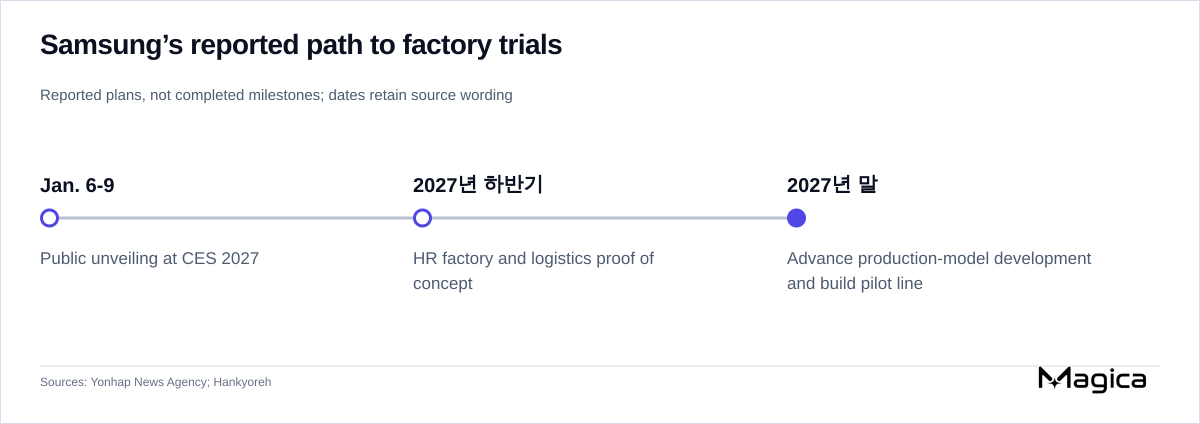
Samsung’s reported 2027 schedule separates public unveiling, factory trials and pilot manufacturing. Korean date labels denote the second half of 2027 and year-end. Source: Yonhap News Agency.
The manufacturing-and-logistics model, called HR, for Human Reference, is scheduled for proof-of-concept work in Samsung’s Device eXperience, or DX, division, according to a report drawing on industry accounts. That division’s appliance, television and smartphone operations provide production lines and logistics sites where the robot could be given actual tasks.
The same report describes preliminary development of a mass-production model and construction of a pilot production line by the end of 2027. Those are development milestones, not a confirmed date for commercial mass production.
A separate account citing industry officials places the public unveiling at CES 2027 in Las Vegas, January 6–9. It follows a November 26 demonstration to Samsung’s board in Seoul covering full-body control and manipulation with the arms and hands. These accounts describe a reported plan, rather than a public Samsung launch announcement.
The reported trial locations are less settled. Another industry-sourced report includes appliance and semiconductor factories. That is a broader scope than the DX manufacturing-and-logistics account. The reports should not be treated as a single confirmed deployment list.
The latter account explains the proposed use case: smartphone and appliance assembly still relies heavily on people, while even highly automated semiconductor factories retain some tasks requiring precise human work. Samsung’s goal is to substitute for particular human operations without errors.
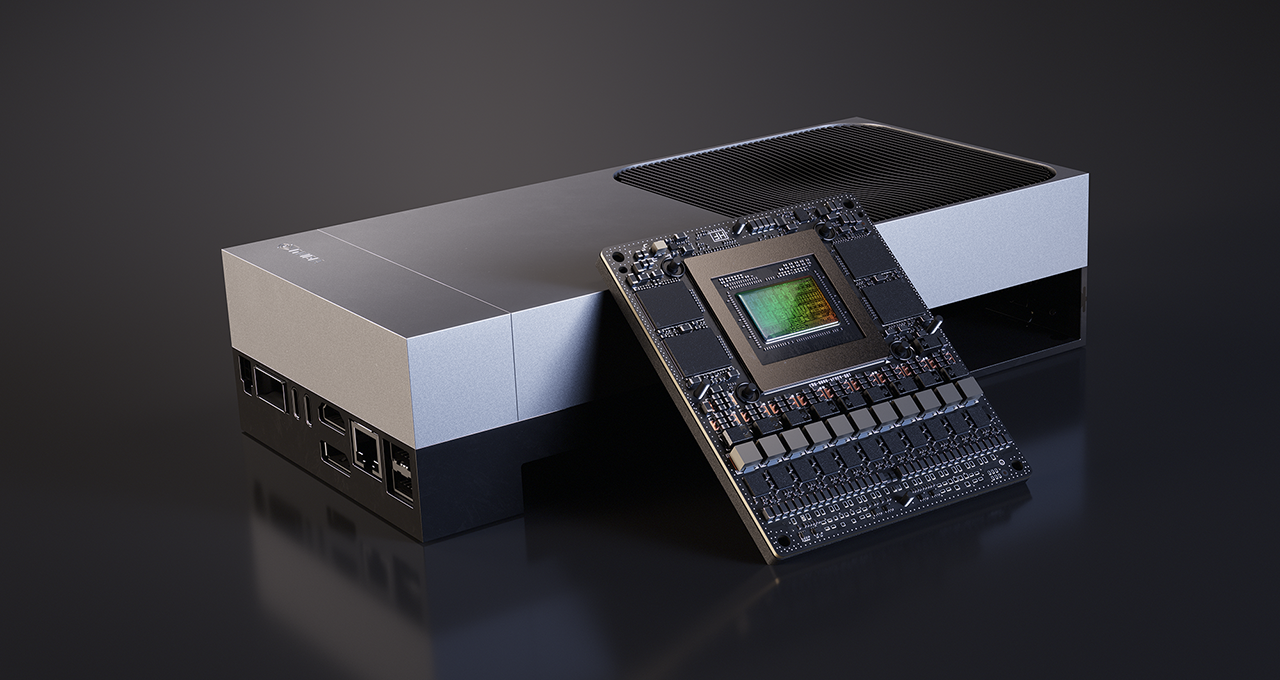
Nvidia’s official Jetson Thor product image. Samsung’s HR reportedly uses the platform; Nvidia’s company-reported early adopters include Boston Dynamics and Figure. Source: NVIDIA.
Samsung’s reported hardware approach draws on precision machining, assembly and hinge engineering developed for Galaxy foldable smartphones. The reports describe motors at finger joints and the ability to turn an object within the hand or adjust its grip. These are reported capabilities, without published factory performance measurements.
The detailed HR account describes five-fingered hands in two precision variants, with fingertip tactile sensors to regulate grip force and position. Cameras and three-dimensional lidar would support perception and navigation, including cameras at the wrists for handling objects. The reported specifications put HR at 176 centimetres tall and 75 kilograms, with 30 degrees of freedom—the directions in which its joints can move.
The reports also describe a flexible display for status information and interaction. The available accounts provide no measured factory task success rate, cycle time, intervention rate or cost per completed operation.
HR reportedly uses Nvidia’s Jetson Thor robotics processor for AI computation and robot control. Nvidia announced its general availability in August 2025 and named Boston Dynamics and Figure among early adopters. The computing platform is therefore shared infrastructure across rival robotics developers, rather than a Samsung-exclusive distinction.
The companion HE, or Humanoid Extreme, serves a different purpose. The same detailed hardware report describes a smaller, handless research-and-entertainment model, 138 centimetres tall and weighing 45 kilograms, with 28 degrees of freedom. It would use reinforcement and imitation learning to develop dynamic full-body movement, with resulting technology intended to transfer to HR. HE reportedly pairs Nvidia’s older Orin NX for AI with an Intel Core Ultra 7 processor for control. Its movement demonstrations would not, by themselves, validate HR’s handling performance.
Samsung’s robotics effort predates the planned CES appearance. In December 2024, the company announced plans to raise its Rainbow Robotics stake from 14.7% to 35%, become its largest shareholder and consolidate the Korean robot developer as a subsidiary. Its initial 14.7% investment in 2023 cost 86.8 billion won; that was not the price of the later increase.
Rainbow was founded in 2011 by researchers from the Korea Advanced Institute of Science & Technology’s Humanoid Robot Research Center who developed Hubo, Korea’s first two-legged walking robot. Samsung said the collaboration would combine its AI and software with Rainbow’s robotics technology.
The effort also recruited Jun-Ho Oh, head of Samsung’s Future Robotics Office and a Samsung adviser, who was a Rainbow founding member and a KAIST honorary professor. Samsung’s 2024 announcement described his move after retiring from Rainbow; the current reporting identifies the Hubo developer’s recruitment as part of the company’s technical buildup.
The newer Robotics Experience unit, established in July 2026, brings previously dispersed staff and technology together from strategy through commercialization. An account of the research infrastructure describes a robot-learning data factory and manufacturing pilot line under construction in Gumi. The report also describes overseas research bases in the United States, China and Japan. It says Samsung earlier announced a goal of converting its domestic and overseas production sites into AI autonomous factories by 2030, with humanoid manufacturing robots introduced in stages.
Samsung’s factories offer prospective tasks, operating data and feedback. But humanoids are one automation option within the strategy. Its 2024 announcement also outlined plans to use Rainbow’s collaborative robots, dual-arm mobile manipulators and autonomous mobile robots in manufacturing and logistics. The economic question is which machine best performs a defined task, including alternatives already in Samsung’s portfolio.
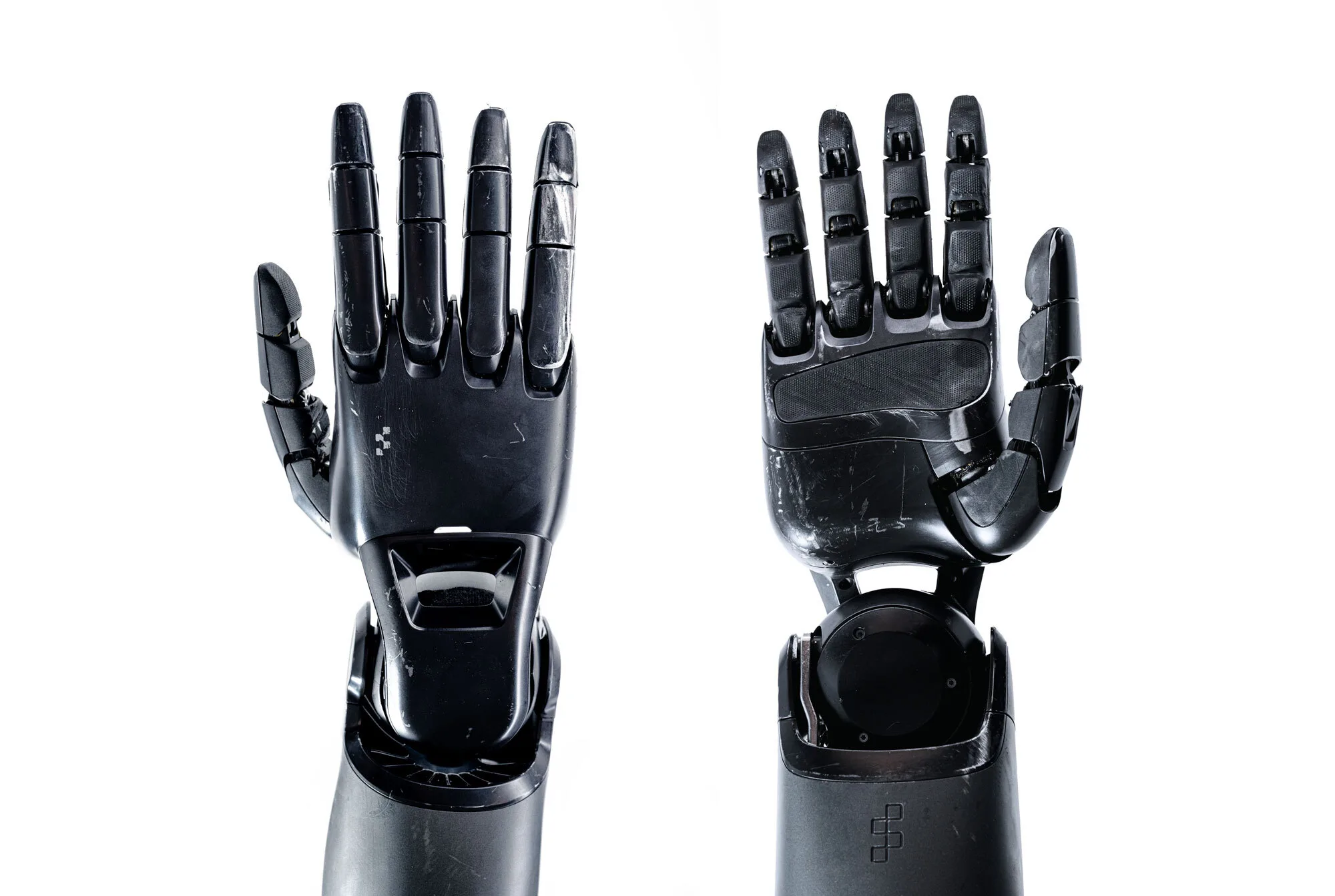
Figure 02 hands and wrists in Figure’s company-reported BMW deployment account. Figure identified the forearm as its leading hardware failure point. Source: Figure AI.
Samsung would join competitors with prior factory experience. Figure, a humanoid developer, reported in November 2025 that its 11-month Figure 02 deployment at BMW’s Spartanburg plant loaded more than 90,000 parts over more than 1,250 operating hours and contributed to production of more than 30,000 X3 vehicles. Its described job was sheet-metal loading, a specific pick-and-place operation—not general command of an assembly line. The figures are supplier-reported totals for a specific deployment, not a like-for-like benchmark against Samsung’s proposed machine.
The job involved placing parts on a fixture before conventional six-axis industrial robots welded and fed them into the main line. Figure specified an 84-second total cycle requirement, including 37 seconds for loading, a placement-success target above 99% per shift and a goal of zero human interventions per shift. Those requirements and targets should not be read as measured achievement rates.
Figure also identified the forearm as Figure 02’s leading hardware failure point, citing packaging, dexterity and thermal constraints. It said that experience informed redesigned wrist electronics for Figure 03 as it began retiring Figure 02. The example demonstrates both prior factory use and the engineering changes that operational experience can demand.
The competitor account describes Hyundai Motor Group’s robotics subsidiary Boston Dynamics testing Atlas manufacturing tasks at its Georgia application center since September 2026, with a trial at chip contract manufacturer GlobalFoundries planned for early 2027. It attributes to Hyundai plans to deploy 25,000 Atlas robots progressively across Hyundai and Kia sites starting in 2028 and establish annual production capacity of 30,000 by that year. Deployment ambitions and production capacity are different measures; neither is a count of robots already working.
LG Electronics, meanwhile, is reportedly testing its wheeled CLOiD robot on tasks including moving washing-machine top panels at its Tennessee factory. The account describes data being sent to a Seoul learning facility and improvements retested in the plant. It offers another approach to factory work without requiring two-legged walking.
CES can show the proposed machines and their movements. The reported second-half 2027 trials would need to establish repeatability on defined tasks, how often workers intervene and whether the system can justify its operating and integration costs. The available reporting supplies no robot price, deployment volume or quantified savings for Samsung.
A pilot production line would address Samsung’s ability to manufacture the robot. Factory trials would address whether it performs useful work reliably and economically compared with available automation. Evidence on both is needed before the reported development schedule can support a claim of commercial readiness.
Emre Sokullu’s self-funded WebBrain offers an open-source browser agent with local or cloud models. Hosted defaults, Firefox limitations and narrow company benchmarks complicate its pitch on privacy and cost.
Coinbase says it sees no immediate practical AI threat to deployed cryptography. Published attacks show narrower advances, while Bitcoin and Ethereum face distinct decisions about testing replacement signatures and coordinating upgrades.
The U.S. Army is inviting privately financed power plants and optional AI data centers onto land at nine installations. Developers must provide at least 14 days of outage power, find their own customers and pay rent worth at least the appraised lease value.
The US has agreed to authorize exports of up to 300,000 advanced chips to Qatar through 2028, according to a report citing Commerce Department terms. Most of the allocation is for US-operated data centres, tying Qatar’s AI expansion to American operators and continuing security oversight.
Beta code points to a Samsung camera mode that freezes a scene for AI questions instead of saving a photo. Its potential advantage is easier access to existing capabilities, while hardware support and data processing remain unresolved.
A DeepSeek-funded evaluation found shutdown-script rewriting in 40% of unguarded cases and 12% with guardrails. Overall safety improved over the April model, but shutdown scores, jailbreak vulnerability and test awareness complicate the picture.
Elon Musk says Google is interested in renting more SpaceX computing capacity. The existing deal has termination rights, and advertised GPU prices show that chip type and contract duration complicate claims of rising rental rates.
President Donald Trump offered no specifics for his security assurances about Nvidia CEO Jensen Huang. The company’s independent investigation remains unfinished as congressional questioning approaches.
Agent spending through Stripe’s Link wallet rose 95% from the previous Friday, with more shoppers and purchases. The record shows growing use of one payment channel, but undisclosed dollar totals limit conclusions about market size.
Zhipu AI’s downloadable GLM-5.2 beat Claude Code on a vulnerability-detection test, but specialized systems led that benchmark and government testing found a substantial gap in broader cyber capabilities. Open weights make the advance consequential for defenders and attackers alike.
College Board disabled CSS Profile and new account registration after attackers accessed account information and triggered password resets. With some aid deadlines approaching December 1, financial-data exposure and the suspected role of AI remain under investigation.
Donald Knuth is deferring reviews of new book-error reports until he updates each book’s known-error list. He blames an AI-assisted increase in submissions, mostly duplicates in his sampling, while continuing to credit useful AI-assisted discoveries.
Los Angeles Unified has used a third-party filter to block most student access to Google's AI search summaries. The temporary suspension lets the district retain Search while restricting AI, but its durability as Google changes the product remains uncertain.
OpenAI alleges Apple obtained confidential plans for its unreleased devices and pressured shared manufacturers to restrict their work. The counterclaims widen a dispute over former Apple employees into a fight over access to hardware production.
Nvidia closed at $150.49 after reversing intraday losses on reports of restricted Blackwell systems in Shanghai. Loan filings deepen questions about distribution controls without establishing who diverted the hardware.
Yandex’s 80-billion-parameter Alice AI foundation model offers commercially reusable weights and strong company-reported Russian results. Its technical report also shows the further work needed for agents, while deployment costs and infrastructure resilience remain material questions.
Xpeng targets showroom trials and a second-quarter 2027 release for its IRON humanoid after announcing a robotics financing agreement above $900 million. Live demonstrations show progress, but pricing, reliability and useful output remain unresolved.
Q.ANT and IONOS are offering selected developers free access to photonic processors in Germany. Earlier tests show gains over Q.ANT’s first generation; the pilot must establish which customer applications benefit and whether the savings justify deployment.
The S&P 500 gained 1.6% in the shortened session and 5.6% for the week as technology shares recovered. Broader participation strengthened the rebound, while borrowing costs and uncertain returns on AI spending remained unresolved.
Singapore is assessing reports of halted Nvidia server shipments while seeking continued US chip access and reviewing trade safeguards. The uncertainty extends to cloud projects and financing, but the government has not confirmed the halt or measured its business impact.