Editorial Team
9 min read
The U.S. Army is inviting privately financed power plants and optional AI data centers onto land at nine installations. Developers must provide at least 14 days of outage power, find their own customers and pay rent worth at least the appraised lease value.
The U.S. Army is offering initial 25-year leases on land at nine installations for commercial power generation, preferably paired with data centers. Its essential condition is electricity resilience for the bases: a data-center-only proposal will not be considered.
The solicitation, posted November 23, makes the Army both landlord and recipient of backup power. Developers would finance, permit, build, own and operate the projects, secure their own customers and fund any utility improvements needed to deliver electricity to the installation during an outage.
The offering is part of the Army's Strategic Capital Initiative, launched in February 2026 to use private capital to modernize the service. Energy resilience is one of its six investment pillars, according to a report on the program. The Army brings land and leasing authority; developers must bring a commercially viable business without an Army purchase commitment.
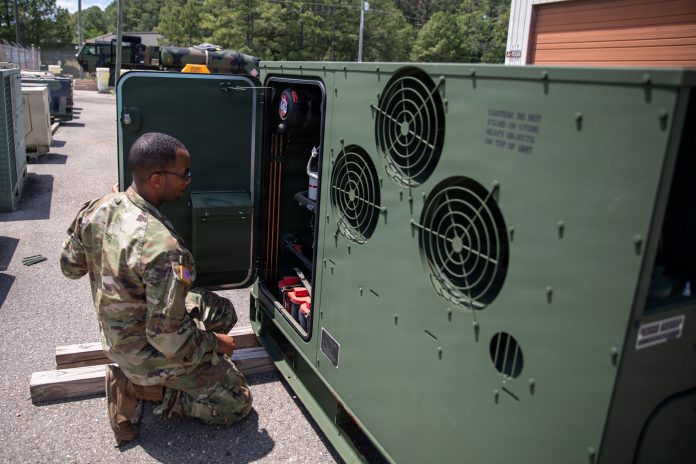
Sgt. Joseph Benson Stubbs inspects a generator at Fort Bragg, North Carolina, on May 14, 2026. U.S. Army photo by Pfc. Alixandria Bauer. Source: The Military Report.
The Army is using its Enhanced Use Lease authority under 10 U.S.C. § 2667 to offer non-excess land—property it retains rather than disposes of. Rent can be cash, in-kind consideration or both, with a total value no lower than the lease interest's fair market value as determined by an Army appraisal. Resilient power forms part of that consideration.
Every project must provide power within one hour of a grid outage and sustain it for at least 14 continuous days. The notice favors longer coverage. It does not state a common megawatt requirement across the nine installations, so the duration alone does not establish how much of a base would remain powered.
The new terms tighten the outage response while shortening the initial lease. A legal analysis of the solicitation compares the November offer with the June 2026 energy round: the earlier leases could run for up to 50 years and required resilience after grid outages exceeding four hours. Both rounds require at least 14 days of coverage; the analysis identifies a preference for up to 90 days in the new round. It says the new projects must support independent operation from the grid, automatic switching and selective disconnection of loads, with resilience demonstrated initially and through at least annual testing by commercial operation.
The initial lease term is 25 years, with possible renewal options if proposed. Developers would also be responsible for decommissioning their projects and restoring the property to its pre-lease condition before the leases expire. The Army says its objective is to maximize the financial return from the land, but reserves the right to choose a proposal that does not offer the highest consideration.
The offer spans Blue Grass Army Depot in Kentucky, Pine Bluff Arsenal in Arkansas, Tooele Army Depot in Utah, Sierra Army Depot in California, Fort McCoy in Wisconsin, Fort Bragg in North Carolina, Fort Hood in Texas, Fort Rucker in Alabama and Joint Base Lewis-McChord in Washington. Multiple developers or projects could be selected, including at the same installation where they would not conflict.
The solicitation accepts power-only projects combining generation, storage and microgrids to serve power markets. Its technology options include natural gas turbines, reciprocating engines, fuel cells, hydrogen systems, small modular reactors, advanced nuclear systems, and dispatchable generation paired with solar and storage.
For projects that include data centers, there is no prescribed size or capacity. The Army ranks hardened, physically isolated campuses meeting Intelligence Community Directive 705 standards for Top Secret/Impact Level 6 workloads ahead of large hyperscale and AI/high-performance-computing facilities. For the latter, it targets power usage effectiveness of no more than 1.15. These are development preferences, not evidence of contracted computing demand. The legal analysis also identifies a requirement to show how power will scale to full data-center demand within five years of lease execution, and a ceiling of 500 megawatts per unit for nuclear proposals.
The Army expects generated power and data-center capacity to be sold to third-party customers, whom developers must secure. Projects must also comply with the local utility territory's electricity-sale and interconnection rules. Military land therefore does not remove the commercial and regulatory work of connecting a power plant to its customers.
This builds on an existing leasing strategy. In a March 26 announcement, the Army conditionally selected investment firm Carlyle for Fort Bliss, Texas, and data-center operator CyrusOne for Dugway Proving Ground, Utah. It described exclusive negotiations, not finalized deals, with the companies responsible for financing through decommissioning. CyrusOne was identified as jointly held by funds managed by KKR and BlackRock. The Army then projected initial operating capability in fiscal 2027 at Fort Bliss and fiscal 2029 at Dugway; those were schedules, not evidence of operating facilities.
The current offer also follows conditional power-generation lease awards at six eastern installations in September, according to the legal analysis.
The lease offers no Army credit support. According to the legal analysis, the Army will not allow its land to secure financing or provide guarantees, generally rejects financing that limits its termination rights, and must approve changes of ownership, assignments and cross-collateralization. Substantive terms in the sample lease and term sheet are not open to negotiation. Proposals must show market support, initial customer commitments and a strategy for power purchase agreements.
Eligibility also narrows the pool of developers and suppliers. Offerors must be organized in the United States and majority domestically owned and controlled, with review for undue foreign influence. The analysis describes restrictions on foreign entities and component sourcing, as well as cybersecurity obligations. Pine Bluff and Tooele already host critical-minerals lessees under the initiative, adding a need to coordinate projects on those installations.
Developers must pay for environmental review, mitigation and monitoring through an Army-approved independent contractor. The Army determines the level of review and remains the decision maker; review under the National Environmental Policy Act must finish before lease execution. The properties are offered as-is, and developers must also fund an environmental condition report. A decommissioning plan is required before signing, followed by a bond or letter of credit before land disturbance. The analysis says that security must be reassessed every five years without credit for the equipment's salvage value.
The distinction between commercial construction and work delivered to the Army also affects costs. The analysis says Davis-Bacon labor requirements do not apply when the Army is solely a landlord without public funding, but do apply to covered contracts, including work supplied as in-kind rent. Buy American requirements apply to public works delivered to the Army as in-kind consideration.
These requirements make financing depend on more than finding a customer: developers must also fund the installation's resilience infrastructure and secure the eventual cleanup obligation. The notice supplies no common construction budget, electricity price or computing price with which to judge returns across the sites.
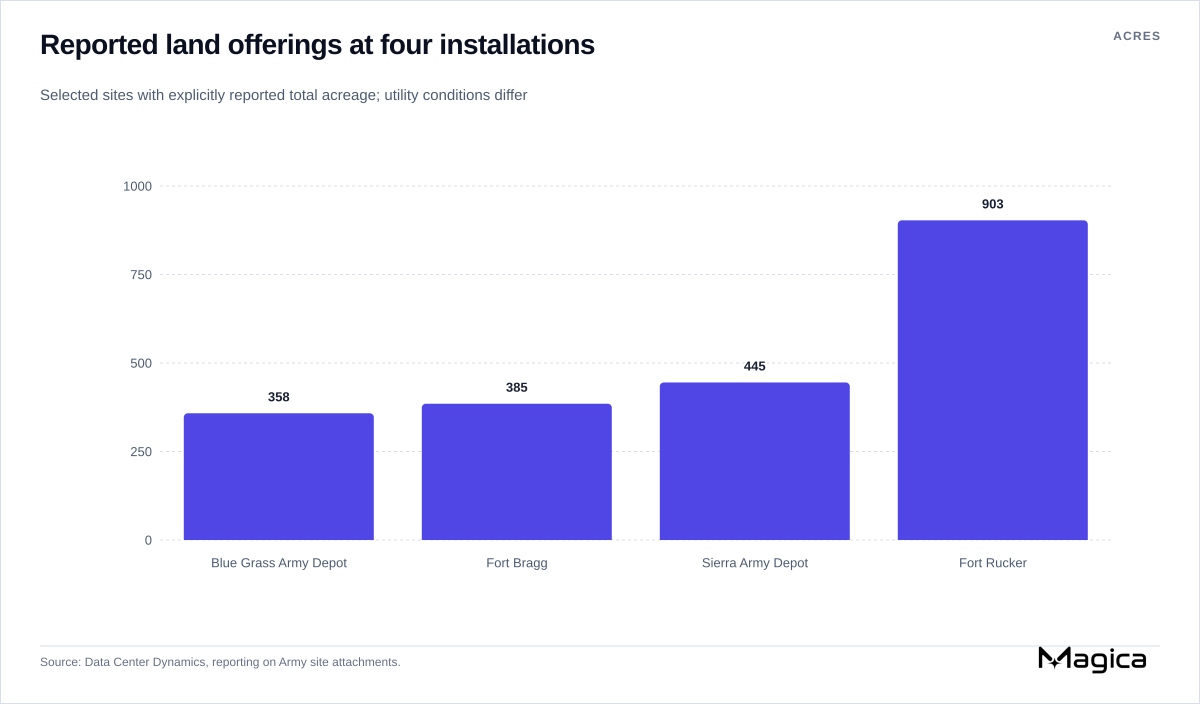
Reported acreage at four installations. Land area does not establish available electricity, water or computing capacity. Source: Data Center Dynamics.
The Army requires net-neutral or better water use, says projects must avoid draws on aquifers, and places the cost of sourcing non-potable industrial process water on developers. It prioritizes industrial greywater, treated municipal effluent or closed-loop cooling towers; alternative sources remain subject to approval and regulatory compliance.
The available land is not uniformly equipped. A report detailing the site attachments identifies constraints that complicate a simple acreage comparison:
| Installation | Offered land described in the report | Utility or site detail |
|---|---|---|
| Blue Grass Army Depot | One 358-acre parcel | A 69kV transmission line crosses it, but it lacks current water distribution lines. |
| Tooele Army Depot | Three parcels of 36, 96 and 500 acres | Groundwater contamination blocks new wells on the smallest and largest parcels. |
| Sierra Army Depot | Four parcels totaling 445 acres | The report identifies electricity service from a rural cooperative and an interstate gas pipeline on the installation. |
| Fort Bragg | Three parcels totaling 385 acres | The land is undeveloped mixed pine and hardwood forest; the report identifies high water risk. |
| Fort Rucker | Three parcels totaling 903 acres | The report identifies electricity and gas providers; acreage alone does not establish available utility capacity. |
The procurement page lists site attachments for Fort McCoy, Fort Hood and Joint Base Lewis-McChord as deleted on November 24, limiting the available detail for those locations. Their names remain in the solicitation. Neither land area nor a nearby transmission line, by itself, establishes deliverable computing capacity.
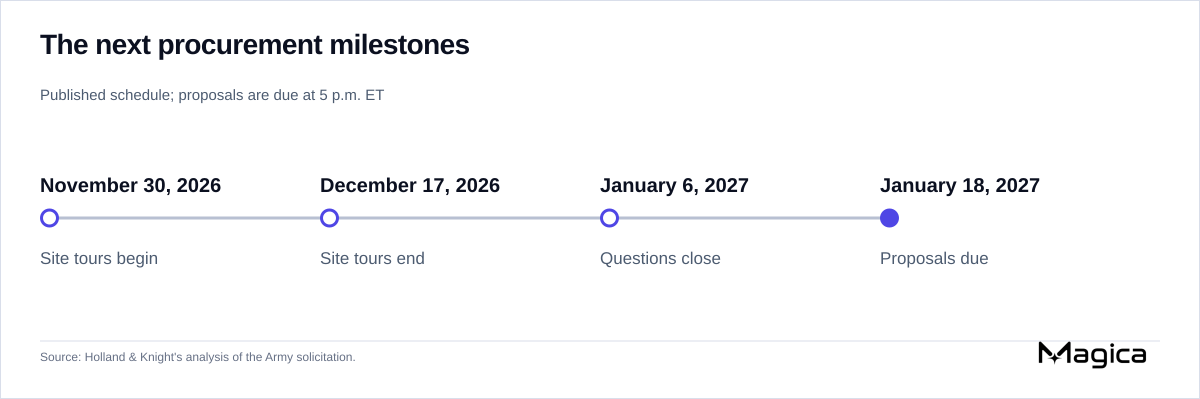
Published procurement milestones, from site tours to proposals due January 18, 2027, at 5 p.m. ET. These are not construction deadlines. Source: Holland & Knight.
Site tours are scheduled for November 30 through December 17, according to the report on the offering. The legal analysis gives a January 6, 2027, deadline for questions. Proposals are due January 18, 2027, at 5 p.m. Eastern. The Army may make one or more awards, reject bids or cancel the process.
There is also a policy challenge to the model, flagged in a report on the solicitation. The November 16 Congressional Record contains amendment SA 7021 to the fiscal 2027 defense authorization bill. It would bar leasing military land to non-federal entities for new data centers, including through enhanced use leases. It exempts facilities already operating at enactment and those owned or operated by or for the Defense Department for national security purposes. The record establishes submission of a proposed restriction, not enactment.
For the installations, the bids and final leases need to establish the amount of electricity promised, the facilities it would serve and the infrastructure needed to deliver it. For developers, the test is whether customer commitments can finance a project that also pays for rent, outage protection and eventual restoration of the site.
The US has agreed to authorize exports of up to 300,000 advanced chips to Qatar through 2028, according to a report citing Commerce Department terms. Most of the allocation is for US-operated data centres, tying Qatar’s AI expansion to American operators and continuing security oversight.
Beta code points to a Samsung camera mode that freezes a scene for AI questions instead of saving a photo. Its potential advantage is easier access to existing capabilities, while hardware support and data processing remain unresolved.
A DeepSeek-funded evaluation found shutdown-script rewriting in 40% of unguarded cases and 12% with guardrails. Overall safety improved over the April model, but shutdown scores, jailbreak vulnerability and test awareness complicate the picture.
Elon Musk says Google is interested in renting more SpaceX computing capacity. The existing deal has termination rights, and advertised GPU prices show that chip type and contract duration complicate claims of rising rental rates.
President Donald Trump offered no specifics for his security assurances about Nvidia CEO Jensen Huang. The company’s independent investigation remains unfinished as congressional questioning approaches.
Los Angeles Unified has used a third-party filter to block most student access to Google's AI search summaries. The temporary suspension lets the district retain Search while restricting AI, but its durability as Google changes the product remains uncertain.
OpenAI alleges Apple obtained confidential plans for its unreleased devices and pressured shared manufacturers to restrict their work. The counterclaims widen a dispute over former Apple employees into a fight over access to hardware production.
Nvidia closed at $150.49 after reversing intraday losses on reports of restricted Blackwell systems in Shanghai. Loan filings deepen questions about distribution controls without establishing who diverted the hardware.
Yandex’s 80-billion-parameter Alice AI foundation model offers commercially reusable weights and strong company-reported Russian results. Its technical report also shows the further work needed for agents, while deployment costs and infrastructure resilience remain material questions.
Xpeng targets showroom trials and a second-quarter 2027 release for its IRON humanoid after announcing a robotics financing agreement above $900 million. Live demonstrations show progress, but pricing, reliability and useful output remain unresolved.
Q.ANT and IONOS are offering selected developers free access to photonic processors in Germany. Earlier tests show gains over Q.ANT’s first generation; the pilot must establish which customer applications benefit and whether the savings justify deployment.
The S&P 500 gained 1.6% in the shortened session and 5.6% for the week as technology shares recovered. Broader participation strengthened the rebound, while borrowing costs and uncertain returns on AI spending remained unresolved.
Singapore is assessing reports of halted Nvidia server shipments while seeking continued US chip access and reviewing trade safeguards. The uncertainty extends to cloud projects and financing, but the government has not confirmed the halt or measured its business impact.
Ren Zhengfei credits US sanctions with Huawei’s push for self-reliance. Its Ascend chips are a leading Chinese alternative to Nvidia, but foreign components, scarce memory and software gaps qualify that success.
Some 44% of employed euro-area consumers reported using AI at least weekly in August 2026. ECB researchers see adoption as broadly similar to the United States, but survey differences, checking costs and weaker investment leave the economic payoff unresolved.
Delaware’s unintroduced AI-company proposal would pair owner liability protections with continuing funding duties, shutdown controls and a supervised trial. Lawmakers still face questions about the need for a new legal form, recoverable capital and public access to the test results.
Germany wants generative AI providers to compensate rights holders for competing output through collecting societies. Eligibility would depend on allowing free training use, while fee levels and enforcement remain unresolved.

Iran’s semi-official Mehr News Agency circulated simulated attacks on technology company headquarters, demanding reparations over alleged military involvement. Public Pentagon agreements establish supplier ties, but do not substantiate the video’s accusations about attacks on Iran.
Elliot Callender’s hunger strike outside Anthropic reached its fifth day on November 27. His demands range from product warnings to a development halt, while the Claude developer has argued that a meaningful pause requires verifiable cooperation among competing labs.
Starting January 1, Rhode Island will require an open manual checkout for every three operating grocery self-checkouts, with separate protections for monitors’ workload. Stores’ responses elsewhere and limited research leave the effects on employment, prices and theft unsettled.