Editorial Team
5 min read
Singapore is assessing reports of halted Nvidia server shipments while seeking continued US chip access and reviewing trade safeguards. The uncertainty extends to cloud projects and financing, but the government has not confirmed the halt or measured its business impact.
Singapore is reviewing safeguards against illicit chip trade and working with the United States to preserve access to advanced computing, while saying it has not confirmed reports that shipments of servers containing processors from Nvidia, the US designer of chips used to train and run AI systems, have stopped.
Gan Kim Yong, Singapore’s deputy prime minister and minister for energy, trade and industry with responsibility for trade, outlined the response at the Asia Future Summit on November 27, 2026. He has spearheaded Singapore’s US negotiations since the start of 2025, according to the moderator’s introduction in the official transcript.
The issue reaches beyond chip deliveries: Singapore wants to sustain its AI ambitions while protecting the trust on which its international business hub depends. Gan offered an argument for continued supply and a review of enforcement processes, without announcing an access agreement or specific new safeguards.
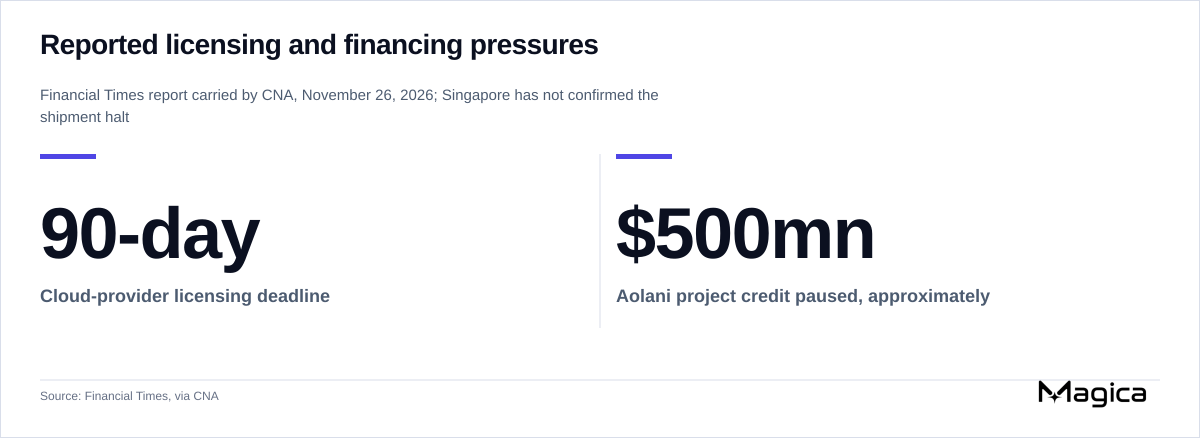
The Financial Times reported a 90-day licensing deadline and about US$500 million in credit disruption at Aolani’s Singapore project. Singapore has not confirmed the shipment halt. Source: CNA.
US restrictions on Nvidia exports to China date to 2022 and cite national security concerns, as an account of Singapore’s business outreach explains. The latest question concerns access through Southeast Asian infrastructure.
Asked whether shipments had stopped, Gan said:
“We have not confirmed it.”
The government was contacting businesses to assess the impact, while firms were organising themselves and working with partners to maintain access, he said in the .
Nvidia closed at $150.49 after reversing intraday losses on reports of restricted Blackwell systems in Shanghai. Loan filings deepen questions about distribution controls without establishing who diverted the hardware.
An earlier Financial Times report carried by CNA cited three people saying server makers including Dell and Supermicro had told buyers in Malaysia, Singapore, Thailand and Indonesia that Nvidia would not allow orders to ship. Whether the halt was temporary remained unclear. That account also described a 90-day deadline for cloud providers to secure licences by demonstrating that their end users exclude restricted entities.
A report on Gan’s remarks says Washington’s November rule requires advanced-chip export licences for firms in those four countries and Brazil, seeking to restrict Chinese access. The countries covered by the licensing rule therefore extend beyond the four in the shipment report. A licence requirement does not itself establish a permanent supply ban.
The earlier shipment report cited two people identifying Aolani, a Singapore cloud company planning to lease computing power to ByteDance, the Chinese owner of TikTok, as affected. It said some bankers had stopped issuing about US$500 million in credit for the project and ByteDance might abandon the deal. Nvidia declined comment; Dell, Supermicro, ByteDance and Aolani did not respond to requests for comment.
That is a reported project-level financing disruption, rather than a government estimate of economy-wide losses. Gan’s assessment did not identify affected deliveries, their volume or duration. Those remain necessary to establish the scale of any supply interruption.
Gan argued that continued access also serves US interests: many large cloud operators in Singapore are American companies supplying regional customers. He said Singapore would work with Washington to address its concerns while helping businesses retain access to high-end computing. That identifies a commercial constituency for an agreement; it does not establish that Washington has accepted one.
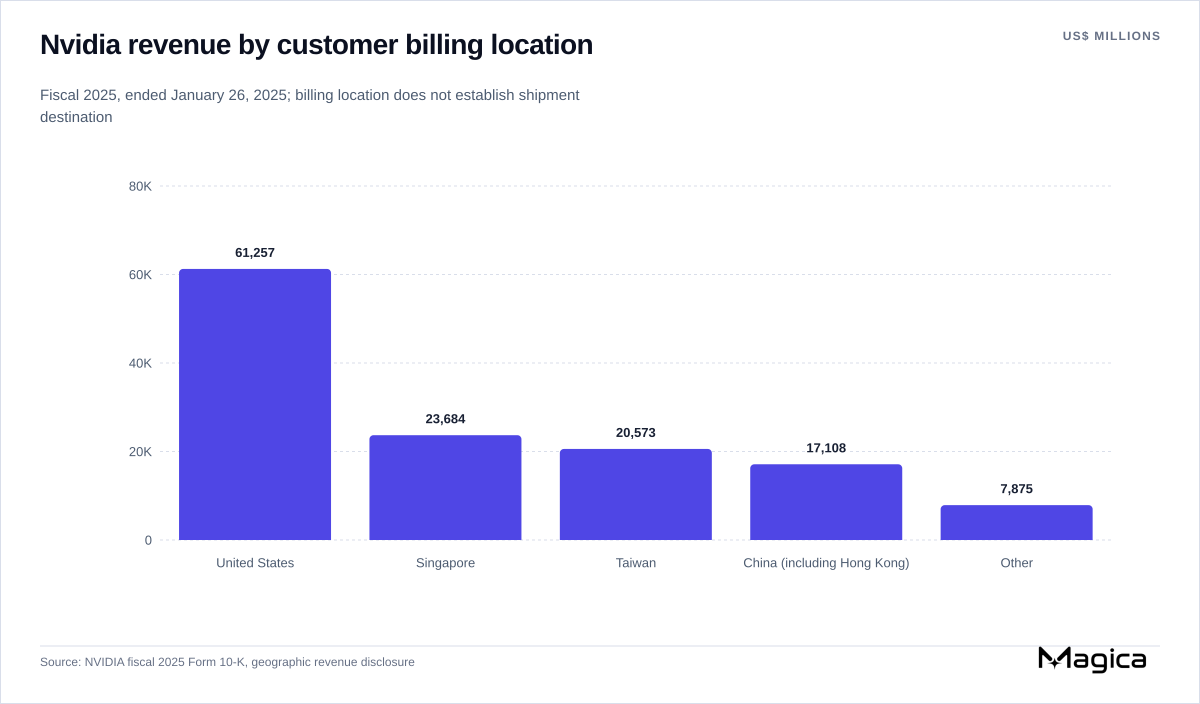
Company-reported fiscal 2025 revenue by customer billing location. Nvidia said shipments to Singapore represented less than 2% of total revenue; billing figures do not measure local chip capacity. Source: Nvidia fiscal 2025 Form 10-K.
Nvidia’s fiscal 2025 annual filing, covering the year ended January 26, 2025, illustrates Singapore’s commercial importance and the limits of using revenue to measure local exposure. Nvidia recorded US$23.7 billion by customer billing location in Singapore, or 18% of total revenue. Shipments to Singapore represented less than 2% of total revenue. Nvidia said customers centralised invoicing there while products were almost always shipped elsewhere.
These are historical revenue measures, not chip counts or estimates of capacity affected by the current reports. They cannot establish how much computing equipment is installed in Singapore or how much is at risk.
Nvidia’s position also rests on software as well as processors. The filing describes its CUDA programming platform, introduced in 2006, as supporting uses beyond graphics, including AI. It lists competing processor suppliers such as AMD, Huawei and Intel, alongside cloud companies developing their own computing hardware. That competitive landscape does not establish that any alternative can immediately replace affected orders or escape applicable controls.
Nor does permission to import chips settle deployment constraints. Nvidia warned that power, water, land and permitting limits could impede customers’ data-centre expansion. Gan separately acknowledged Singapore’s constraints in land, energy and manpower during the summit dialogue.
Gan said Singapore was reviewing regulations and monitoring to prevent it becoming a conduit for illegal transactions. He distinguished enforcing domestic law from enforcing foreign rules: companies should respect rules where they operate, and Singapore would assist foreign investigations where its own law permits.
He said Singapore already monitors domestic company activity but can lack information about overseas dealings. Investigations therefore require credible information and cooperation from other countries. He defended investigations and legal action as evidence of Singapore’s trustworthiness, rather than accepting that enforcement itself damaged its reputation. In his opening remarks, Gan also said cloud services gave smaller firms capabilities that previously required substantial investment of their own, illustrating the users served by this infrastructure. The account of his remarks records that argument alongside his insistence that Singapore continue pursuing its AI ambitions.
The immediate tests are whether businesses confirm interrupted deliveries, how licensing works in practice, and what additional monitoring or information-sharing Singapore proposes. Gan said the review was at an early stage and more would be shared when ready. Licence decisions and the proposed safeguards will determine the terms on which businesses can secure new computing equipment; Gan gave no timetable for either.
Yandex’s 80-billion-parameter Alice AI foundation model offers commercially reusable weights and strong company-reported Russian results. Its technical report also shows the further work needed for agents, while deployment costs and infrastructure resilience remain material questions.
Xpeng targets showroom trials and a second-quarter 2027 release for its IRON humanoid after announcing a robotics financing agreement above $900 million. Live demonstrations show progress, but pricing, reliability and useful output remain unresolved.
Q.ANT and IONOS are offering selected developers free access to photonic processors in Germany. Earlier tests show gains over Q.ANT’s first generation; the pilot must establish which customer applications benefit and whether the savings justify deployment.
The S&P 500 gained 1.6% in the shortened session and 5.6% for the week as technology shares recovered. Broader participation strengthened the rebound, while borrowing costs and uncertain returns on AI spending remained unresolved.
Ren Zhengfei credits US sanctions with Huawei’s push for self-reliance. Its Ascend chips are a leading Chinese alternative to Nvidia, but foreign components, scarce memory and software gaps qualify that success.
Some 44% of employed euro-area consumers reported using AI at least weekly in August 2026. ECB researchers see adoption as broadly similar to the United States, but survey differences, checking costs and weaker investment leave the economic payoff unresolved.
Delaware’s unintroduced AI-company proposal would pair owner liability protections with continuing funding duties, shutdown controls and a supervised trial. Lawmakers still face questions about the need for a new legal form, recoverable capital and public access to the test results.
Germany wants generative AI providers to compensate rights holders for competing output through collecting societies. Eligibility would depend on allowing free training use, while fee levels and enforcement remain unresolved.

Iran’s semi-official Mehr News Agency circulated simulated attacks on technology company headquarters, demanding reparations over alleged military involvement. Public Pentagon agreements establish supplier ties, but do not substantiate the video’s accusations about attacks on Iran.
Elliot Callender’s hunger strike outside Anthropic reached its fifth day on November 27. His demands range from product warnings to a development halt, while the Claude developer has argued that a meaningful pause requires verifiable cooperation among competing labs.
Starting January 1, Rhode Island will require an open manual checkout for every three operating grocery self-checkouts, with separate protections for monitors’ workload. Stores’ responses elsewhere and limited research leave the effects on employment, prices and theft unsettled.
The German consumer organization wants an injunction against ChatGPT subscription cancellation hurdles and a price-change clause. The clause promises advance notice, but the claimant says it leaves the grounds for increases insufficiently defined.
Moonshot AI is accepting applications for Kimi for Science through December 8. Selected researchers can receive model-use credits and technical support, but the company has not disclosed the program’s total budget or cohort size.
Nvidia's proposed $290 million shareholder settlement would end disputed claims over cryptocurrency demand within gaming sales. The fund equals about 14% of plaintiffs' estimated maximum damages before fees and costs; court approval and individual payouts remain pending.
TrueLayer says an AI agent’s Papa John’s order was a UK first for direct bank payments to a retailer. The trial used customer-set, bank-enforced limits and human approval; merchant savings and readiness for wider use remain unproven.
Taiwan forecasts 6.51% economic growth in 2027 after a projected 13.28% surge in 2026, as AI hardware demand drives exports and capacity expansion despite risks to infrastructure investment.
Two Dutch court actions seek restrictions on Meta’s camera glasses, including a sales ban, over covert recording and disputed AI data practices. The cases test how much responsibility belongs to the companies that design and operate the glasses, rather than their wearers.
Dante Security has raised a $10 million seed round for AI agent monitoring and human accountability. Its founders bring enterprise-security experience, but existing vendor controls and limited deployment evidence complicate the pitch.
Avicena has raised over $100 million for microLED connections between AI chips, with a new CEO targeting a first product in 2027. Chipmaker backing strengthens its commercialization effort, but deployment economics remain unproven in the announcement.