Editorial Team
8 min read
Nvidia closed at $150.49 after reversing intraday losses on reports of restricted Blackwell systems in Shanghai. Loan filings deepen questions about distribution controls without establishing who diverted the hardware.
Nvidia recovered its intraday losses on November 27 after reports that its restricted Blackwell AI computing systems had reached a Shanghai data center. The chip and computing-system supplier finished nearly 1% higher at $150.49. The rebound left the central export-control question unresolved: how the equipment reached China, through whose hands, and with what authorization.
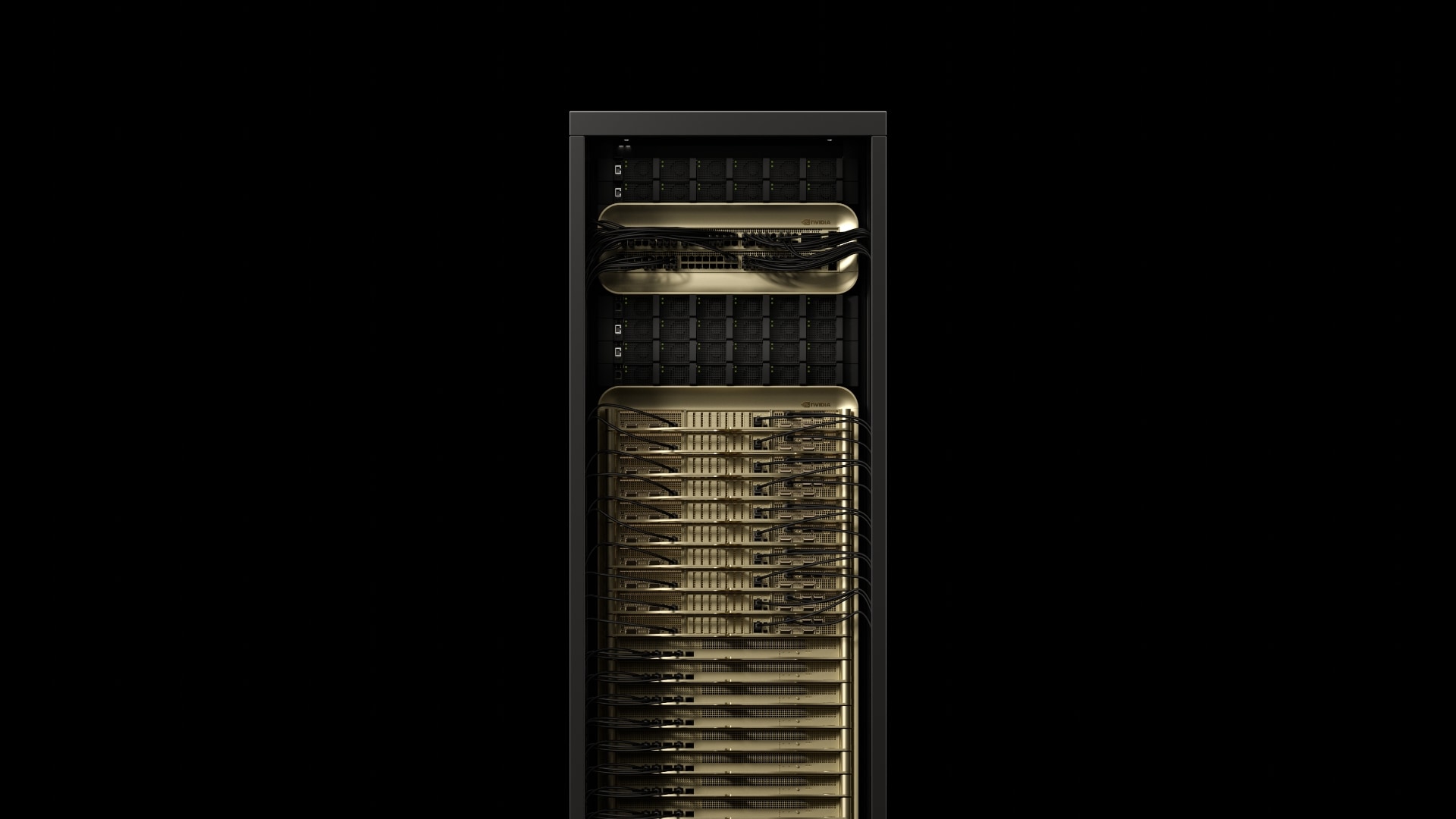
Nvidia’s GB300 NVL72 product rendering illustrates the hardware discussed in the Shanghai reports; it does not depict that installation. Image: Nvidia. Source: NVIDIA.
The closing account put Nvidia’s earlier loss at almost 3%. An earlier trading update recorded a 1.7% opening gain followed by a 1.9% decline while the Nasdaq Composite and semiconductor index remained higher. These are observations from different points in the holiday-shortened session, rather than competing closing prices.
The reversal came during a broader debate about financing AI infrastructure. A morning market account described bargain hunting in chip stocks alongside investment managers’ concerns about the cost and monetization of the AI build-out. Friday’s moves alone cannot isolate how much of Nvidia’s performance reflected the Shanghai report.
Leadership uncertainty also preceded the news. Jensen Huang, Nvidia’s founder and chief executive, was reinstated by its board on Monday, 12 days after resigning, according to the account of the week’s developments. The closing report described a 31% rally at the start of the week and a combined decline of about 10% on Tuesday and Wednesday.
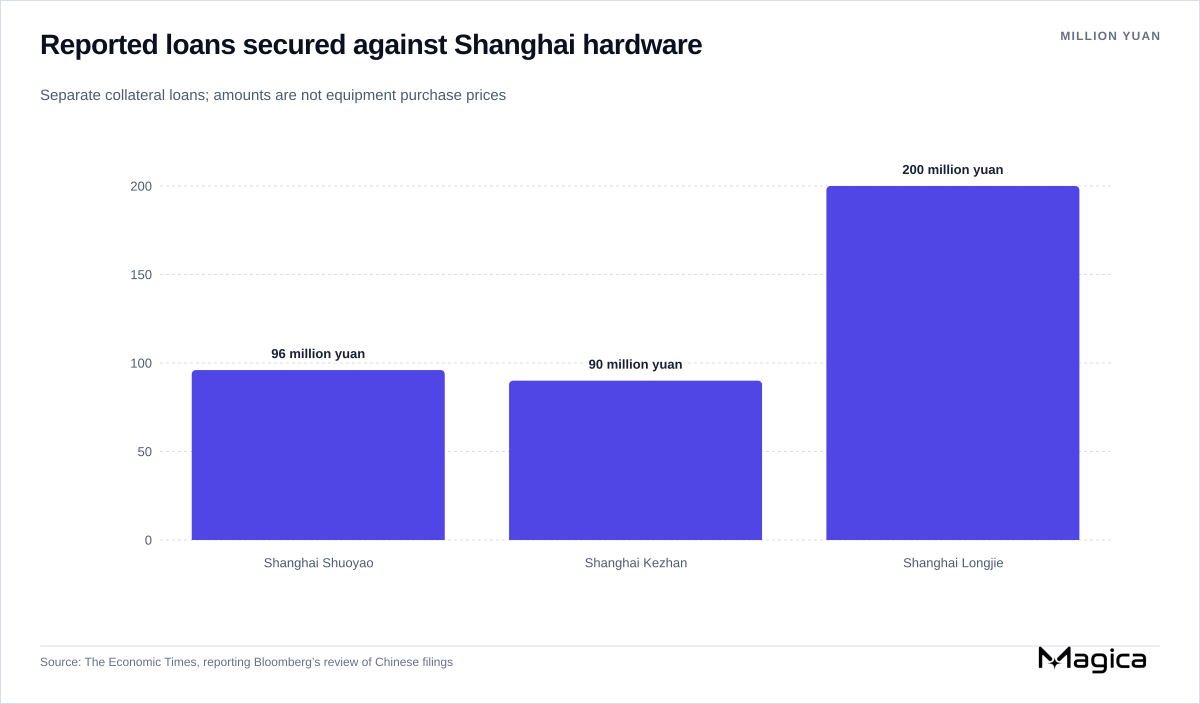
Reported collateral loans secured against computing hardware. The amounts do not establish equipment purchase prices, total investment or who transferred the hardware. Source: The Economic Times.
A Bloomberg investigation, described in the report on Chinese regulatory filings, identified Nvidia systems at the Yangtze River Delta Project, a Shanghai data center. The reported collateral records cover three borrowers:
| Borrower | Equipment pledged | Loan |
|---|---|---|
| Shanghai Shuoyao | GB300 NVL72 rack | 96 million yuan from Shanghai Innovation Bank; documents submitted in November |
| Shanghai Kezhan | GB200 server and 32 H200 servers | 90 million yuan from a finance-leasing company owned by a Shanghai government agency; issued in late 2025 |
| Shanghai Longjie | Restricted Hopper-generation hardware manufactured by Super Micro Computer and Dell Technologies | Separate 200 million yuan loan |
The amounts are loans secured against equipment. They do not establish the hardware’s purchase prices, the data center’s total investment or its full inventory.
Blackwell is Nvidia’s AI computing architecture, introduced in 2024; Blackwell Ultra is its subsequent platform. In its March 2025 announcement, Nvidia described the GB300 NVL72 as connecting 72 Blackwell Ultra graphics processors and 36 Grace central processors in a rack designed for workloads including reasoning inference, when a model uses additional computation to work through a request. The company then expected partner products in the second half of 2025, naming Gigabyte, Dell and Supermicro among the server suppliers.
This is substantial infrastructure. The filings account describes a standard GB300 NVL72 rack as weighing more than 1,500 kilograms, standing about two meters tall and using liquid cooling. Huang had previously questioned whether systems of that size could be smuggled. Their reported presence in Shanghai challenges that reassurance, but size alone cannot establish how a shipment moved.
The investigation reportedly traced the GB300 rack’s serial number through a public warranty database to Taiwan-based server manufacturer Gigabyte Technology. Gigabyte declined to disclose the original buyer and said it conducts business in compliance with applicable laws and regulations. A manufacturer identification is a starting point for tracing the distribution chain; it does not establish who arranged a transfer to China.
Alice Huang founded Megaspeed, a Singapore-based cloud computing company, in 2023 and led it until summer 2025. It became one of Nvidia’s largest Southeast Asian customers and presented the Shanghai project to investors as its largest data center in 2024. Shanghai Shuoyao confirmed that it provides services to Megaspeed, describing ordinary commercial cooperation.
The reported ownership links extend to the other Blackwell borrower. NeXPower Japan, identified in the filings account as controlled by Alice Huang, owns 83.3% of Shanghai Kezhan. The remaining 16.7% is held through a subsidiary linked to Chinese gaming company 7Road, Megaspeed’s former parent.
The same account says trade records show an approximately $11 million shipment to Shanghai Kezhan from Malaysia in May 2025, described as storage chassis but carrying a product classification corresponding to computing servers. That discrepancy does not identify the shipment as the Blackwell equipment in the collateral records.
Megaspeed is under US investigation for suspected chip smuggling to China and denies wrongdoing. The report relaying the investigation’s findings explicitly preserves its limitation: Bloomberg found no evidence that Megaspeed itself diverted Nvidia hardware to the Shanghai facility. The report says Blackwell exports to China require a US license. The published accounts do not establish the shipment route or any applicable authorization.
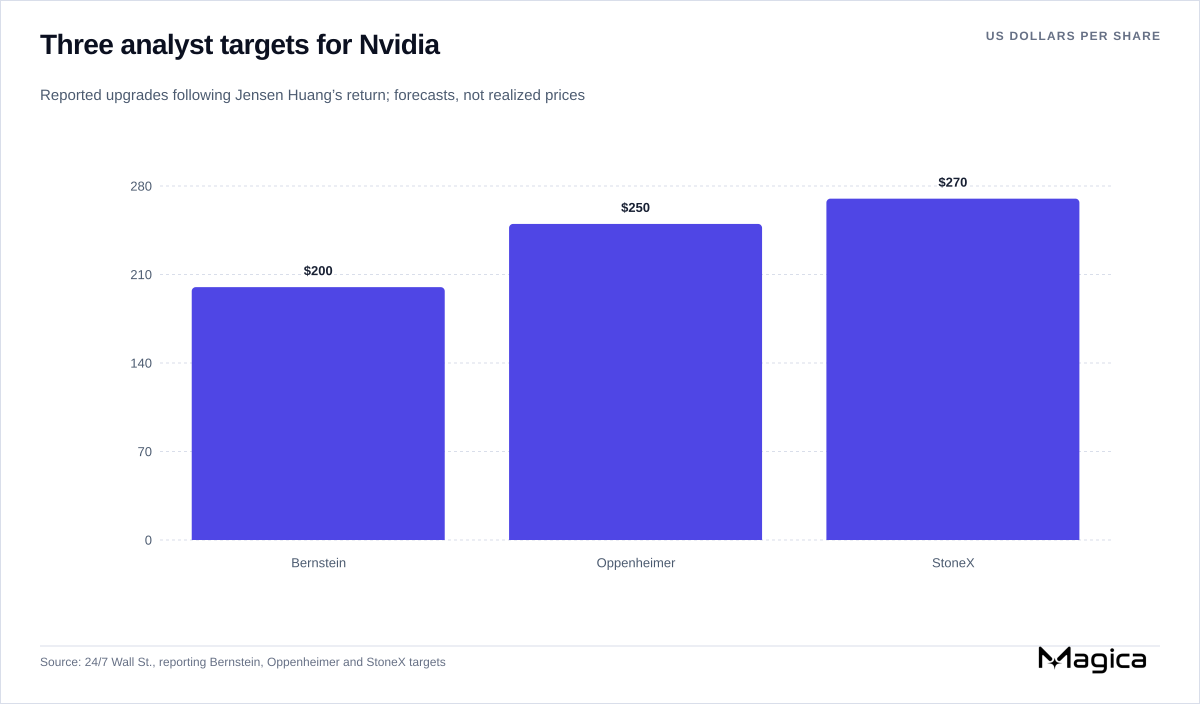
Reported analyst targets following Jensen Huang’s return. These forecasts do not establish future prices or returns. Source: 24/7 Wall St..
Nvidia maintains that it follows US export regulations and says its latest outlook excludes data-center compute revenue from China, according to the filings account. Restrictions on intermediaries and overseas cloud access can nevertheless affect business outside China.
The account says the US Commerce Department added seven Megaspeed-linked entities to its Entity List on November 23: three in Singapore, three in Malaysia and one in Thailand. Controlled exports require licenses subject to a presumption of denial, with a December 23 arrival deadline for in-transit shipments under the stated transition arrangements.
Separately, a report on regional shipment restrictions, citing Financial Times reporting, says Nvidia instructed manufacturing partners including Dell and Supermicro to halt shipments of servers containing its chips to Malaysia, Singapore, Thailand and Indonesia. It links the halt to tighter US controls intended to prevent Chinese companies from accessing advanced AI computing through regional cloud providers.
That account cites Jefferies estimating $44 billion to $62 billion of Nvidia data-center revenue at risk next year. It also cites UBS estimating that as much as 2 gigawatts of new data-center demand could be affected, while cautioning that the eventual impact was difficult to quantify. The account also cites Gene Munster, managing partner at investment firm Deepwater Asset Management, estimating a 2% to 5% reduction in Nvidia’s 2027 revenue. These forecasts use different measures and cannot be treated as equivalent estimates: revenue at risk, a projected reduction in company revenue, and power capacity. None establishes a booked loss.
Demand and customer financing provide separate tests. An analysis of Nvidia’s business and analyst upgrades relays management’s statement that demand continues to exceed supply. It also says Nvidia requires neocloud customers—specialist cloud providers—to secure funding and activate data centers before its purchase commitments take effect. Strong demand therefore does not by itself resolve financing, deployment or export constraints.
The same analysis lists analyst price targets of $200 from Bernstein, $250 from Oppenheimer and $270 from StoneX after Huang’s return. It recorded Broadcom and Taiwan Semiconductor rising about 2% while Nvidia was lower. Their roles differ: Broadcom supplies custom AI accelerators and networking, while Taiwan Semiconductor manufactures chips for both designers. That intraday comparison shows differing market reactions, not a measure of orders shifting away from Nvidia.
The US Bureau of Industry and Security, the export-control agency whose guidance addresses advanced-chip diversion, had already outlined relevant checks in May 13, 2025 guidance. It dates advanced-computing restrictions to October 2022 and describes subsequent expansion to address transshipment, diversion and access to data centers outside China. BIS cites potential military-intelligence and weapons uses as its rationale.
Its recommended diligence includes examining customer ownership, identifying end users and installation addresses, and seeking written confirmation that a data center has the infrastructure to operate the servers. It recommends site visits or independent audits to confirm those attestations. These are checks to investigate risk, not findings that a particular company violated the rules.
The regional-restrictions account says Huang is scheduled for House committee interviews on December 1 and a public Senate Banking Committee hearing on December 3. It also reports that S&P Global Ratings placed Nvidia’s AA rating on CreditWatch Negative over management and governance concerns, including board independence and succession planning, with a possible downgrade within 90 days.
For the Shanghai equipment, the missing evidence is the chain from the original buyer to its reported installation, together with any export authorization. For Nvidia’s wider business, the next consequential question is which shipments can resume under the rules and how much demand can still be served. The collateral records make the equipment identifiable; they leave those decisions unresolved.
Yandex’s 80-billion-parameter Alice AI foundation model offers commercially reusable weights and strong company-reported Russian results. Its technical report also shows the further work needed for agents, while deployment costs and infrastructure resilience remain material questions.
Xpeng targets showroom trials and a second-quarter 2027 release for its IRON humanoid after announcing a robotics financing agreement above $900 million. Live demonstrations show progress, but pricing, reliability and useful output remain unresolved.
Q.ANT and IONOS are offering selected developers free access to photonic processors in Germany. Earlier tests show gains over Q.ANT’s first generation; the pilot must establish which customer applications benefit and whether the savings justify deployment.
The S&P 500 gained 1.6% in the shortened session and 5.6% for the week as technology shares recovered. Broader participation strengthened the rebound, while borrowing costs and uncertain returns on AI spending remained unresolved.
Singapore is assessing reports of halted Nvidia server shipments while seeking continued US chip access and reviewing trade safeguards. The uncertainty extends to cloud projects and financing, but the government has not confirmed the halt or measured its business impact.
Ren Zhengfei credits US sanctions with Huawei’s push for self-reliance. Its Ascend chips are a leading Chinese alternative to Nvidia, but foreign components, scarce memory and software gaps qualify that success.
Some 44% of employed euro-area consumers reported using AI at least weekly in August 2026. ECB researchers see adoption as broadly similar to the United States, but survey differences, checking costs and weaker investment leave the economic payoff unresolved.
Delaware’s unintroduced AI-company proposal would pair owner liability protections with continuing funding duties, shutdown controls and a supervised trial. Lawmakers still face questions about the need for a new legal form, recoverable capital and public access to the test results.
Germany wants generative AI providers to compensate rights holders for competing output through collecting societies. Eligibility would depend on allowing free training use, while fee levels and enforcement remain unresolved.

Iran’s semi-official Mehr News Agency circulated simulated attacks on technology company headquarters, demanding reparations over alleged military involvement. Public Pentagon agreements establish supplier ties, but do not substantiate the video’s accusations about attacks on Iran.
Elliot Callender’s hunger strike outside Anthropic reached its fifth day on November 27. His demands range from product warnings to a development halt, while the Claude developer has argued that a meaningful pause requires verifiable cooperation among competing labs.
Starting January 1, Rhode Island will require an open manual checkout for every three operating grocery self-checkouts, with separate protections for monitors’ workload. Stores’ responses elsewhere and limited research leave the effects on employment, prices and theft unsettled.
The German consumer organization wants an injunction against ChatGPT subscription cancellation hurdles and a price-change clause. The clause promises advance notice, but the claimant says it leaves the grounds for increases insufficiently defined.
Moonshot AI is accepting applications for Kimi for Science through December 8. Selected researchers can receive model-use credits and technical support, but the company has not disclosed the program’s total budget or cohort size.
Nvidia's proposed $290 million shareholder settlement would end disputed claims over cryptocurrency demand within gaming sales. The fund equals about 14% of plaintiffs' estimated maximum damages before fees and costs; court approval and individual payouts remain pending.
TrueLayer says an AI agent’s Papa John’s order was a UK first for direct bank payments to a retailer. The trial used customer-set, bank-enforced limits and human approval; merchant savings and readiness for wider use remain unproven.
Taiwan forecasts 6.51% economic growth in 2027 after a projected 13.28% surge in 2026, as AI hardware demand drives exports and capacity expansion despite risks to infrastructure investment.
Two Dutch court actions seek restrictions on Meta’s camera glasses, including a sales ban, over covert recording and disputed AI data practices. The cases test how much responsibility belongs to the companies that design and operate the glasses, rather than their wearers.
Dante Security has raised a $10 million seed round for AI agent monitoring and human accountability. Its founders bring enterprise-security experience, but existing vendor controls and limited deployment evidence complicate the pitch.
Avicena has raised over $100 million for microLED connections between AI chips, with a new CEO targeting a first product in 2027. Chipmaker backing strengthens its commercialization effort, but deployment economics remain unproven in the announcement.