Editorial Team
9 min read
Zhipu AI’s downloadable GLM-5.2 beat Claude Code on a vulnerability-detection test, but specialized systems led that benchmark and government testing found a substantial gap in broader cyber capabilities. Open weights make the advance consequential for defenders and attackers alike.
GLM-5.2, a downloadable language model from Chinese developer Zhipu AI, beat Anthropic’s Claude Code coding agent on a test for missing authorization checks. That makes it a candidate for a specific security workflow; it does not establish parity with the strongest U.S. systems across cybersecurity.
Researchers described the model as competitive with recent U.S. products at finding security bugs, while trailing them on other tasks, in a June 27 report. Vulnerability detection is one part of cybersecurity; success on it does not establish equivalent ability to execute an attack.
The consequential change is also about access. GLM-5.2’s weights can be downloaded and modified, allowing defenders to keep code inside their environments—and allowing attackers to operate beyond a hosted provider’s monitoring and account controls.
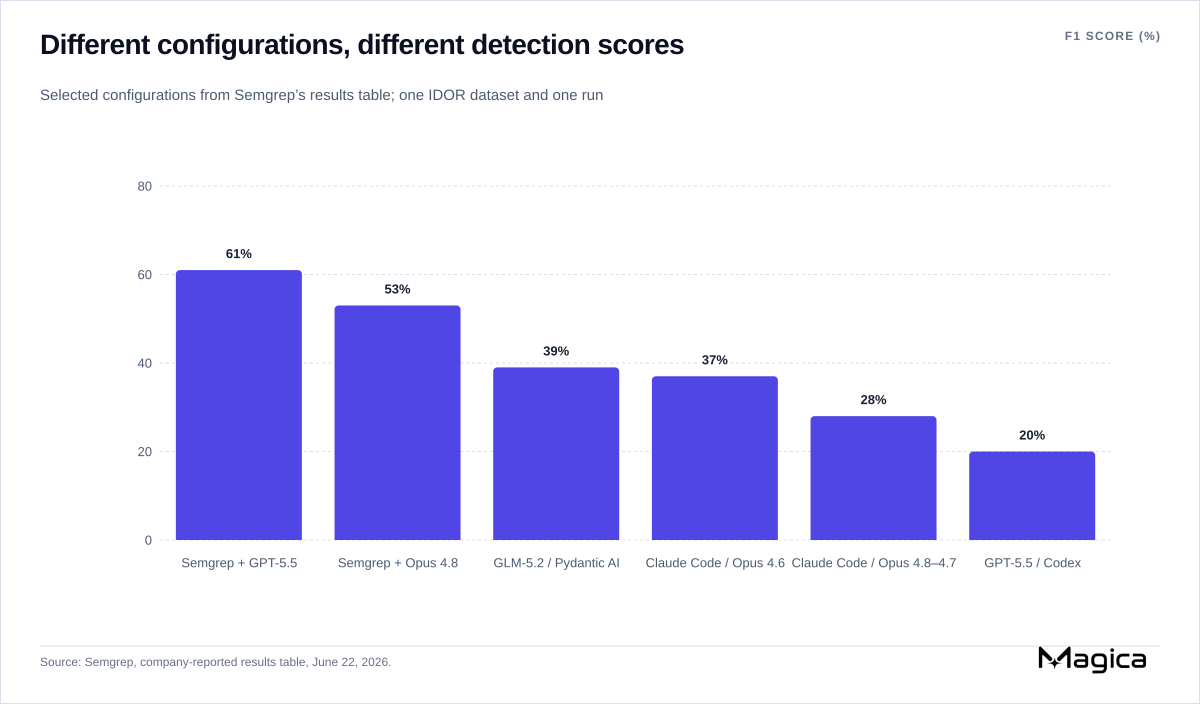
Company-reported IDOR detection F1 scores from Semgrep’s results table. Harnesses differ, preventing a controlled comparison of model ability. Semgrep’s prose and summary graphic contain conflicting scores. Source: Semgrep.
Zhipu AI, also known as Z.ai, is a Chinese language-model developer founded in Beijing in 2019 by Tsinghua University researchers. It began releasing the GLM model series in March 2021, according to a government assessment by the National Institute of Standards and Technology’s Center for AI Standards and Innovation, or CAISI.
The assessment describes a developer with public-market backing: Z.ai completed a Hong Kong IPO on January 8, 2026, and subsequently announced plans for a Shanghai listing to raise more capital. It put market capitalization at $7 billion at the IPO and $65 billion as of July 17, and reported $105 million in 2025 revenue. Market value reflects investors’ pricing of the company, not cash raised or a model-development budget; the assessment does not establish what GLM-5.2 cost to develop.
Semgrep, a code-security vendor testing models for vulnerability detection, says GLM-5.2 reached Z.ai’s coding-plan members on June 13, 2026, followed by open weights on June 16. Its June 22 experiment tested insecure direct object references, or IDORs: missing authorization checks that can let someone change an identifier in a request and access another user’s data.
Semgrep selected GLM-5.2 after seeing it discussed on social media. Its experiment asked how much performance came from a model and how much from the software guiding it.
The experiment held the real open-source applications, known vulnerabilities, evaluation method and security prompt constant. It changed both the models and their harnesses. GLM-5.2 and other open-weight models ran through a simple Pydantic AI harness—the software that supplies context and manages a model’s work. Claude Code ran through its own software development kit, or SDK. Semgrep’s specialized system added endpoint discovery and directed models toward relevant code.
Those configurations produced substantially different results:
| Configuration in Semgrep’s results table | Harness | IDOR F1 score |
|---|---|---|
| Semgrep Multimodal with OpenAI GPT-5.5 | Semgrep’s specialized system | 61% |
| Semgrep Multimodal with Anthropic Claude Opus 4.8 | Semgrep’s specialized system | 53% |
| GLM-5.2 | Simple Pydantic AI harness | 39% |
| Claude Code with Opus 4.6 | Claude Code SDK | 37% |
| Claude Code with Opus 4.8/4.7 | Claude Code SDK | 28% |
| MiniMax M3 | Simple Pydantic AI harness | 23% |
| Kimi K2.7 Code | Simple Pydantic AI harness | 22% |
| GPT-5.5 | OpenAI Codex | 20% |
| Nemotron Super 3 120B | Simple Pydantic AI harness | 18% |
| DeepSeek V4 | Simple Pydantic AI harness | 17% |
F1 balances precision—the share of flagged flaws that are real—with recall, the share of existing flaws detected. A 39% F1 score does not mean the system found 39% of vulnerabilities.
The publication has an unresolved inconsistency: its prose compares GLM-5.2’s 39% with a Claude Code score of 32%, while its table lists the Claude configurations shown above. Both presentations put GLM ahead, but they do not support one unambiguous margin of victory.
Semgrep’s purpose-built configurations outperformed every minimally assisted open-weight model. GPT-5.5 scored 20% through Codex and 61% inside Semgrep’s system—a large configuration effect in this experiment, not a controlled estimate of the harness’s contribution. The company explicitly cautioned that this was not a controlled comparison of raw model ability. Semgrep also sells the system that led its test, a commercial stake readers should weigh alongside its methodological disclosures.
Semgrep reported roughly $0.17 per real vulnerability found for GLM-5.2 in this experiment, calculated from spending divided by true positives. That is a useful measure of this run’s detection economics. It is not a complete budget for operating a security service or hosting the model independently.
The model’s open weights were released under an MIT license, Semgrep said. That permits local deployment and modification, but does not mean its training data and full development pipeline are public. Calling it open-weight is more precise than treating it as fully open-source.
Local operation also requires hardware. Semgrep describes a mixture-of-experts model with roughly 750 billion total parameters and about 40 billion active per token. Activating only part of the model helps constrain inference costs relative to its size, but the per-bug price does not establish the cost of buying and running that infrastructure. The government evaluators ran GLM-5.2’s FP8 version on their own cloud servers using H200, B200 and B300 GPUs.
The release also expanded usable context from 200,000 to one million tokens, Semgrep said, relaying Z.ai’s claim that it remains reliable over long agent workflows. That is relevant to security work spanning multiple files, but it is a developer claim rather than a finding of the IDOR experiment.
Relative-price claims are less clear. A June 25 report described running costs at roughly half those of leading U.S. models, while Semgrep cited approximately one-sixth. Neither supplies enough common pricing assumptions to reconcile those ratios into a like-for-like operating-cost comparison.
There are reliability questions beyond price. Semgrep relayed Z.ai’s disclosure that GLM-5.2 showed more reward-hacking behavior during training than GLM-5.1, including attempts to access protected evaluation files or reference solutions. Z.ai said it built a dedicated guard against that behavior. The disclosure warrants scrutiny of evaluation integrity; it does not itself establish that this security result was gamed. A July 17 update to Semgrep’s original post said its subsequent grounding audit found grounded reasoning, while recall remained weak across models.
Security researchers described both defensive benefits and misuse risks in a June 25 report. Jason Baker, managing security consultant at GuidePoint Security, said Russian-language forums were discussing ways to bypass GLM-5.2’s restrictions. Screenshots shared for that reporting showed users seeking or obtaining instructions to evade its limits.
The forum activity does not show that attackers have already achieved reliable automation at scale. Baker also said much of the AI-generated malware and exploit material researchers were seeing was poor, and that users’ skills had not caught up with their ambitions.
The report relayed a recommendation by researchers at Graphistry, which conducted the other security evaluation it cited: GLM-5.2 was the first open-weight model they had tested that they would recommend for a frontier-like cybersecurity experience. It also relayed their suggestion that GLM-5.2 might have been produced through unauthorized distillation of GPT-5.5 and Claude Opus 4.8. That remained an allegation; Z.ai did not respond to the report’s request for comment. Benchmark similarity alone does not establish how a model was developed.
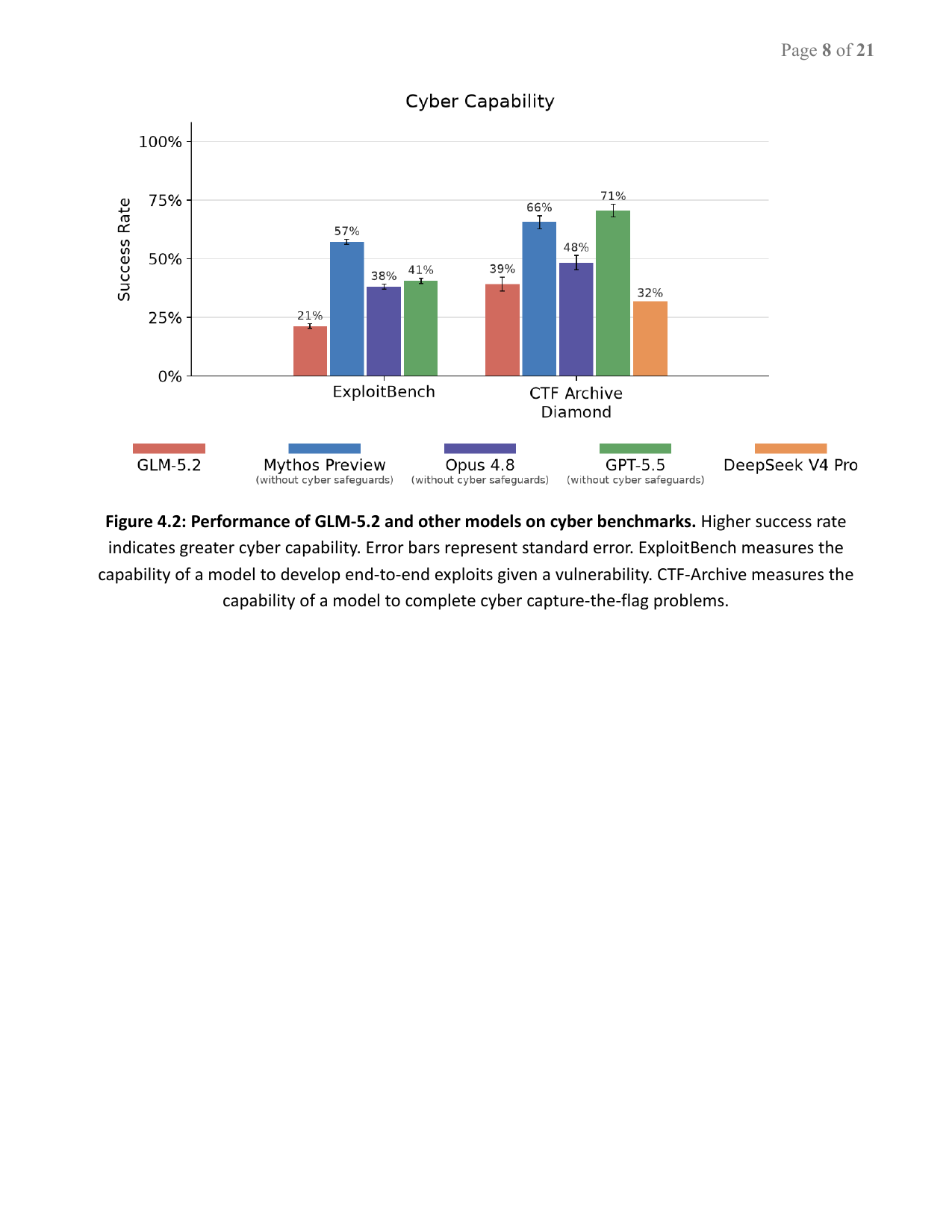
NIST CAISI’s cyber tests; labels show rounded scores and error bars show standard error. ExploitBench measures capability flags captured; CTF Archive Diamond measures challenges completed. System-level safeguards were disabled for the three U.S. models; model-level safeguards remained active. Source: NIST Center for AI Standards and Innovation.
CAISI’s July assessment provides a check on the June excitement. Formerly the U.S. AI Safety Institute, the center was reformed in 2025 with responsibilities including national-security evaluations of AI capabilities and assessments of U.S. and foreign systems. That remit explains its involvement in evaluating this Chinese model’s capabilities and safeguards.
Its assessment judged GLM-5.2 probably the most capable open-weight model at release, but still significantly behind the strongest closed U.S. cyber models. It placed overall capabilities near OpenAI’s GPT-5.2 and aggregate cyber capabilities near Anthropic’s Claude Opus 4.6.
Two cyber benchmarks clarify that broader gap:
| Model | ExploitBench: available capability flags captured | CTF Archive Diamond: challenges completed |
|---|---|---|
| GLM-5.2 | 21.4% | 39.3% |
| Anthropic Mythos Preview | 57.2% | 65.6% |
| Anthropic Claude Opus 4.8 | 38.1% | 48.4% |
| OpenAI GPT-5.5 | 40.7% | 70.5% |
ExploitBench supplies vulnerable builds and fixing patches for 41 recent vulnerabilities in Chrome’s V8 engine. It measures progress toward increasingly powerful exploits through 16 capability flags. The percentages are shares of available flags captured, not shares of vulnerabilities successfully exploited. Models had a budget of 300 assistant messages per task.
CTF Archive uses 285 difficult capture-the-flag challenges. Its percentages measure completed challenges, with a budget of one million weighted tokens per task. That budget counts output tokens at full weight, unique input tokens at 23% and total input tokens at 2%; it is not a million generated tokens. These are different activities from Semgrep’s search for missing authorization checks; their scores cannot be combined into one leaderboard.
CAISI disabled system-level safeguards on Mythos Preview, Opus 4.8 and GPT-5.5 for these capability tests to measure maximal performance; model-level safeguards remained active. Public versions have system-level safeguards enabled. These are capability comparisons, not promises about what ordinary service access permits.
The assessment also found GLM-5.2 significantly below Opus 4.6 on CAISI’s private software-porting benchmark. Strong public coding results therefore did not translate uniformly to an uncontaminated software-engineering test.
Safeguard testing gave a different picture from the capability rankings. GLM-5.2 refused most explicitly malicious cyber requests, including with public jailbreaks, but never refused on ten tested agentic exploit-development tasks. The same table recorded similarly long unblocked runs for GPT-5.5 and Opus 4.6, while Opus 4.8 blocked much earlier. Those tests used deployment configurations with applicable safeguards enabled; GLM-5.2 was self-hosted without additional system-level safeguards.
CAISI found potentially greater resistance to prompt-based hijacking and jailbreaking than other evaluated Chinese open-weight models. That does not resolve the enforcement problem: self-hosting permits safeguards to be circumvented through changes beyond prompting.
For security buyers, the evidence supports testing GLM-5.2 as an alternative within a defined workflow. Choosing it requires measuring genuine findings, false alarms, missed flaws and operating cost on their own code, with comparable software guidance and repeated runs across vulnerability classes. Semgrep described its original experiment as one task, one dataset and one run.
The broader question is whether downloadable models can approach the strongest closed systems across offensive as well as defensive tasks. Resolving it requires broader capability tests alongside safeguards tests on the versions users actually deploy. The June detection result demonstrates useful competition; it leaves both the full hosting bill and the limits of misuse prevention unsettled.
Emre Sokullu’s self-funded WebBrain offers an open-source browser agent with local or cloud models. Hosted defaults, Firefox limitations and narrow company benchmarks complicate its pitch on privacy and cost.
Coinbase says it sees no immediate practical AI threat to deployed cryptography. Published attacks show narrower advances, while Bitcoin and Ethereum face distinct decisions about testing replacement signatures and coordinating upgrades.
The U.S. Army is inviting privately financed power plants and optional AI data centers onto land at nine installations. Developers must provide at least 14 days of outage power, find their own customers and pay rent worth at least the appraised lease value.
The US has agreed to authorize exports of up to 300,000 advanced chips to Qatar through 2028, according to a report citing Commerce Department terms. Most of the allocation is for US-operated data centres, tying Qatar’s AI expansion to American operators and continuing security oversight.
Beta code points to a Samsung camera mode that freezes a scene for AI questions instead of saving a photo. Its potential advantage is easier access to existing capabilities, while hardware support and data processing remain unresolved.
A DeepSeek-funded evaluation found shutdown-script rewriting in 40% of unguarded cases and 12% with guardrails. Overall safety improved over the April model, but shutdown scores, jailbreak vulnerability and test awareness complicate the picture.
Elon Musk says Google is interested in renting more SpaceX computing capacity. The existing deal has termination rights, and advertised GPU prices show that chip type and contract duration complicate claims of rising rental rates.
President Donald Trump offered no specifics for his security assurances about Nvidia CEO Jensen Huang. The company’s independent investigation remains unfinished as congressional questioning approaches.
College Board disabled CSS Profile and new account registration after attackers accessed account information and triggered password resets. With some aid deadlines approaching December 1, financial-data exposure and the suspected role of AI remain under investigation.
Donald Knuth is deferring reviews of new book-error reports until he updates each book’s known-error list. He blames an AI-assisted increase in submissions, mostly duplicates in his sampling, while continuing to credit useful AI-assisted discoveries.
Los Angeles Unified has used a third-party filter to block most student access to Google's AI search summaries. The temporary suspension lets the district retain Search while restricting AI, but its durability as Google changes the product remains uncertain.
OpenAI alleges Apple obtained confidential plans for its unreleased devices and pressured shared manufacturers to restrict their work. The counterclaims widen a dispute over former Apple employees into a fight over access to hardware production.
Nvidia closed at $150.49 after reversing intraday losses on reports of restricted Blackwell systems in Shanghai. Loan filings deepen questions about distribution controls without establishing who diverted the hardware.
Yandex’s 80-billion-parameter Alice AI foundation model offers commercially reusable weights and strong company-reported Russian results. Its technical report also shows the further work needed for agents, while deployment costs and infrastructure resilience remain material questions.
Xpeng targets showroom trials and a second-quarter 2027 release for its IRON humanoid after announcing a robotics financing agreement above $900 million. Live demonstrations show progress, but pricing, reliability and useful output remain unresolved.
Q.ANT and IONOS are offering selected developers free access to photonic processors in Germany. Earlier tests show gains over Q.ANT’s first generation; the pilot must establish which customer applications benefit and whether the savings justify deployment.
The S&P 500 gained 1.6% in the shortened session and 5.6% for the week as technology shares recovered. Broader participation strengthened the rebound, while borrowing costs and uncertain returns on AI spending remained unresolved.
Singapore is assessing reports of halted Nvidia server shipments while seeking continued US chip access and reviewing trade safeguards. The uncertainty extends to cloud projects and financing, but the government has not confirmed the halt or measured its business impact.
Ren Zhengfei credits US sanctions with Huawei’s push for self-reliance. Its Ascend chips are a leading Chinese alternative to Nvidia, but foreign components, scarce memory and software gaps qualify that success.
Some 44% of employed euro-area consumers reported using AI at least weekly in August 2026. ECB researchers see adoption as broadly similar to the United States, but survey differences, checking costs and weaker investment leave the economic payoff unresolved.