Editorial Team
10 min read
Yandex’s 80-billion-parameter Alice AI foundation model offers commercially reusable weights and strong company-reported Russian results. Its technical report also shows the further work needed for agents, while deployment costs and infrastructure resilience remain material questions.
Yandex, the Russian search and online-services group behind the Alice AI assistant, released the weights of AliceAI-Foundation-80B-A3B-Base on September 21. The experimental language model was trained from scratch, the company says. Its September 21 announcement makes the pretrained model available for research and commercial projects under Apache 2.0. A technical paper submitted on November 25 describes the training and evaluations.
The release gives developers a foundation they can run and adapt themselves, while giving Yandex a platform for testing the architecture of a future unified reasoning model. That future system is intended to power Alice AI’s ability to carry out actions for users. The released base checkpoint is an intermediate step toward a finished conversational assistant.
The potential audience is substantial. In its third-quarter 2026 results, Yandex reported 45 million weekly users of Alice AI chat across its assistant app, browser, Yandex app and website, up 36% from the previous quarter. Those figures measure existing services; they do not establish adoption of the new checkpoint or growth caused by its release.
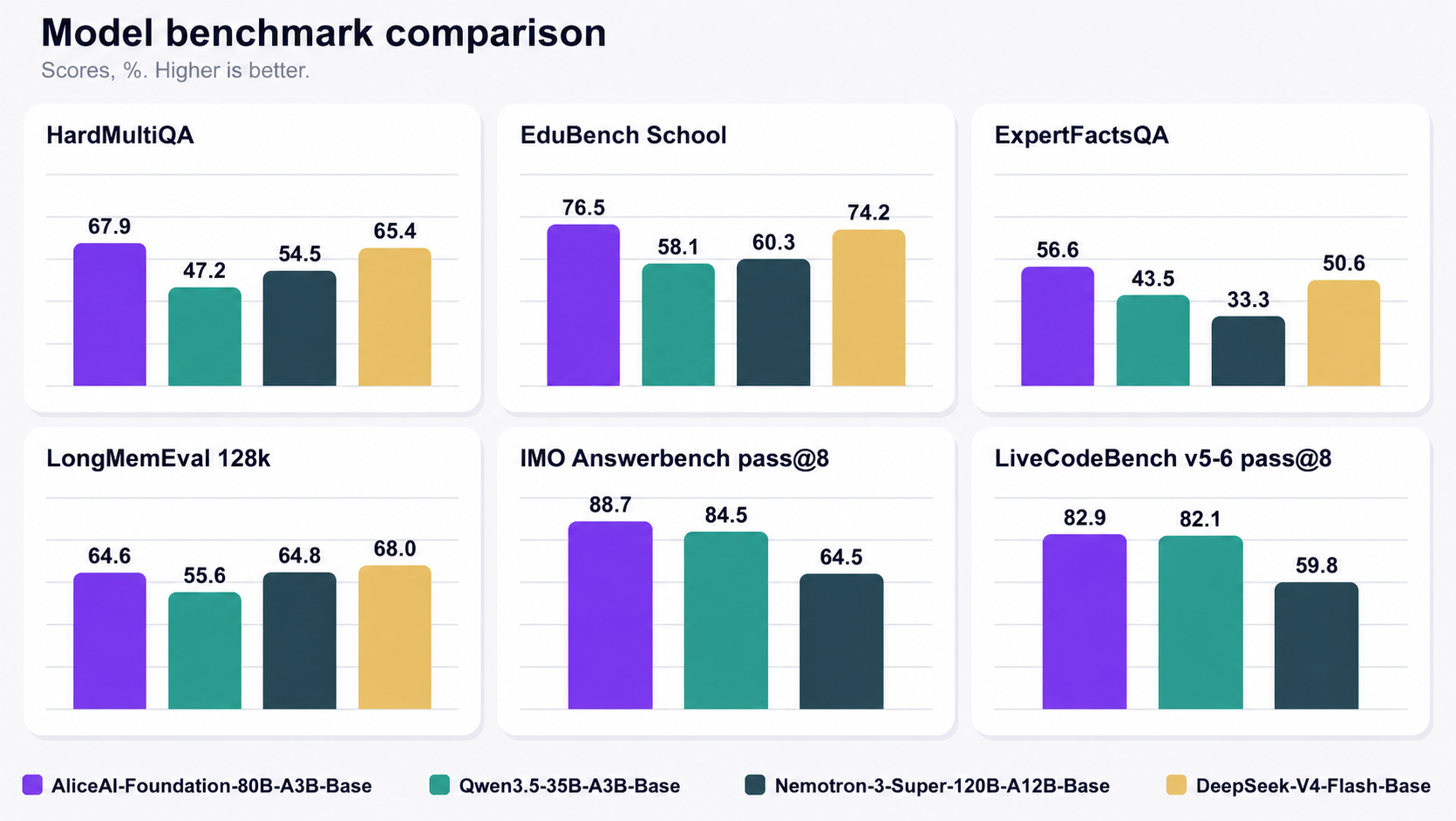
Yandex’s company-reported benchmark overview. Evaluation protocols differ across panels; the mathematics and coding panels use pass@8, counting success within eight attempts. Source: Hugging Face.
Yandex says its team completed the project in about six months without initializing it from another developer’s model weights. That differs from its previous Alice AI LLM 235B, released in October 2025, which started from Alibaba’s Qwen3-235B-A22B weights, according to the company’s engineering account.
The distinction matters because Yandex can choose and test the starting architecture, corpus and training recipe rather than inherit an existing checkpoint. It is not the company’s first recent model trained without outside weights: the same account identifies its preceding Alice AI Search pretrain release as another example.
Nor does training from scratch mean that every technical idea originated inside Yandex. Its full technical report describes expert routing drawn from DeepSeek-V3, Kimi Delta Attention and Attention Residuals. The model combines attention mechanisms with a mixture-of-experts architecture, which selects a subset of its parameters for each token. Independent initialization and reliance on published research can coexist.
Yandex also brings an established data pipeline to the project. The report describes using its search crawler’s document collection and anonymized user queries to guide data selection and evaluations. That connects the model’s emphasis on Russian factual knowledge to the questions its own users ask.
Yandex’s model card reports the following results on two Russian factual-knowledge benchmarks released alongside the weights. These are company-run evaluations using five examples in the prompt and greedy decoding, rather than independent measurements.
| Base model | Total parameters | Active parameters per token | WikiWebFacts score (%) | HardMultiQA score (%) |
|---|---|---|---|---|
| AliceAI-Foundation-80B-A3B-Base | 80B | 3B | 86.5 | 67.9 |
| Qwen3.5-35B-A3B-Base | 35B | 3B | 62.4 | 47.2 |
| GLM-4.5-Air-Base | 106B | 12B | 70.2 | 48.6 |
| Nemotron-3-Super-120B-A12B-Base | 120B | 12B | 72.8 | 54.5 |
| DeepSeek-V4-Flash-Base | 284B | 13B | 83.2 | 65.4 |
WikiWebFacts uses short factual questions drawn from encyclopedic material and search queries. HardMultiQA uses topics inspired by anonymized Alice queries, with newly written questions that can require several answers or identifying a factual error. Publishing the datasets and evaluation protocols allows outsiders to test the results. Their focus also matters: they measure knowledge selected for Russian-language users, not universal model quality.
The broader tables contain meaningful counterexamples. NVIDIA’s Nemotron leads Alice on the English-language TriviaQA factual benchmark and on MMLU-Pro; DeepSeek leads on long-dialogue memory. Alibaba’s Qwen comparator has the same active-parameter count and fewer total parameters, so the efficiency argument cannot rest solely on comparisons with larger models.
Long-context capacity also needs qualification. Yandex says in its technical report that in its experiments, irrelevant documents reduced factual benchmark scores by 30–40% relative to giving no context. Training on distracting documents reduced that drop to 10%, but did not eliminate it.
The reasoning results require another distinction. Yandex reports 88.7% on IMO-AnswerBench at pass@8, meaning a problem counts as solved if at least one of eight attempts succeeds. Its zero-shot LiveCodeBench v5–6 result is 82.9% at pass@8, compared with 60.4% at pass@1. Those figures describe different sampling budgets, not interchangeable success rates for a single user request.
Qwen leads on Codeforces in the same reasoning table. DeepSeek and GLM are absent from that table because Yandex says the zero-shot protocol did not give a useful signal for them without worked examples. The evidence supports a strong base-model contender under specified tests, with its clearest advantage in Russian knowledge.
Yandex attributes lower inference computation to activating roughly 3 billion of 80 billion parameters per token. It says the model reaches roughly the factual-knowledge level of its previous closed Alice AI LLM with about one-third the total parameters and one-seventh the active parameters. That is a potentially useful efficiency gain within its own model family.
The full checkpoint nevertheless contains 80 billion parameters to store and manage. The model card’s example serving commands distribute it across four GPUs; its example for LoRA fine-tuning is designed for four GPUs with 80 GB of memory each. Those examples are not minimum hardware requirements, but they make the scale of the released artifact clearer than the active-parameter figure alone.
The training was substantial too. Yandex describes a main pretraining stage on 17.5 trillion tokens, followed by context extension and a final stage devoted to reasoning and agentic interactions. The model card advertises support for up to 262,144 context tokens; the report says the last training stage used 131,072 to save computation.
The company reports specific engineering savings. Its document-selection pipeline avoided running an expensive classifier over the entire corpus—a job it estimates would have exceeded 200,000 GPU-hours—while retaining about 95% of useful documents and cutting that selection computation by more than tenfold. It also says overlapping GPU communication with computation roughly halved optimizer-step time. Neither result is a measurement of the model’s total training-cost reduction or production serving price.
Yandex has not disclosed the project’s development cost. A report on the release quotes sharply differing external estimates: an unnamed cloud-provider source put the main training stage at 150–450 million rubles, while Valentin Malykh, head of a large-language-model development center, supplied an estimate through MWS AI of about 4 billion rubles for training on rented NVIDIA DGX systems. A third estimate, from Alexander Gromov, business development director at Data Light, put computation including experiments and failed runs at roughly 500 million–1 billion rubles on rented infrastructure. These are estimates with different scopes and infrastructure assumptions, not a common cost range or an audited budget.
Gromov estimated that computing accounts for 30–50% of a full project budget, with data, staff and infrastructure making up the rest. The same report cited Yandex’s September statement that it planned to spend 3.5 billion rubles on AI trainers in 2026. That company-wide plan is not the budget for this model, but it shows why GPU time alone is an incomplete accounting of model development.
The engineering account also records a failed run in which mixture-of-experts activations grew and the training loss spiked. Yandex says an auxiliary loss applied to the experts’ output activations stabilized the final run without an observed quality penalty. That disclosure helps explain why a successful checkpoint’s token count alone cannot capture the resources spent reaching it.
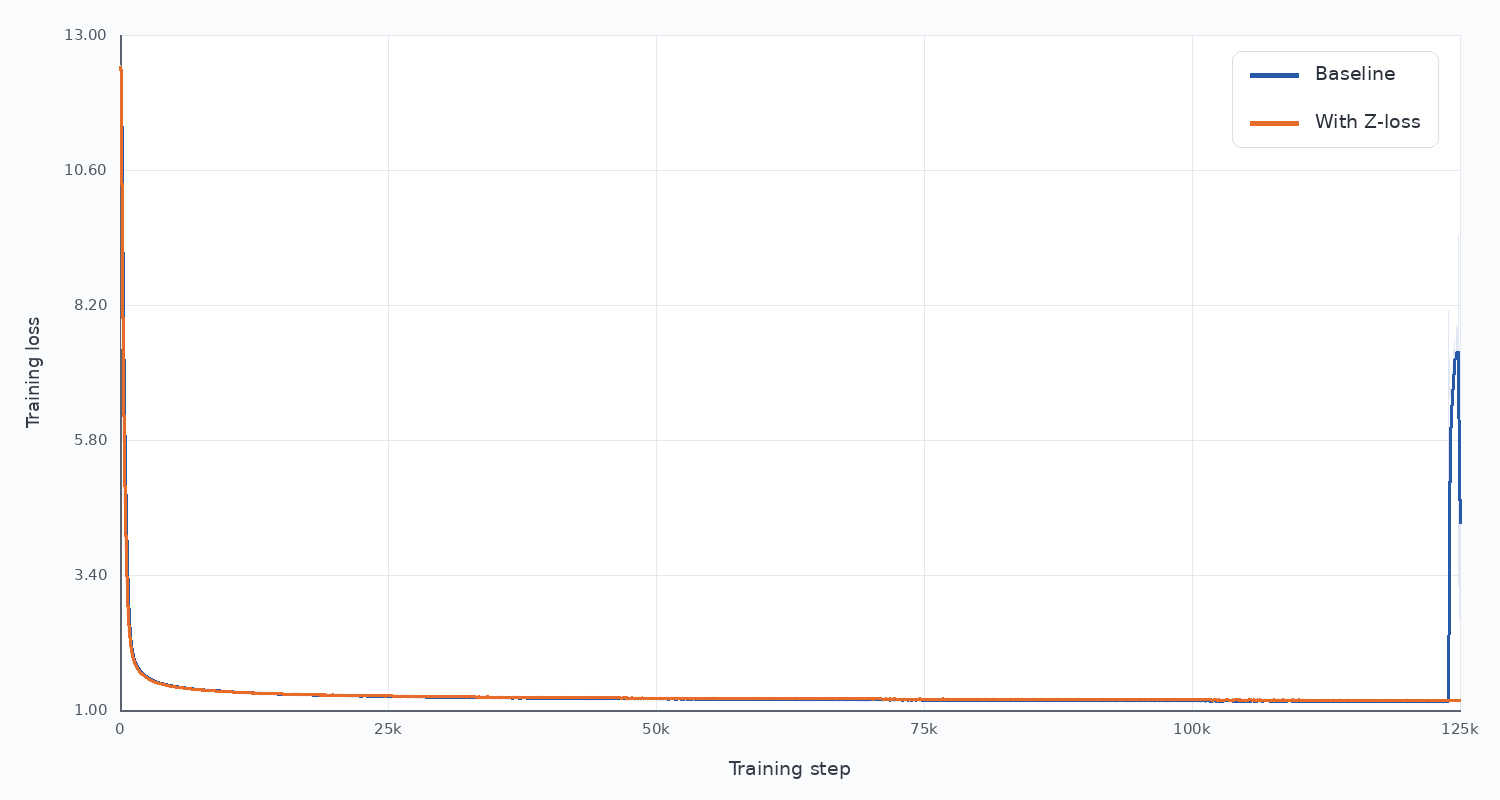
Yandex’s company-reported training experiment shows a late baseline loss spike alongside a stable run using Z-loss on mixture-of-experts output activations. Source: Habr.
The infrastructure question became more immediate after the release. In its October 29 results, Yandex said drone attacks had damaged several of its data centers during October. It said key functions across its services had been restored, while engineers were still restoring all capabilities. The company withdrew its 2026 revenue and adjusted EBITDA forecasts, citing the resulting uncertainty, while retaining its plans to develop foundation models. It said it was moving toward more distributed infrastructure. The filing does not identify an effect on this model’s training.
Yandex said it did not plan to increase 2026 capital spending, having bought equipment and invested in reserve capacity in advance. It reported 115 billion rubles of investment over the first nine months. That is group-wide investment, not a disclosed budget for AliceAI-Foundation.
The release also enters a domestic competition over technological independence. A contemporaneous account of that debate, citing earlier reporting, describes rival Russian bank and AI developer Sberbank’s July assertion that Yandex merely adapted Qwen while Sberbank had the only fully Russian foundational model. Yandex rejected that characterization. In the September release coverage, a Sberbank representative praised the engineering but argued that models below 100 billion parameters were already plentiful and that much larger flagships determined international standing. That size-based judgment is a competitor’s assessment, not a benchmark finding. Ownership of the development process, model size and measured usefulness are distinct questions.
The same report quoted Mikhail Koroteev, head of the Financial University’s AI department, identifying Sberbank’s GigaChat 3.5 Reasoning as a potential competitor after Yandex’s model undergoes post-training.
The September reporting says Yandex positioned the model as fully sovereign. It describes Russia’s AI law, effective September 1, as distinguishing sovereign models, which require domestic code, architecture and infrastructure, from national models, which can use foreign components. A representative of the deputy prime minister’s office said the government would assign formal status under implementing rules then being developed. The report identifies March 1, 2027 as the start date for the model-accounting and status procedure. It also describes proposed subsidies for discounts on Russian AI products for small and medium-sized businesses, and an investment tax deduction for model-development expenses. Criteria, funding and launch dates had not been settled. The release announcement therefore does not by itself establish either legal certification or an entitlement to support.
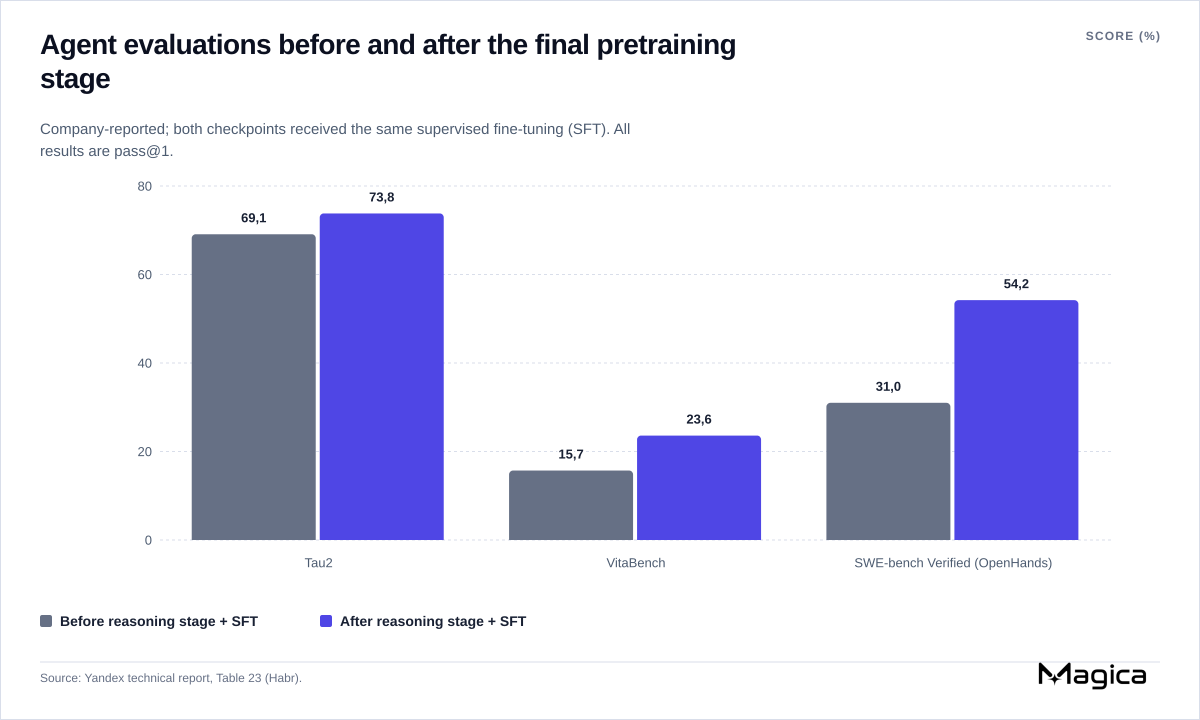
Company-reported agent evaluations after identical supervised fine-tuning, comparing checkpoints before and after the final pretraining stage. These are not results for the untouched public base checkpoint. Data: Yandex. Source: Habr.
For developers, the immediate opportunity is to adapt the released base weights. The next product question is whether Yandex can turn that foundation into an assistant that reliably uses tools and completes actions. Its own experiments found that hard reasoning examples alone left an early version behind Qwen on most agent tests; adding tool-interaction data narrowed the gap. The reported agent evaluations followed supervised fine-tuning, so those scores should not be presented as capabilities of the untouched public base checkpoint.
For a developer choosing between Alice, Qwen and other open base models, the next economic test is a reproducible serving comparison with specified hardware, precision, context length, throughput and latency. The published parameter counts and benchmark scores do not establish that bill. Independent task-completion results and measured serving costs would let developers judge whether the Russian benchmark advantage carries through to a working agent.
Nvidia closed at $150.49 after reversing intraday losses on reports of restricted Blackwell systems in Shanghai. Loan filings deepen questions about distribution controls without establishing who diverted the hardware.
Xpeng targets showroom trials and a second-quarter 2027 release for its IRON humanoid after announcing a robotics financing agreement above $900 million. Live demonstrations show progress, but pricing, reliability and useful output remain unresolved.
Q.ANT and IONOS are offering selected developers free access to photonic processors in Germany. Earlier tests show gains over Q.ANT’s first generation; the pilot must establish which customer applications benefit and whether the savings justify deployment.
The S&P 500 gained 1.6% in the shortened session and 5.6% for the week as technology shares recovered. Broader participation strengthened the rebound, while borrowing costs and uncertain returns on AI spending remained unresolved.
Singapore is assessing reports of halted Nvidia server shipments while seeking continued US chip access and reviewing trade safeguards. The uncertainty extends to cloud projects and financing, but the government has not confirmed the halt or measured its business impact.
Ren Zhengfei credits US sanctions with Huawei’s push for self-reliance. Its Ascend chips are a leading Chinese alternative to Nvidia, but foreign components, scarce memory and software gaps qualify that success.
Some 44% of employed euro-area consumers reported using AI at least weekly in August 2026. ECB researchers see adoption as broadly similar to the United States, but survey differences, checking costs and weaker investment leave the economic payoff unresolved.
Delaware’s unintroduced AI-company proposal would pair owner liability protections with continuing funding duties, shutdown controls and a supervised trial. Lawmakers still face questions about the need for a new legal form, recoverable capital and public access to the test results.
Germany wants generative AI providers to compensate rights holders for competing output through collecting societies. Eligibility would depend on allowing free training use, while fee levels and enforcement remain unresolved.

Iran’s semi-official Mehr News Agency circulated simulated attacks on technology company headquarters, demanding reparations over alleged military involvement. Public Pentagon agreements establish supplier ties, but do not substantiate the video’s accusations about attacks on Iran.
Elliot Callender’s hunger strike outside Anthropic reached its fifth day on November 27. His demands range from product warnings to a development halt, while the Claude developer has argued that a meaningful pause requires verifiable cooperation among competing labs.
Starting January 1, Rhode Island will require an open manual checkout for every three operating grocery self-checkouts, with separate protections for monitors’ workload. Stores’ responses elsewhere and limited research leave the effects on employment, prices and theft unsettled.
The German consumer organization wants an injunction against ChatGPT subscription cancellation hurdles and a price-change clause. The clause promises advance notice, but the claimant says it leaves the grounds for increases insufficiently defined.
Moonshot AI is accepting applications for Kimi for Science through December 8. Selected researchers can receive model-use credits and technical support, but the company has not disclosed the program’s total budget or cohort size.
Nvidia's proposed $290 million shareholder settlement would end disputed claims over cryptocurrency demand within gaming sales. The fund equals about 14% of plaintiffs' estimated maximum damages before fees and costs; court approval and individual payouts remain pending.
TrueLayer says an AI agent’s Papa John’s order was a UK first for direct bank payments to a retailer. The trial used customer-set, bank-enforced limits and human approval; merchant savings and readiness for wider use remain unproven.
Taiwan forecasts 6.51% economic growth in 2027 after a projected 13.28% surge in 2026, as AI hardware demand drives exports and capacity expansion despite risks to infrastructure investment.
Two Dutch court actions seek restrictions on Meta’s camera glasses, including a sales ban, over covert recording and disputed AI data practices. The cases test how much responsibility belongs to the companies that design and operate the glasses, rather than their wearers.
Dante Security has raised a $10 million seed round for AI agent monitoring and human accountability. Its founders bring enterprise-security experience, but existing vendor controls and limited deployment evidence complicate the pitch.
Avicena has raised over $100 million for microLED connections between AI chips, with a new CEO targeting a first product in 2027. Chipmaker backing strengthens its commercialization effort, but deployment economics remain unproven in the announcement.