Editorial Team
8 min read
Xpeng targets showroom trials and a second-quarter 2027 release for its IRON humanoid after announcing a robotics financing agreement above $900 million. Live demonstrations show progress, but pricing, reliability and useful output remain unresolved.
Xpeng plans to move its IRON humanoid from the stage into its own Chinese car showrooms in the first quarter of 2027, giving its proposed robotic coworker a workplace test before a targeted second-quarter public release. The Guangzhou-based, publicly listed electric-car maker describes IRON as a work partner; its immediate assignment is learning customer service, rather than demonstrating that it can take over an entire job, according to the company’s announcement.
The trial carries financial stakes beyond a product demonstration. In its September production announcement, Xpeng said its robotics business had entered share purchase agreements on August 24 to raise more than $900 million at a post-money valuation above $6.3 billion. It also forecast robot gross margins significantly higher than those of new-energy vehicles. These are financing terms and a company expectation, rather than demonstrated customer economics.
Xpeng wants to sell businesses the robot and charge for software, using its automotive technology and retail network to develop the product. The unresolved question is how much useful work buyers get after charging, supervision, maintenance and subscription costs.
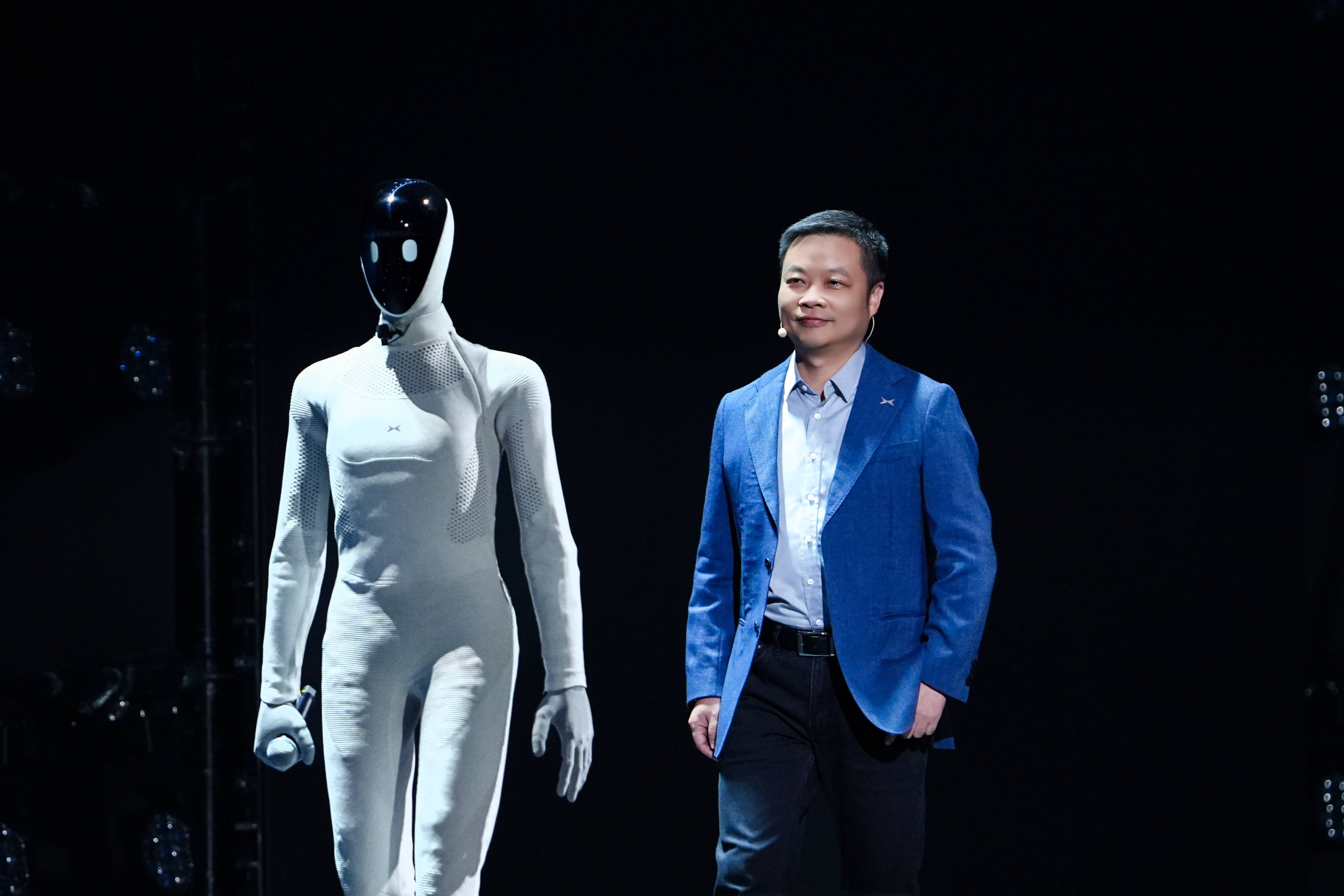
IRON beside XPENG chairman and CEO He Xiaopeng at AI Day in Guangzhou on November 25, 2026. Photo: XPENG. Source: XPENG.
The production-intent IRON appeared at Xpeng’s November 25 AI Day in Guangzhou. Chairman and chief executive He Xiaopeng, the carmaker’s co-founder, previously co-founded mobile-internet software company UCWeb, which Alibaba acquired in 2014, according to Xpeng’s annual report. He is extending the carmaker’s software and hardware development into robotics.
IRON follows the humanlike robot shown a year earlier, whose gait prompted suspicions that a person was inside. This version walked onstage autonomously, spoke with the audience and returned to its charging position, according to the event report.
The company has also abandoned the earlier male and female body variants for a standardized unisex form. Executives tied that decision to manufacturing practicality and fitting into different workplaces, according to on-site reporting. Animated eyes and warmed hands retain the emphasis on approachable human interaction.
Xpeng says IRON stands 170 centimeters tall, weighs 62 kilograms and has 76 degrees of freedom, including 21 in each hand, with more than 1,500 tactile sensing points. Three of its own Turing AI chips support onboard intelligence and body control. These specifications describe sensing and movement capacity; they are not measurements of completed workplace tasks.
The manufacturing chronology deserves care. Xpeng commissioned its production lines in September, when it said mass production was scheduled by the end of 2026. The latest event reporting instead places hardware mass production in January 2027. The line is designed to assemble one robot every 2.5 minutes at full capacity, a design rate rather than evidence of current output or customer demand.
On-site reporting observed walking, microphone holding and proximity to crowds without incident across the stage and media sessions. Seven robots mingled with visitors after the presentation. This demonstrated progress in movement and interaction, although it did not establish reliability across ordinary working shifts.
The conversational system was less polished. Robots interrupted people and repeatedly asked questions after answering them. He acknowledged that the questioning habit was an error and that more training was needed, according to the demonstration report. Separate on-site reporting observed an unexpected switch from English to Chinese.
Xpeng’s round-the-clock scheduling claim also needs to be read alongside its battery specification: 20 minutes of charging provides 90 minutes of work. Autonomous charging can reduce the need for a person to plug it in, but charging remains downtime. The reporting also identifies limited tool use and an inability to work outdoors in rain.
Xpeng vice president Jacky Gu, the executive in charge of IRON, supplied further limits in an interview after AI Day. He said formal engineering work on IRON began two and a half years ago, following a longer period of robotics work. IRON cannot pick up a person, and its dexterous hands can comfortably hold and carry three to five kilograms.
Gu said soft skin makes interaction friendlier while complicating heat removal from batteries, actuators and electronics. Most processing happens onboard, with cloud computing used for slower reasoning; local processing does not mean every capability is independent of a connection. He declined to give a standard time for learning a new skill, saying it depends on the task’s size and complexity.
Xpeng describes safeguards including a backup balance controller, pinch protection, a controlled response to falls and a physical emergency-stop button. It calls the battery solid-state and says it tolerates temperatures up to 200 degrees Celsius, but has not disclosed the exact electrolyte chemistry. The on-site technical report leaves unresolved whether the production cells are all-solid-state or a semi-solid hybrid. These remain company specifications and open technical questions.
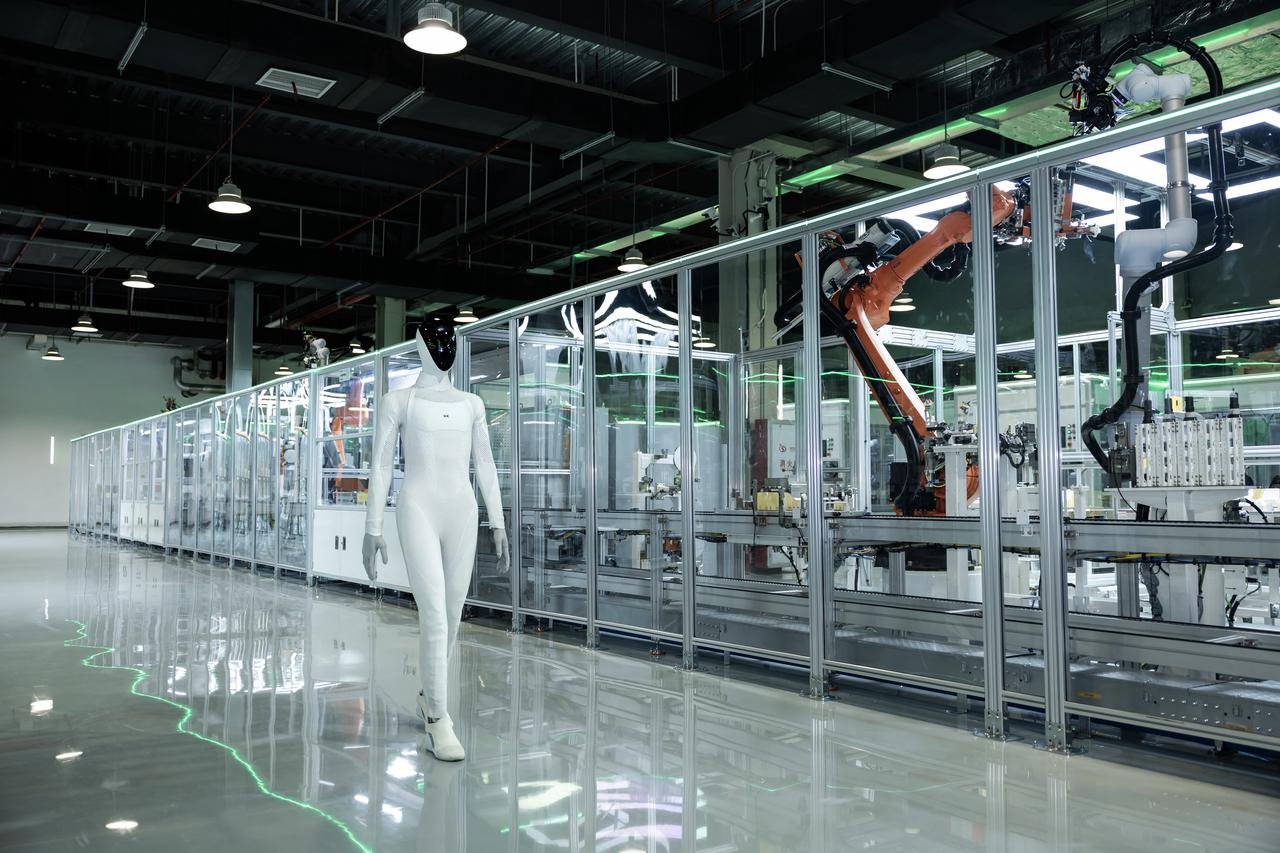
IRON beside manufacturing equipment in XPENG’s September 2026 production-line commissioning announcement. Photo: XPENG. Source: XPENG September production announcement.
Xpeng’s development plan draws on infrastructure it already uses in cars. Its new Turing Physical AI Architecture, also called VLA 3.0, connects higher-level task planning, rapid interpretation and action, and physical hardware control. The company says cars and robots can share computing, data-processing, evaluation and safety technologies while developing capabilities specific to each machine.
Xpeng says its Robot Data Factory covers more than 250 scenarios and 15 job categories. These are development settings and intended types of work, rather than a count of proven commercial deployments. The company also describes more than 600 AI quality-inspection items and over 1,000 tests for complete robots and components on its assembly line. Those establish a manufacturing process to test, rather than field reliability results. Its own showrooms provide places to collect experience; Xpeng says its global network includes more than 1,300 retail stores, although it has not said how many will receive robots.
The proposed commercial model combines hardware sales, software subscriptions and a platform for partners to download or develop job-specific capabilities. Token-based subscriptions and scenario-based services remain under exploration. No hardware price or subscription tariff has been announced. Neither the robotics business’s financing valuation nor its forecast margins supplies those missing costs. Without prices and measured task performance, a comparison with staffing costs would be premature.
Xpeng says IRON can lift boxes, stock bookshelves and chop vegetables, according to the product report. These are claimed capabilities rather than published shift-level productivity results. Its proposed roles range from reception to window cleaning. Whether IRON assists staff or substitutes for some of their work depends on what it reliably completes and how employers deploy it.
He himself described the robotics business as promising over the long term but warranting caution in the short term. In the post-event briefing, he identified extensive human assistance and achieving a viable return on investment as central industry challenges, according to the event report.
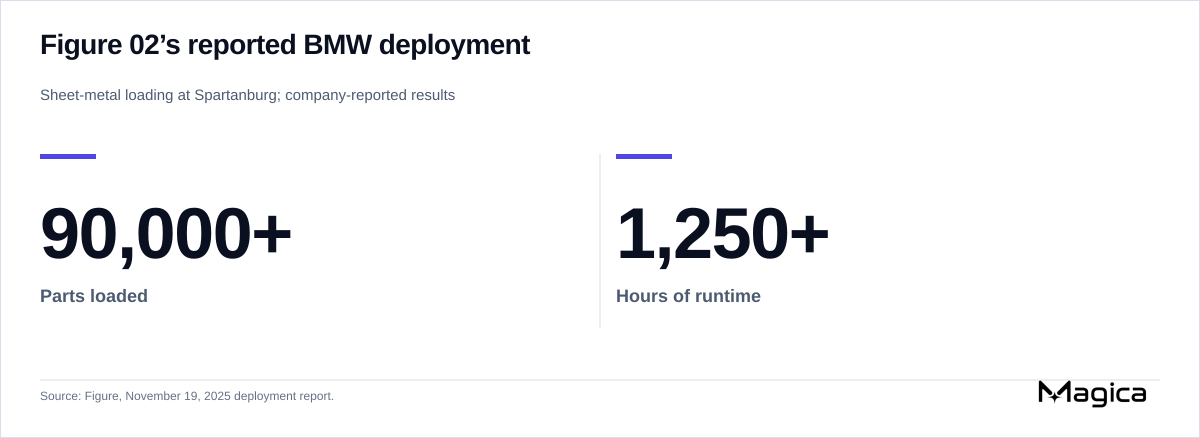
Figure’s company-reported BMW deployment totals: 90,000-plus parts loaded and 1,250-plus runtime hours. Its industrial task differs from IRON’s proposed retail roles. Source: Figure BMW deployment report.
Humanoid workplace deployment already has a relevant comparison. Robot developer Figure reported in November 2025 that its second-generation Figure 02 robots loaded more than 90,000 parts across more than 1,250 hours of runtime during an 11-month deployment at carmaker BMW’s Spartanburg plant. The task was sheet-metal loading for industrial robots to weld, rather than retail interaction, so those figures cannot rank IRON’s performance.
Figure identified cycle time, placement accuracy and human interventions as its key measures. Its placement target was for all three sheet-metal parts to be correctly loaded in more than 99% of cycles per shift; its intervention goal was zero per shift. Those were targets, not disclosed achieved rates. It also reported a forearm electronics failure point that informed a redesign for Figure 03, as Figure 02 began retirement.
The account is the developer’s own report. It establishes a useful standard of evidence: a defined task, recorded runtime, countable output and an account of failures. Humanlike movement alone is a weaker basis for a business purchase.
Xpeng’s November 27 auto-show announcement says multiple IRON units greeted visitors, explained vehicles and answered enquiries at its booth. It also announces a Hong Kong research center focused on humanoid robotics and general-purpose intelligence, and plans international deployment beginning with overseas showrooms in the second half of 2027.
That overseas-showroom target is earlier than the 2028 or 2029 possibility for wider overseas deployment discussed in the executive interview, which emphasized regulation. The scopes differ; neither should be treated as a firm timetable for broad international availability. Household chores remain a later ambition, with even the interview’s pre-2030 prospect qualified as covering only some tasks.
The immediate milestones are January hardware production, first-quarter showroom training and the second-quarter release. What would make those milestones consequential is evidence of completed tasks, human interventions, charging and maintenance time, and the full price of operation. Until then, IRON’s coworker identity is a commercial proposition awaiting an ordinary working shift.
Nvidia closed at $150.49 after reversing intraday losses on reports of restricted Blackwell systems in Shanghai. Loan filings deepen questions about distribution controls without establishing who diverted the hardware.
Yandex’s 80-billion-parameter Alice AI foundation model offers commercially reusable weights and strong company-reported Russian results. Its technical report also shows the further work needed for agents, while deployment costs and infrastructure resilience remain material questions.
Q.ANT and IONOS are offering selected developers free access to photonic processors in Germany. Earlier tests show gains over Q.ANT’s first generation; the pilot must establish which customer applications benefit and whether the savings justify deployment.
The S&P 500 gained 1.6% in the shortened session and 5.6% for the week as technology shares recovered. Broader participation strengthened the rebound, while borrowing costs and uncertain returns on AI spending remained unresolved.
Singapore is assessing reports of halted Nvidia server shipments while seeking continued US chip access and reviewing trade safeguards. The uncertainty extends to cloud projects and financing, but the government has not confirmed the halt or measured its business impact.
Ren Zhengfei credits US sanctions with Huawei’s push for self-reliance. Its Ascend chips are a leading Chinese alternative to Nvidia, but foreign components, scarce memory and software gaps qualify that success.
Some 44% of employed euro-area consumers reported using AI at least weekly in August 2026. ECB researchers see adoption as broadly similar to the United States, but survey differences, checking costs and weaker investment leave the economic payoff unresolved.
Delaware’s unintroduced AI-company proposal would pair owner liability protections with continuing funding duties, shutdown controls and a supervised trial. Lawmakers still face questions about the need for a new legal form, recoverable capital and public access to the test results.
Germany wants generative AI providers to compensate rights holders for competing output through collecting societies. Eligibility would depend on allowing free training use, while fee levels and enforcement remain unresolved.

Iran’s semi-official Mehr News Agency circulated simulated attacks on technology company headquarters, demanding reparations over alleged military involvement. Public Pentagon agreements establish supplier ties, but do not substantiate the video’s accusations about attacks on Iran.
Elliot Callender’s hunger strike outside Anthropic reached its fifth day on November 27. His demands range from product warnings to a development halt, while the Claude developer has argued that a meaningful pause requires verifiable cooperation among competing labs.
Starting January 1, Rhode Island will require an open manual checkout for every three operating grocery self-checkouts, with separate protections for monitors’ workload. Stores’ responses elsewhere and limited research leave the effects on employment, prices and theft unsettled.
The German consumer organization wants an injunction against ChatGPT subscription cancellation hurdles and a price-change clause. The clause promises advance notice, but the claimant says it leaves the grounds for increases insufficiently defined.
Moonshot AI is accepting applications for Kimi for Science through December 8. Selected researchers can receive model-use credits and technical support, but the company has not disclosed the program’s total budget or cohort size.
Nvidia's proposed $290 million shareholder settlement would end disputed claims over cryptocurrency demand within gaming sales. The fund equals about 14% of plaintiffs' estimated maximum damages before fees and costs; court approval and individual payouts remain pending.
TrueLayer says an AI agent’s Papa John’s order was a UK first for direct bank payments to a retailer. The trial used customer-set, bank-enforced limits and human approval; merchant savings and readiness for wider use remain unproven.
Taiwan forecasts 6.51% economic growth in 2027 after a projected 13.28% surge in 2026, as AI hardware demand drives exports and capacity expansion despite risks to infrastructure investment.
Two Dutch court actions seek restrictions on Meta’s camera glasses, including a sales ban, over covert recording and disputed AI data practices. The cases test how much responsibility belongs to the companies that design and operate the glasses, rather than their wearers.
Dante Security has raised a $10 million seed round for AI agent monitoring and human accountability. Its founders bring enterprise-security experience, but existing vendor controls and limited deployment evidence complicate the pitch.
Avicena has raised over $100 million for microLED connections between AI chips, with a new CEO targeting a first product in 2027. Chipmaker backing strengthens its commercialization effort, but deployment economics remain unproven in the announcement.