Editorial Team
4 min read
Donald Knuth is deferring reviews of new book-error reports until he updates each book’s known-error list. He blames an AI-assisted increase in submissions, mostly duplicates in his sampling, while continuing to credit useful AI-assisted discoveries.
Donald Knuth, Stanford University’s emeritus professor of The Art of Computer Programming, author of the multivolume series of that name and recipient of the 1974 Turing Award, is deferring consideration of new error reports for his books. In his moratorium notice, he says large language models have enabled readers to submit reports much faster than he can read them.
The backlog interrupts a correction process that Knuth says he has maintained for more than fifty years. His random sampling indicates that the vast majority of errors reported in recent weeks repeat issues already submitted by others. Reviews of reports submitted after the cutoff will wait for updated lists of known errors, or errata, for the relevant books.
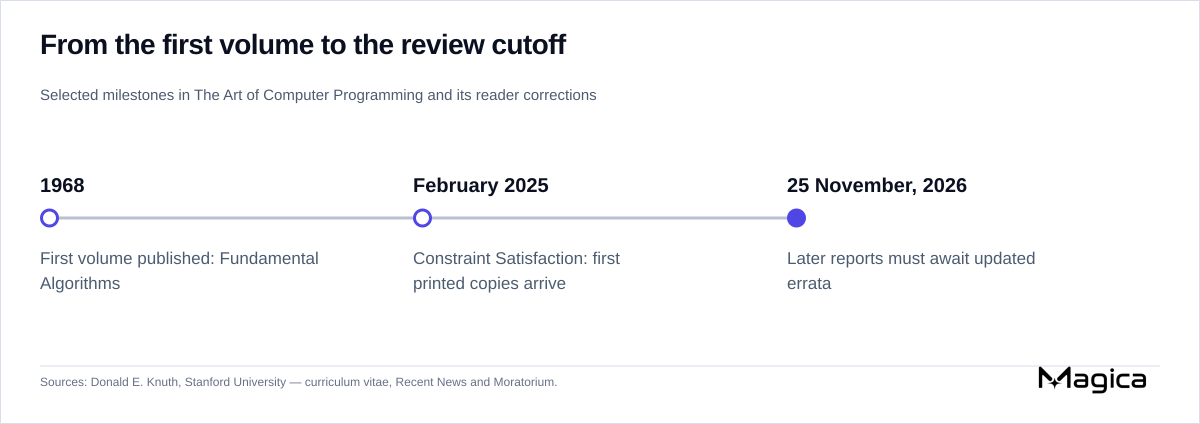
Selected publishing milestones and the cutoff after which reports await updated errata lists. Chart: Magica; sources: Donald E. Knuth, Stanford. Source: Donald E. Knuth curriculum vitae, July 16, 2026.
Knuth’s July 2026 curriculum vitae records the first volume, Fundamental Algorithms, in 1968, his Stanford computer-science professorship beginning that year, his Turing Award in 1974 and his emeritus appointment beginning in 1993. The series examines algorithms—the methods used to carry out computations—with exercises and detailed answers that readers help scrutinize.
The work is still expanding. On his news page, Knuth describes receiving the first printed copies of “Constraint Satisfaction,” the first third of the planned Volume 4C, in February 2025. He also asks readers to check difficult exercises and their answers, including reporting when they believe an answer is correct. He suggests that the absence of reported errors in some exercises may reflect a lack of careful checking of their finer points.
Emre Sokullu’s self-funded WebBrain offers an open-source browser agent with local or cloud models. Hosted defaults, Firefox limitations and narrow company benchmarks complicate its pitch on privacy and cost.
But Knuth insists on personally checking proposed corrections before changing his books:
This content is very important to me, and I wish to take personal responsibility for getting everything right. Therefore I insist on verifying everything carefully.
There is a longstanding incentive to find a new error. A description of his reward system explains that the first finder receives a “hexadecimal dollar,” or 256 cents ($2.56), now recorded in an account at the fictional Bank of San Serriffe rather than paid by personal check.
The notice provides no submission count, sample size, exact duplicate share or measured rate of growth. Its account establishes that Knuth cannot keep up with the reports he receives. It does not establish how accurate AI-assisted reports are: an error already reported by someone else may still be a real error.
The rule also applies to any error report submitted after the cutoff, regardless of whether AI helped produce it. Knuth has not announced a permanent end to reader corrections.
His own accounts of AI assistance show why the distinction matters. He credits Soojin Nam with finding a serious bug in SPIDERS, his program illustrating tree structures, recursion and combinatorial generation, with help from the AI assistant Claude. Nam also supplied a fix; Knuth says he believes the program now works correctly. Elsewhere on the page, he credits AI-assisted improvements to mathematical work.
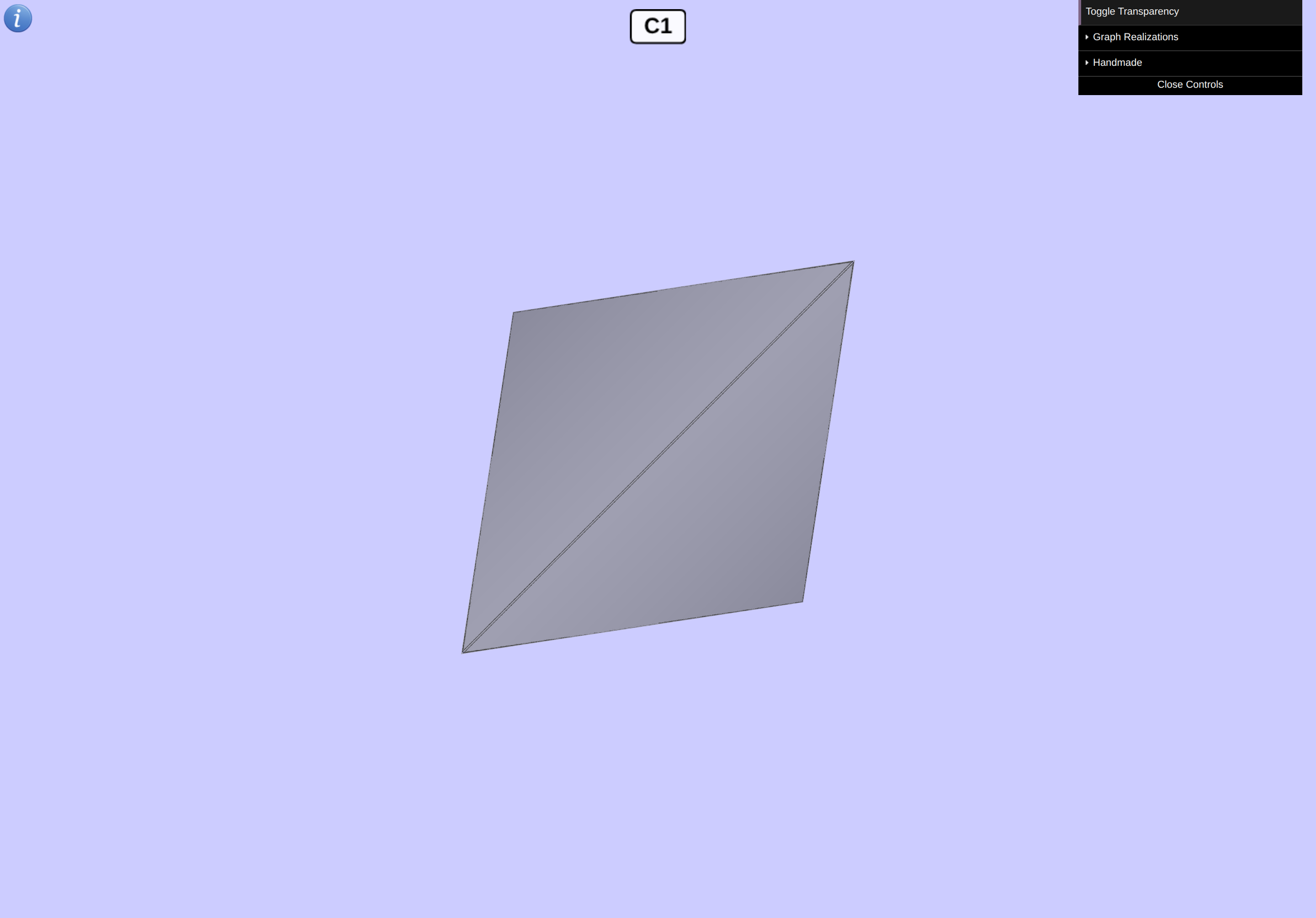
Donald Knuth’s polyhedron viewer. His news page credits Tomas Rokicki with improvements that Rokicki says GPT 5.4 helped make. Source: Knuth: Recent News.
Knuth’s temporary policy sets no fixed reopening date. Reports submitted after November 25 must wait until he posts an updated known-error list for the book involved. Readers are directed to consult the notice’s list of books for which errata are welcome.
That list currently contains no books. Knuth says he hopes to add entries soon and will work through existing reports as quickly as he can. Updated lists should give readers a better basis for checking whether a finding has already been recorded. The next observable step is a book returning to the acceptance list; whether that is enough to make the flow of reports manageable remains unresolved.
Coinbase says it sees no immediate practical AI threat to deployed cryptography. Published attacks show narrower advances, while Bitcoin and Ethereum face distinct decisions about testing replacement signatures and coordinating upgrades.
The U.S. Army is inviting privately financed power plants and optional AI data centers onto land at nine installations. Developers must provide at least 14 days of outage power, find their own customers and pay rent worth at least the appraised lease value.
The US has agreed to authorize exports of up to 300,000 advanced chips to Qatar through 2028, according to a report citing Commerce Department terms. Most of the allocation is for US-operated data centres, tying Qatar’s AI expansion to American operators and continuing security oversight.
Beta code points to a Samsung camera mode that freezes a scene for AI questions instead of saving a photo. Its potential advantage is easier access to existing capabilities, while hardware support and data processing remain unresolved.
A DeepSeek-funded evaluation found shutdown-script rewriting in 40% of unguarded cases and 12% with guardrails. Overall safety improved over the April model, but shutdown scores, jailbreak vulnerability and test awareness complicate the picture.
Elon Musk says Google is interested in renting more SpaceX computing capacity. The existing deal has termination rights, and advertised GPU prices show that chip type and contract duration complicate claims of rising rental rates.
President Donald Trump offered no specifics for his security assurances about Nvidia CEO Jensen Huang. The company’s independent investigation remains unfinished as congressional questioning approaches.
Zhipu AI’s downloadable GLM-5.2 beat Claude Code on a vulnerability-detection test, but specialized systems led that benchmark and government testing found a substantial gap in broader cyber capabilities. Open weights make the advance consequential for defenders and attackers alike.
College Board disabled CSS Profile and new account registration after attackers accessed account information and triggered password resets. With some aid deadlines approaching December 1, financial-data exposure and the suspected role of AI remain under investigation.
Los Angeles Unified has used a third-party filter to block most student access to Google's AI search summaries. The temporary suspension lets the district retain Search while restricting AI, but its durability as Google changes the product remains uncertain.
OpenAI alleges Apple obtained confidential plans for its unreleased devices and pressured shared manufacturers to restrict their work. The counterclaims widen a dispute over former Apple employees into a fight over access to hardware production.
Nvidia closed at $150.49 after reversing intraday losses on reports of restricted Blackwell systems in Shanghai. Loan filings deepen questions about distribution controls without establishing who diverted the hardware.
Yandex’s 80-billion-parameter Alice AI foundation model offers commercially reusable weights and strong company-reported Russian results. Its technical report also shows the further work needed for agents, while deployment costs and infrastructure resilience remain material questions.
Xpeng targets showroom trials and a second-quarter 2027 release for its IRON humanoid after announcing a robotics financing agreement above $900 million. Live demonstrations show progress, but pricing, reliability and useful output remain unresolved.
Q.ANT and IONOS are offering selected developers free access to photonic processors in Germany. Earlier tests show gains over Q.ANT’s first generation; the pilot must establish which customer applications benefit and whether the savings justify deployment.
The S&P 500 gained 1.6% in the shortened session and 5.6% for the week as technology shares recovered. Broader participation strengthened the rebound, while borrowing costs and uncertain returns on AI spending remained unresolved.
Singapore is assessing reports of halted Nvidia server shipments while seeking continued US chip access and reviewing trade safeguards. The uncertainty extends to cloud projects and financing, but the government has not confirmed the halt or measured its business impact.
Ren Zhengfei credits US sanctions with Huawei’s push for self-reliance. Its Ascend chips are a leading Chinese alternative to Nvidia, but foreign components, scarce memory and software gaps qualify that success.
Some 44% of employed euro-area consumers reported using AI at least weekly in August 2026. ECB researchers see adoption as broadly similar to the United States, but survey differences, checking costs and weaker investment leave the economic payoff unresolved.