Editorial Team
7 min read
Step 5 Preview reaches OpenRouter at $1 per million input tokens and $2.70 for output. Caching lowers the input bill, but benchmark results show why buyers must weigh task consumption and performance; StepFun remains the sole listed provider ahead of a promised October 15 weight release.
StepFun, the Shanghai-based developer of the Step family of AI models, has added its 600-billion-parameter Step 5 Preview to OpenRouter, a gateway through which developers access multiple model makers using a common API. The October 8 listing extends distribution of a flagship aimed at software engineering and multistep professional work, days before StepFun’s promised release of its weights.
The commercial test is whether its combination of capability and token prices produces better value on completed work. Independent evaluations show a capable but verbose model; StepFun’s own tests show substantial gaps to leading rivals on some coding tasks. OpenRouter makes it easier for existing customers to compare those trade-offs, although every request on this route still goes to StepFun.
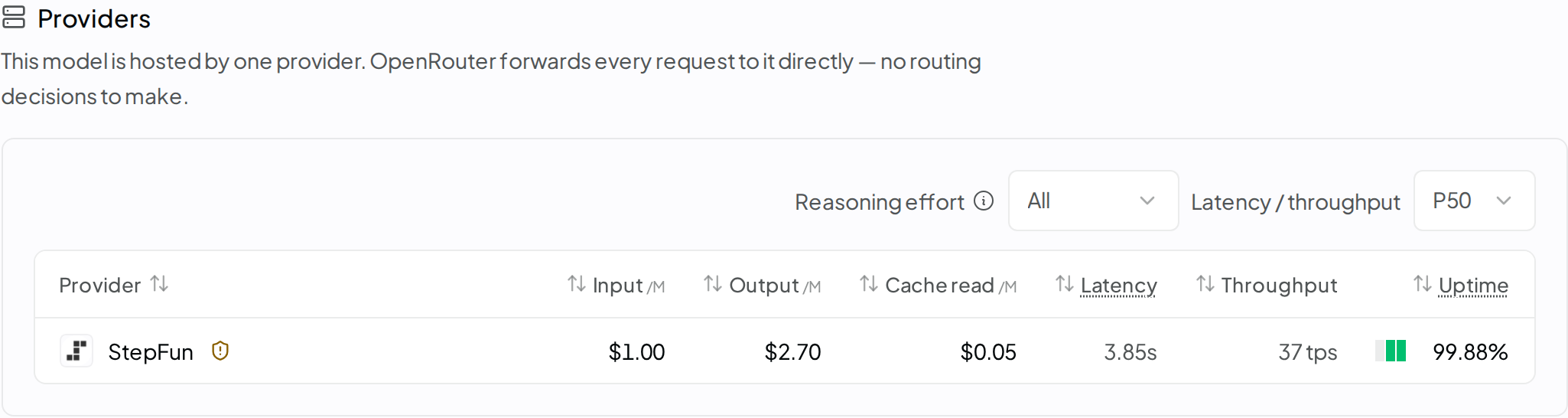
OpenRouter’s listing at the article’s original snapshot showed StepFun as the sole provider. Prices and company-reported performance observations describe that capture. Source: OpenRouter.
The model was already available before this listing. An account of the catalogue addition places StepFun’s announcement in September; the independent evaluation page records September 18 as the release date. October 8 is the date shown by OpenRouter, not evidence of the model’s first availability.
StepFun brings both an existing model range and substantial financing. A January financing report citing Chinese business reporting said it had completed a B+ round exceeding RMB 5 billion, approximately $718 million at the report’s conversion. Existing shareholders Tencent, Qiming Venture Partners and 5Y Capital participated alongside other investors. The report described the proceeds as supporting foundational models and StepFun’s strategy of putting AI into devices; it did not assign that sum to Step 5.
OpenRouter has its own expansion to fund. In a May 28 announcement updated August 19, it disclosed a $113 million Series B led by CapitalG, Alphabet’s independent growth fund, with investors including NVIDIA’s NVentures. OpenRouter said it served more than 8 million developers across more than 400 models and that weekly traffic had grown from 5 trillion to 25 trillion tokens over six months. These are company-reported platform totals, not Step 5 adoption figures.
That audience is the distribution opportunity. OpenRouter says it is investing in enterprise capabilities and routing between providers, but its Step 5 listing explicitly identifies a single provider. The gateway’s general ability to switch suppliers does not establish backup capacity for this particular model.
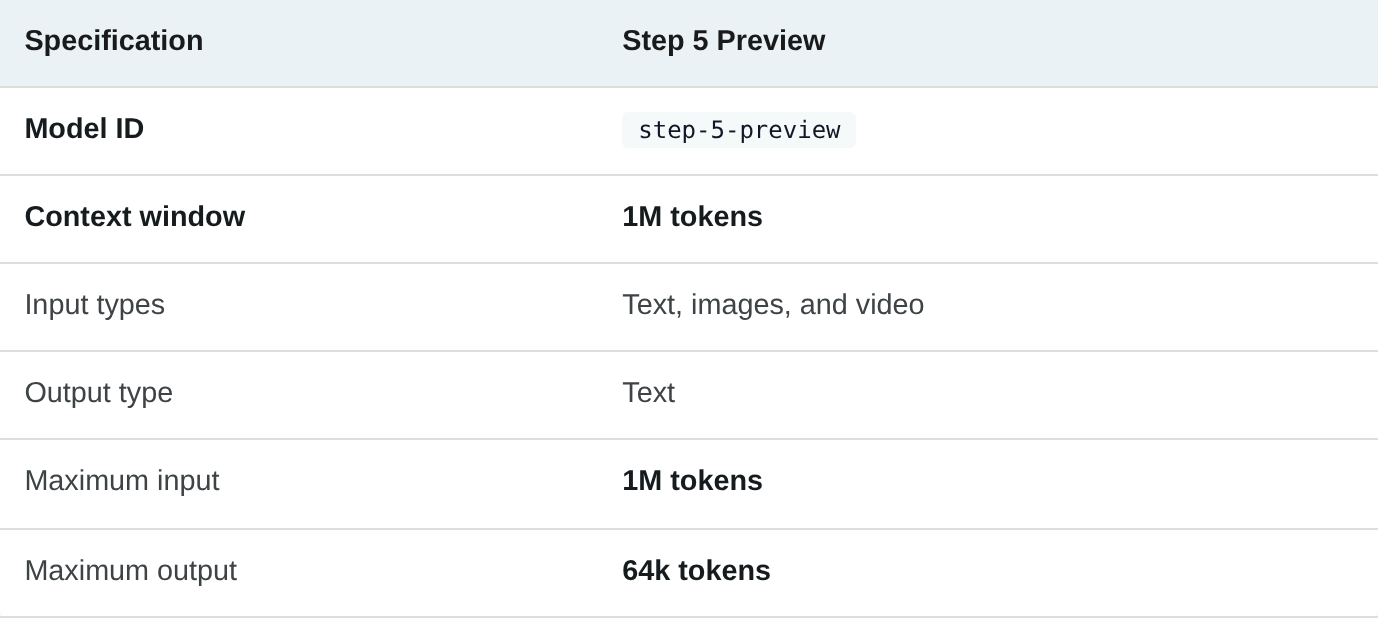
StepFun’s company-reported specifications list a 1M-token context window, text, image and video input, and a maximum output of 64k tokens. Source: StepFun Documentation.
According to StepFun’s announcement, Step 5 uses a sparse mixture-of-experts architecture, activating 27 billion of its 600 billion parameters per token. Its technical documentation specifies a million-token context window, text output of up to 64,000 tokens, and text, image and video input. It supports tool calling, structured output and selectable reasoning effort.
StepFun already offers less expensive alternatives. The same catalogue page describes Step 3.7 Flash as a multimodal model with a 196-billion-parameter language backbone, roughly 11 billion active parameters and a 256K context window. It also describes Step 3.5 Flash as an open-source reasoning model with 196 billion total and 11 billion active parameters.
| StepFun model | Listed input price per million tokens | Listed output price per million tokens |
|---|---|---|
| Step 3.5 Flash | $0.10 | $0.30 |
| Step 3.7 Flash | $0.20 | $1.15 |
| Step 5 Preview | $1.00 | $2.70 |
These are ordinary input and output rates, excluding cache discounts. Step 5’s larger context and flagship positioning must justify a premium even within StepFun’s own range. Parameter count alone does not answer that question.
OpenRouter lists cache reads at $0.05 per million input tokens, a 95% reduction from uncached input. Its captured pricing panel reports an effective input price of about $0.0915 per million tokens and a 95.6% cache-hit rate. That is an observed platform snapshot, not a promised rate for a new customer: the mix of reused and fresh input determines the bill.
For illustration, 1 million uncached input tokens plus 100,000 output tokens across multiple requests would cost $1.27 at the listed rates. If all that input instead qualified for cache reads, the cost would be $0.32. Neither example is a measured session. The Pi agent-session estimator explains that one user turn can trigger multiple model requests, that the first request normally starts without cached input, and that providers differ in cache eligibility and retention.
The independent model evaluation reports an Intelligence Index score of 44 against a comparison median of 26, and a weighted cost of $1.03 per index task. Its index combines ten evaluations; the cost measure incorporates input, cache, reasoning and answer tokens, divided by task count and weighted by each evaluation’s contribution to the index.
The comparison group is broad. The page’s methodology allows reasoning models to be compared with non-reasoning models and places proprietary models in price bands using a three-to-one input/output mix. Step 5 falls in the band above $1 per million blended tokens. The median therefore does not represent a tightly matched shortlist at Step 5’s exact price.
Step 5 generated 160 million output tokens across the index evaluations, against the page’s comparison median of 81 million. That consumption is already reflected in the benchmark cost, rather than an extra charge to add to $1.03. Also, the evaluator lists a 90% cache discount for StepFun’s API, different from OpenRouter’s 95% listed discount. Its task cost is useful evidence about a particular evaluation workload, not a quote for running it through OpenRouter.
Early usage offers another bounded signal. The OpenCode usage dashboard reports about 13,000 unique users in its displayed August 15–October 9 window, with the model’s daily token entries appearing on October 8 and 9. It ranks Step 5 tenth for the preceding week while assigning it 0.1% of observed two-month token volume. Those different time windows describe early activity on that service; neither figure establishes industry-wide market share or successful task completion.
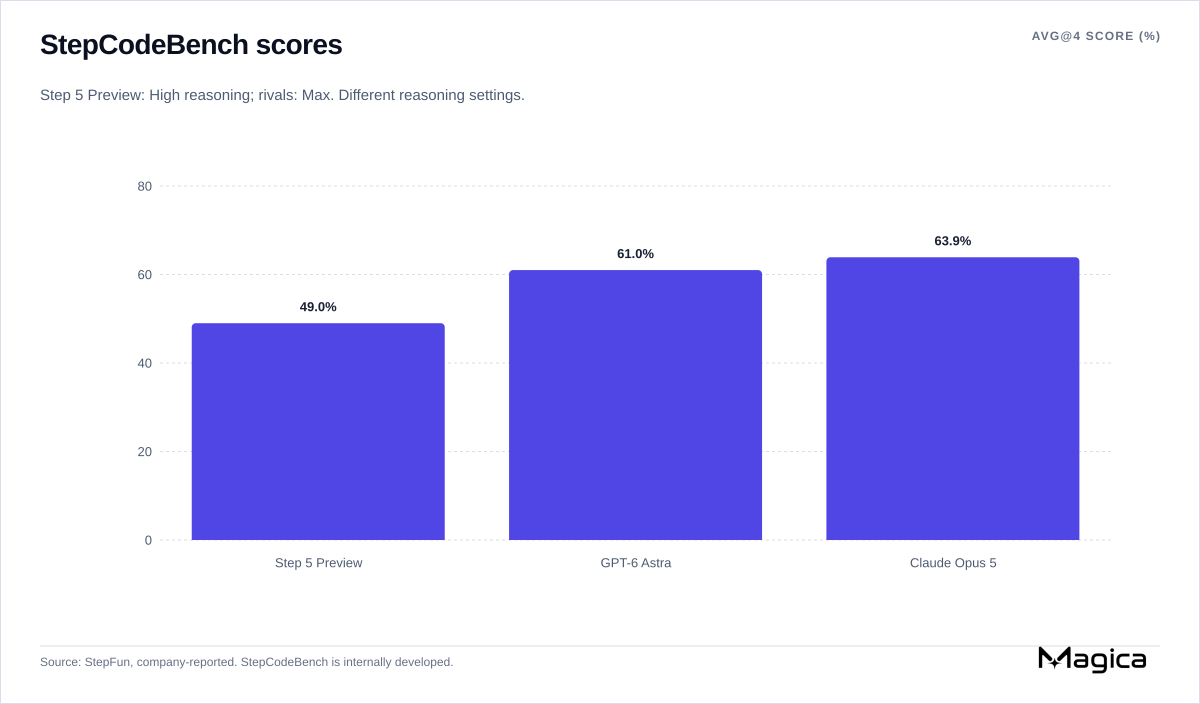
StepFun’s company-reported StepCodeBench scores use High reasoning effort for Step 5 Preview and Max for both rivals; these are not equal-compute or equal-cost comparisons. Source: StepFun.
StepFun’s evaluation table makes the performance trade-off concrete. On StepCodeBench, its internally developed software-engineering test spanning 553 repositories, Step 5 scores 49.0% on the reported avg@4 measure, versus 63.9% for Anthropic’s Claude Opus 5. StepFun explicitly acknowledges a gap on the most difficult long-running tasks.
The company reports a closer result in finance: 66.4% on FrontierFinance, versus 69.7% for Claude Opus 5 and 55.0% for OpenAI’s GPT-6 Astra. That external benchmark covers six investment use cases through 220 expert-crafted questions. The results here are still StepFun-reported runs. Its table uses High reasoning effort for Step 5 and Max for those rivals, so the scores do not establish equal-compute or equal-cost comparisons.
StepFun promises open weights on October 15. At the October 9 snapshot, the independent evaluation still describes the weights as unavailable. The announcement supplies neither a deployment configuration nor a license; buyers seeking self-hosting need the actual files, permitted uses and hardware requirements before judging that alternative’s cost or practicality.
For hosted users, the immediate decision is whether Step 5 delivers acceptable work with their application’s tools. StepFun’s documentation says the integrating application provides search, code execution and external-service access. A meaningful comparison therefore needs the same task, tools and acceptance criteria, with retries and human corrections counted alongside token charges. The weight release and any additional hosting providers will determine whether the next step expands control over deployment as well as access to the model.
Supertake's seed round and former Coinbase AI leaders back a service that turns market opinions into portfolios. Brokerage constraints, unaudited returns and an undefined revenue-sharing model complicate its ambition to reward the best ideas.
South Korean stocks rebounded as Nvidia co-founder Jensen Huang returned as CEO, lifting Samsung Electronics and SK hynix. The rally recovered only part of recent losses, with a board investigation and doubts about AI investment still unresolved.
AWS has released five open-weight decision models that read shared context in both directions and return probabilities rather than generated text. Its results suggest better handling of pivotal details, but deployment savings and confidence scores still need testing on real workloads.
OpenAI is bringing a conversational version of GPT-6.2 Sol to four paid ChatGPT tiers ahead of a reported December 23 retirement of two older models. Its tests show better image understanding and web search, but uneven progress on factuality and instruction steering.
Redwood and Crusoe announced plans to expand their Nevada AI campus after reporting 99.2% microgrid availability. Crusoe separately cites grid backup for cloud reliability, while undisclosed project costs leave the used-battery business case unresolved.
Jensen Huang’s return as Nvidia CEO leaves December congressional questioning intact. Lawmakers want evidence behind the board’s security assurance and answers about chip exports and the administration’s involvement.
The Commerce Department added Singapore-based Megaspeed to its Entity List, imposing a licensing barrier on supplies to a longstanding Nvidia customer while allegations of chip diversion remain unresolved.
Google is rolling out optional Wallet access in Search’s AI Mode, with Drive and Gemini connections to follow. The expansion brings existing personal-finance capabilities into Search, while data-use permissions extend beyond the read-only limit on financial actions.
Anthropic has launched Claude Ship for GitHub repositories, combining code review with new agents that fix problems and apply approval policies. Teams retain control through repository rules, while automation adds token costs and can allow changes to merge without human review.
Google’s patent application describes generating videos from viewing habits, demographics and device context, with optional replicas of the viewer and inserted ads. Existing video tools show parts of the idea are already available; a commercial service and its economics remain unproven.
Google’s Gemini API can slice documents, spreadsheets and recordings on its servers and bill for selected content sent to the model. The controls reduce local preparation work, but upload limits, model defaults and the cost of finding relevant material qualify the savings.
OpenAI's OpenWorks pilot offers free AI assistance to eligible small businesses in 20 U.S. communities, pairing paid local partners with a three-month ChatGPT Business trial. It builds on earlier training efforts, but its total budget is undisclosed and typical business returns are unproven.
Nothing plans to unveil Ear (note) on December 8, pairing call-recording earbuds with a case that captures meetings for AI transcription. Existing recording products, uncertain service costs and unresolved privacy details narrow the novelty of the pitch.
Anthropic’s Enterprise Frontier Safeguards beta lets eligible businesses use its most capable Claude models while keeping encrypted safety records in their own cloud accounts. Automated monitoring remains; customers pay cloud costs and review flagged cases.
Hakeem Jeffries promised an investigation after Nvidia reinstated Jensen Huang following Donald Trump’s intervention. Reports that directors excluded interim CEO Colette Kress sharpen questions about the reversal and its national security assurances.
The European Commission has confirmed a leak affecting users of its public learning platform, while the number affected, the wider exposure of staff data and responsibility for the attack remain unresolved.
Maintainers defend continued distribution of the AI penetration-testing framework after its creator withdrew it. Investigations document data theft and cheap automation, but also failed payouts, blocked attacks and safeguards that vary by version.
China Telecom's AI arm has released the 285-billion-parameter Xing4.1-Preview under Apache 2.0, extending its TeleChat model lineage and domestic-compute strategy. Its million-token context and quantized variants widen deployment choices, but mixed benchmarks and incomplete cost disclosures leave its low-cost pitch unproven.
Applied Digital signed an 18-year lease for 150 MW with an unnamed investment-grade hyperscaler. Higher pricing strengthens its contracted revenue book, but financing, power arrangements and construction still stand between the agreement and delivery.
Sarvam Dictate combines speech recognition and text editing for English and 22 Indian languages at ₹0.50 per audio minute. Its company-run benchmarks show fewer character edits than rival APIs, but the advantage varies by language and recording length.