Editorial Team
7 min read
A symbolic strike by 11 Micron union officials left production running but exposed a larger dispute over who sets the rules for sharing the memory chipmaker’s AI gains.
A symbolic strike at U.S. memory chipmaker Micron Technology’s Taiwan operations has left a consequential bargaining question unresolved: how much of its AI-driven earnings surge should flow to workers through a lasting profit-sharing formula? Negotiations with the Taoyuan union were continuing as of November 5, despite a separate agreement with the company’s larger Taichung union.
The Idaho-based company employs more than 15,000 people in Taiwan, where workers produce over 60% of its dynamic random access memory, or DRAM, used in AI servers, according to a November 5 account of the dispute. That manufacturing concentration makes the duration and reach of any future action important to customers beyond Taiwan.
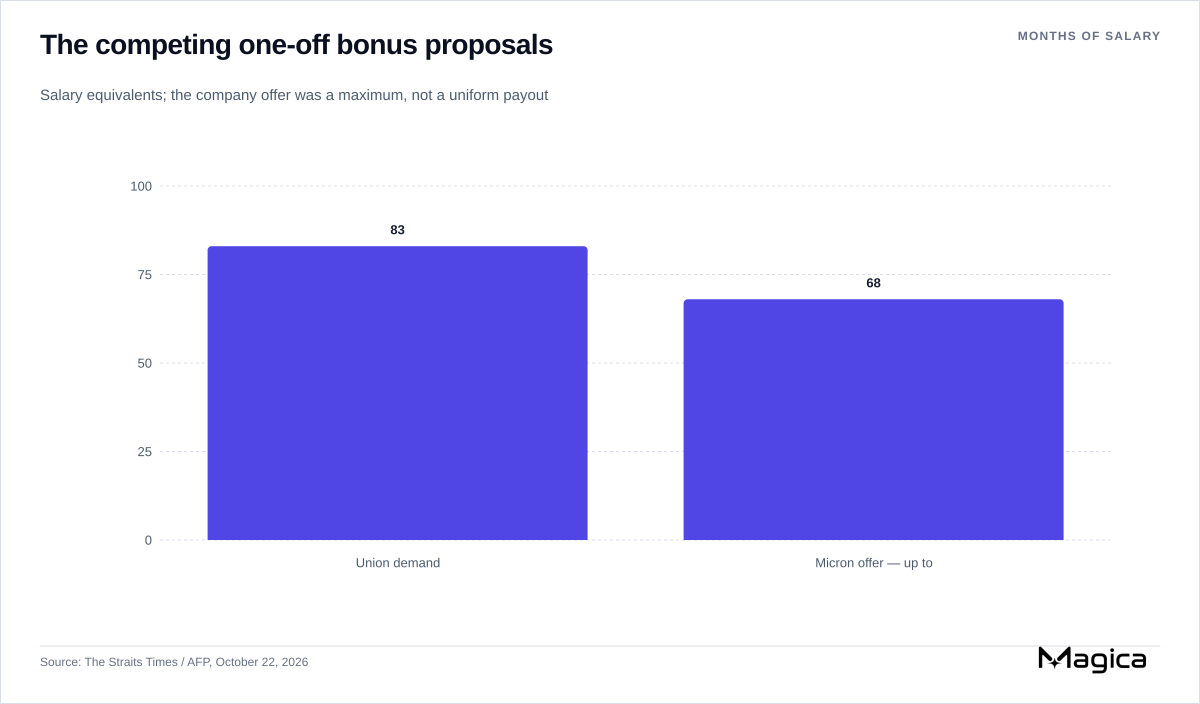
The unions sought a one-off bonus of 83 months of salary; Micron offered up to 68 months. These proposals were separate from recurring profit-sharing negotiations. Source: The Straits Times.
Eleven Taoyuan union officials began the 24-hour action at 9 a.m. on October 22. Production lines were not directly halted, according to the account of the warning strike. The November 5 report described it as the first strike in Taiwan’s semiconductor industry.
The small turnout reflected the action’s deliberately limited scope. On October 7, 1,994 of 2,012 voting Taoyuan union members had authorized industrial action. Wei Yu-ling, secretary-general of the Taoyuan union, said the symbolic strike was not intended to disrupt production, while warning that more workers could join future action, according to the October 22 account of the negotiations.
The dispute centers on Micron’s Incentive Pay Plan, which the union says lacks transparency. Workers want a permanent mechanism allocating 15% of the company’s operating profits to employee bonuses, paid quarterly rather than annually. The unions also sought a one-off bonus equivalent to 83 months of salary. Micron said in September that it would offer up to 68 months of pay, but workers rejected the one-off payment, according to the report on the competing proposals.
Those salary multiples describe a demand and a maximum offer, rather than an identical award for every employee. They also concern a different decision from the recurring share of profits workers are seeking.
The Taoyuan action was announced in solidarity with the Taichung union ahead of mediation scheduled there for October 22. On October 21, however, Micron and the Taichung union announced a labor-management agreement and canceled the mediation meeting. Taoyuan proceeded with its strike.
Micron Taiwan Chairman Donghui Lu said at an October 22 news conference that the agreement introduced a quarterly profit-sharing bonus linked to company earnings, in addition to the existing Incentive Pay Plan. In the account of his announcement, he also promised structural salary adjustments, higher shift allowances, three additional paid leave days and an increase in the employer’s labor pension contribution rate from 8% to 10%.
These are substantive announced benefits. But the account did not disclose a percentage for the new quarterly bonus or establish that Micron accepted the requested 15% formula. The November 5 report said Micron had announced higher salaries, quarterly bonuses and larger pension contributions for workers across its Taiwan operations, while a majority of Taoyuan union members remained dissatisfied with the agreement’s terms.
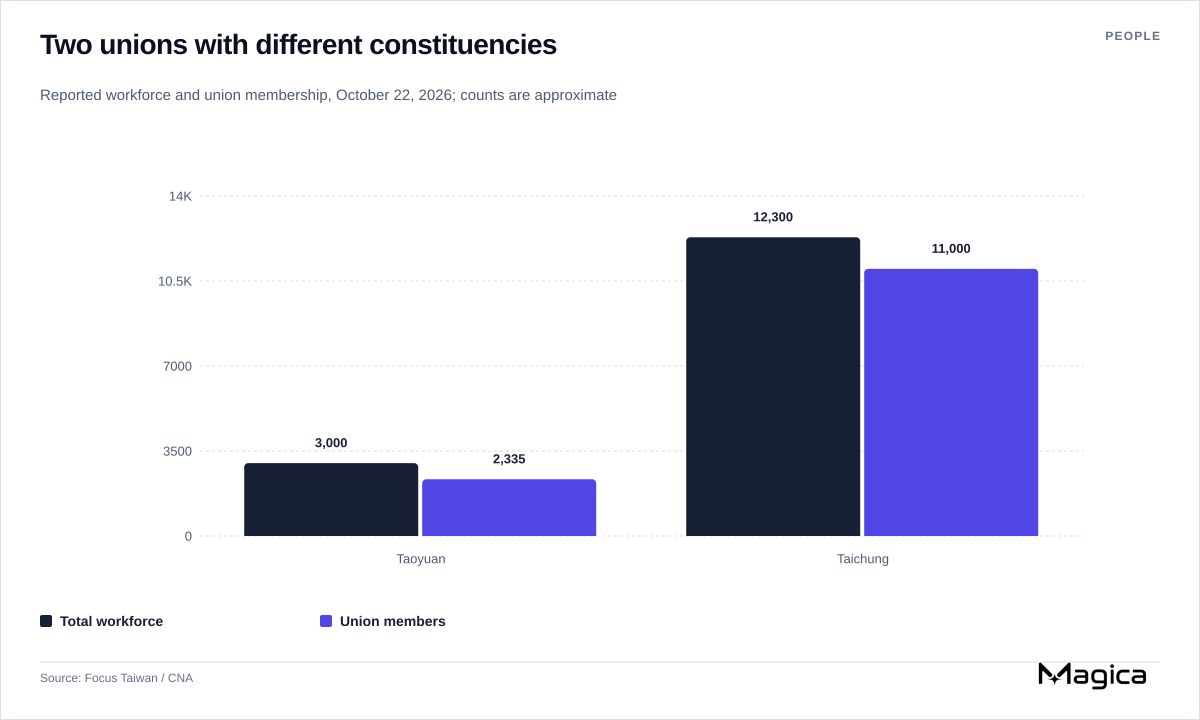
Union membership is included within each location’s workforce total. These approximate counts describe the two constituencies, not participation in the symbolic strike. Source: Focus Taiwan.
Jerry Lin, chairman of Micron’s Taoyuan union, has been pressing for a permanent profit-sharing mechanism alongside the Taichung organization. He said the two unions jointly formulated four demands but Taoyuan representatives and their views were not adequately included in negotiations that produced the Taichung agreement.
Lin also challenged the agreement’s reported vote: nine in favor, two against and one invalid ballot. He argued that 12 Taoyuan representatives should have been allowed to vote and that including their opposition would have defeated it. He said Micron cited confidentiality obligations when asked to disclose the terms. These are the Taoyuan leadership’s objections, rather than an established finding that the agreement was invalid.
The constituencies differ markedly. October 22 reporting put Micron’s workforce at about 3,000 in Taoyuan and 12,300 in Taichung, with union membership of 2,335 and around 11,000 respectively. The Taoyuan union is separately registered and retains the ability to strike, according to the November 5 report.
Taiwan’s Ministry of Labor said October 21 talks with Taoyuan had ended without agreement. The ministry, which participated at the city government’s invitation, said it respected the union’s legal right to strike and would continue facilitating negotiations. Micron said it would keep communicating toward a mutually acceptable outcome.
Micron’s Taiwan manufacturing presence predates the current AI surge. In December 2016 it completed its acquisition of Taiwan’s Inotera Memories, buying the equity it did not already own in a transaction valued at approximately $4 billion, net of Inotera’s cash and debt.
Its recent financial results explain the scale of the bargaining stakes. In its September 30 results release, Micron presented record results against a backdrop of AI-driven demand and strong operational execution. Its unaudited consolidated statements show:
| Company-wide measure, U.S. dollars | Fiscal 2025, ended August 28 | Fiscal 2026, ended September 3 |
|---|---|---|
| Revenue | $37.38 billion | $133.19 billion |
| GAAP operating income | $9.77 billion | $99.34 billion |
| Operating income as a share of revenue | 26.1% | 74.6% |
Operating income increased roughly tenfold, while revenue grew to about 3.6 times the prior year’s level. That makes operating profit a particularly consequential basis for recurring compensation. These figures cover Micron globally; they do not identify earnings generated by Taiwan or establish the accounting basis and employee coverage of any negotiated bonus pool. The union demand cannot be converted into an agreed payout from these figures alone.
The company also reported $27.37 billion in net capital expenditures for fiscal 2026, a non-GAAP measure that deducts government incentives and asset-sale proceeds from spending on property, plant and equipment. Manufacturing investment is a substantial use of cash alongside the compensation question.
Workers have a regional precedent. Samsung Electronics, a South Korean rival memory producer, averted a strike by agreeing to bonuses equivalent to 10.5% of operating profit for its semiconductor employees, according to the October 22 report. That supports the feasibility of bargaining over a profit-linked pool, but the report does not establish identical accounting definitions, employee coverage or payout rules at the two companies.
Wu Yu-ren, a labor relations professor at National Chung Cheng University, said labor actions at Samsung and fellow South Korean memory producer SK Hynix had influenced organizing among Taiwanese technology workers. The November 5 report put combined membership in Micron’s two unions at more than 13,000, up from around 440 over the preceding few months.
Micron told the November 5 report that it respected workers’ lawful rights and remained committed to constructive engagement with both unions. Continuing talks must resolve the size and calculation of the recurring bonus pool, alongside Taoyuan’s objections to how its workers were represented.
Supply consequences depend on what happens next. Ellie Wang, an analyst at memory-market consultancy TrendForce, said a brief production stoppage would likely have limited impact if backup personnel were available for maintenance, process monitoring and troubleshooting. She identified customer concern about delivery reliability as the main consequence. A prolonged or spreading dispute would pose a greater supply risk.
Pan Shih-wei, a former Taiwanese labor minister and adjunct labor relations professor, said Taiwan had traditionally relied on government intervention in labor disputes, while companies lacked established channels for dialogue with workers. His assessment makes the pending agreement a test of bargaining arrangements as well as bonus size. The evidence needed is a disclosed formula, clear employee coverage and acceptance by the workforce it is meant to cover. A quarterly payment schedule alone does not settle those questions.
Microsoft, Amazon and Alphabet rallied as investors bet Democratic election gains would restrain AI infrastructure spending. Strong cloud demand, existing commitments and risks to indebted operators complicate the hoped-for cash-flow relief.
Companies are expanding AI monitoring and patching as cyber threats strain security teams. Binance’s preliminary breach findings and attacks on aging refrigeration systems show why faster tools also need tighter access controls and investment in basic infrastructure.
Five technology groups have accumulated an estimated $3.2 trillion in future purchase and lease commitments. Filings show the funding pressure, but broad spending categories, long payment schedules and a methodology change limit what the total says about AI debt and growth.
PwC finds growth in a subset of AI-exposed junior job postings demanding senior skills, alongside pressure on entry-level opportunities. Workplace research suggests AI can support learning, but leaves employers to demonstrate how recruits acquire independent expertise.
CoreWeave bonds fell after the election of candidates favoring data center restrictions. Texas governor-elect Gina Hinojosa wants to extend an existing approvals pause until lawmakers pass protections, adding delivery uncertainty for an industry whose expansion depends on power and financing.

Walmart plans new permissions and a gateway for outside shopping agents, while Amazon blocks unauthorized tools and sells ads through its own assistant. The stakes are product discovery, customer data and whether delegated purchases add sales or displace advertising opportunities.
Apple reportedly cut some engineers’ daily AI allowances from $300 to $200 in October and is weighing deeper restrictions. The limits tighten control over model use, but unused allowances make the savings uncertain.
Factory is acquiring coding-agent collaboration platform HumanLayer after raising $200 million in September. It plans to integrate shared tasks and planning tools, while HumanLayer promises open source, refunds and at least 30 days of continued service.
A minister identifies Google-commissioned research behind the action plan’s £400 billion AI claim. The government’s central estimate is £120 billion, but different methods and adoption assumptions prevent a straightforward forecast-cut comparison.
Research has separated language models’ detection of altered internal activity from their ability to identify its content. Mechanistic studies and skeptical controls leave the interpretation disputed—and one intervention that improved detection made other measures of self-knowledge worse.
The IEA maps 134 policies governing data-center integration, arguing that credible project queues, coordinated tariffs and flexible connections can protect consumers while accommodating AI growth. Many measures remain too new to judge.
Three watchdog groups seek to halt Project Meridian, alleging that its contractor-heavy membership and closed meetings violate federal advisory committee law. MITRE’s invitation for outside ideas complicates the dispute over public participation.
Meta is seeking up to €9 billion in its first euro bond sale, drawing record orders while offering wider spreads than Alphabet. Its advertising business and large liquid reserves cushion an AI investment push that has overtaken quarterly operating cash flow.
Pangram is expanding its text-detection business into images and video. Browser checks and developer access broaden its reach, while company benchmark scores leave real-world error rates and costs unresolved.
About two dozen restrictive data center measures appeared to pass in initial returns. Texas governor-elect Gina Hinojosa’s promised construction pause adds a state-level constraint, though the capacity ultimately delayed remains uncertain.
Riot Platforms says its 15-year Corsicana lease with Anthropic will generate about $28 billion in revenue. The tenant owns and operates the compute, while Riot develops power infrastructure and funds module reimbursements through debt or credits against future rent.
Sonos plans limited U.S. early access for its conversational assistant, with a reported November 6 start. Users can return to older voice controls—a choice that also separates local audio processing from the new assistant’s cloud processing.
Tesla, SpaceX and AI infrastructure shares fell after Democratic election wins, while broader stocks rallied. Texas governor-elect Gina Hinojosa’s proposed data center pause puts a major construction pipeline in focus, but Republicans retain control of the Texas Legislature and federal agencies.
Capital One Ventures leads Sentra’s $150 million Series C and gains a board seat as the company expands AI-agent data controls. Sentra reports roughly 100 major enterprise customers and revenue in the tens of millions, but exact revenue, valuation and comparative costs remain undisclosed.
Google agreed to support Anthropic’s lease obligations at TeraWulf’s Kentucky campus, strengthening its bid for project financing. The support starts after delivery milestones, while debt terms and a guaranteed construction price remain unsettled.