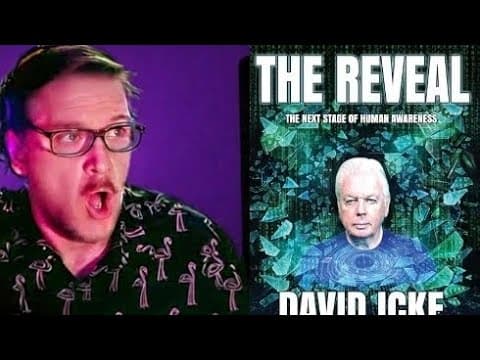
This article critically examines David Icke's New Age philosophy, focusing on his views about reality as a simulation and the Gnostic worldview. It explores the contradictions in Icke's statements, the historical context of Gnosticism, its appeal, and contrasts it with a Logos Christian perspective. The discussion highlights the philosophical and epistemological challenges of simulation theory and Gnostic beliefs.
David Icke, a prominent figure in New Age philosophy, posits that our reality is a virtual simulation created by an entity other than the traditional concept of God. This perspective aligns closely with ancient Gnostic ideas, which view the material world as a flawed or evil creation by a lesser deity. This article delves into Icke's claims, the contradictions within his statements, the historical and philosophical background of Gnosticism, and contrasts these views with a Logos Christian worldview.
Icke argues that the recurring mathematical and geometrical patterns in nature, such as Fibonacci sequences and Mandelbrot sets, indicate that we live in a virtual reality simulation. He rejects the notion that this simulation was created by a benevolent God, instead suggesting it was created by a "bloodthirsty tyrant" akin to the Old Testament God. This presents a contradiction: on one hand, he denies a traditional God as creator; on the other, he acknowledges a creator deity, albeit a malevolent one.
Icke emphasizes that mathematical principles are not mere human inventions but discoveries that transcend human social constructs. For example, Mandelbrot sets, complex fractal patterns, were discovered through computational power rather than invented. This suggests an underlying design or structure to reality, which Icke interprets as evidence of a simulated matrix.
Icke's views echo ancient Gnosticism, a diverse set of religious ideas from the first and second centuries AD. Gnostics believed the material world was created by a lesser, often malevolent deity called the Demiurge, distinct from the true, transcendent God. This Demiurge is responsible for imprisoning souls in the physical realm.
Gnosticism attempts to address the problem of evil by positing that the world itself is inherently flawed or evil. This explains suffering, disease, and injustice as features of a deceptive, illusory reality. Salvation, in this view, comes through secret knowledge (gnosis) that allows one to transcend or escape the material prison.
There is no single Gnostic tradition; rather, many sects existed with varying beliefs and practices. Some were ascetic, others engaged in libertine behaviors. Modern groups claiming Gnostic heritage often do not align historically with these ancient sects.
Two main factors draw people to Gnostic-like views today:
In our technology-driven era, simulation theory has gained popularity, paralleling ancient Gnostic ideas about reality as an illusion or prison.
Gnosticism tends to be morally relativistic, lacking a coherent ethical framework. If reality is a simulation, moral distinctions become arbitrary, potentially undermining the basis for right and wrong.
It is also ahistorical, viewing history and tradition as meaningless or part of the prison to escape, which conflicts with the value many place on heritage and personal identity.
Gnostic and similar New Age views often reject logic and reason, which are essential for coherent thought and communication. Denying fundamental laws of logic, such as the law of identity and non-contradiction, undermines the possibility of knowledge.
In contrast to Gnosticism, the Logos Christian worldview holds that:
This perspective affirms the value of reason, tradition, and ethical living within the created order.
David Icke's New Age philosophy, with its emphasis on simulation theory and a malevolent creator, reflects ancient Gnostic themes. While these ideas offer an explanation for evil and suffering, they face significant philosophical, epistemological, and moral challenges. The rejection of logic and objective truth leads to contradictions and relativism. In contrast, a Logos Christian worldview provides a coherent framework affirming meaning, purpose, and the possibility of true knowledge.
Understanding these perspectives helps clarify the ongoing cultural and philosophical debates about the nature of reality, knowledge, and spirituality in the modern world.