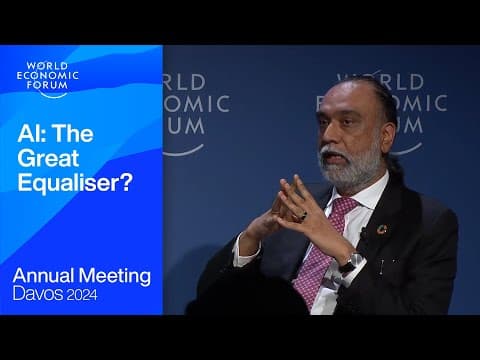
At the World Economic Forum 2024, panelists discussed the potential of AI as a great equalizer across global economies, emphasizing the need for governance, access, and education to ensure equitable benefits from AI advancements.
At the World Economic Forum 2024, a panel moderated by CNBC anchor Karen Cho explored the transformative potential of artificial intelligence (AI) as a great equalizer in the global economy. The discussion featured prominent leaders from various countries, including South Korea, Rwanda, Saudi Arabia, and representatives from Google and the United Nations. The panelists delved into the implications of AI across different sectors, the challenges of equitable access, and the necessary governance frameworks to harness AI's benefits.
The conversation began with a reflection on the rapid acceleration of AI technologies over the past year. Cho noted the significant impact of AI on stock market returns, particularly in the U.S., where a handful of AI-focused companies drove substantial gains. This raises questions about the future disruptions AI may bring and who stands to benefit from these advancements.
The panel included:
Prime Minister Han highlighted South Korea's significant investments in AI, with local companies like Samsung and LG Electronics leading the charge. He emphasized the importance of AI literacy and the customization of AI technologies to meet specific needs in sectors such as healthcare and climate change. Han expressed optimism about South Korea emerging as an AI leader, given its strong digital infrastructure and commitment to innovation.
Minister Ingabire discussed Rwanda's national AI policy, which aims to leverage AI for economic growth, particularly in agriculture and healthcare. She noted that AI could contribute up to 6% of Rwanda's GDP, emphasizing the need for simultaneous digital adoption and AI integration. Ingabire pointed out the youthful population in Rwanda as a driving force for AI innovation and adoption.
Minister Asar shared insights on Saudi Arabia's ambitious plans for AI, projecting a $135 billion contribution to the economy by 2030. He highlighted the kingdom's focus on generative AI as a transformative technology across industries, particularly in healthcare. Asar recounted a personal story about leveraging AI for drug formulation, showcasing the potential of AI to address critical health challenges.
Ruth Porat emphasized Google's long-standing investment in AI, which has been integrated into various products for over a decade. She discussed the potential of AI to democratize healthcare and improve food security, while also addressing climate change challenges. Porat underscored the importance of connectivity and infrastructure in ensuring that AI benefits are widely accessible.
Amandeep Singh Gill raised concerns about the current trajectory of AI, suggesting that without deliberate governance efforts, AI may not fulfill its potential as a great equalizer. He stressed the need for inclusive policies that address issues such as misinformation, data privacy, and the digital divide. Gill called for a global effort to build the necessary foundations for AI to benefit all nations, particularly those in the Global South.
The panelists acknowledged that access to AI technologies remains a significant barrier, particularly in developing countries. Minister Ingabire highlighted Rwanda's efforts to improve digital literacy and affordability of devices, while Prime Minister Han discussed South Korea's initiatives to promote AI education and training. The consensus was clear: without addressing access and education, the promise of AI as an equalizer may remain unfulfilled.
As the discussion concluded, the panelists expressed cautious optimism about AI's potential to serve as a great equalizer. However, they emphasized that achieving this goal requires concerted efforts in governance, education, and infrastructure development. The need for collaboration among nations and sectors was underscored as essential for maximizing the benefits of AI while minimizing its risks.
The panel at Davos 2024 highlighted the transformative potential of AI across global economies, while also addressing the critical challenges that must be overcome to ensure equitable access and benefits. As AI continues to evolve, the dialogue around its role as a great equalizer will remain vital in shaping a future that is inclusive and beneficial for all.