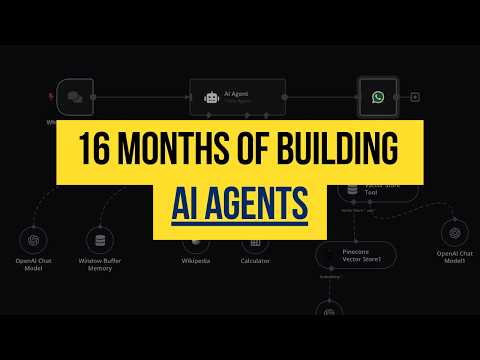
This blog post summarizes a comprehensive overview of building AI agents based on 16 months of experience. It covers foundational concepts, the role of language models, the importance of data quality, and practical tips for creating effective AI systems. The discussion includes the differences between AI agents and automations, the significance of prompt engineering, and the future of multi-agent systems in business.
In this blog post, we will explore the journey of building AI systems over a span of 16 months. This experience encompasses the development of AI agents for personal use, agency projects, and a software company focused on AI solutions. We will discuss essential tips, fundamental concepts, and practical insights that can help you create valuable AI systems for yourself and your clients.
To kick off, let's look at some of the AI systems developed during this period:
AI agents are designed to assist businesses by automating tasks and providing insights. To effectively leverage AI agents, it is crucial to understand the core concepts behind their functionality, particularly the use of language models.
Language models are programs that take human language as input and generate text output. Their power lies in their ability to understand not just the words but also the semantic meaning behind them. This understanding allows for more nuanced interactions and responses.
Historically, integrating language models into applications was complex, requiring extensive coding. However, frameworks like LangChain have simplified this process, enabling developers to chain language models with tools and actions, thus creating more sophisticated applications.
RAG systems enhance language models by allowing them to access external knowledge bases, thus overcoming limitations related to the models' training data cut-off. This integration enables more accurate and contextually relevant responses.
Multi-agent systems consist of several AI agents working collaboratively to tackle complex tasks. This approach can lead to significant advancements in productivity, as agents can specialize in different areas, such as programming, marketing, and infrastructure management.
The effectiveness of an AI system heavily relies on the quality of the data used for training and operation. High-quality data leads to better outputs and more reliable performance.
Crafting effective prompts is essential for guiding AI agents. A well-structured prompt includes:
Understanding how to connect AI systems with other applications via APIs and webhooks is crucial. Familiarity with GET and POST requests, as well as authorization methods, will enhance the functionality of your AI solutions.
AI agents are poised to revolutionize the way businesses operate by automating complex tasks and enabling teams to focus on strategic and creative roles. As the market for AI agents continues to grow, early adopters will have a significant advantage.
Building AI agents requires a solid understanding of foundational concepts, effective data management, and the ability to integrate various technologies. As we move forward, the potential for AI agents to transform business processes is immense. By embracing these technologies now, you can position yourself at the forefront of this evolving landscape.
Thank you for joining me on this exploration of AI agents. If you have any questions or topics you would like to see covered in future discussions, please feel free to reach out.