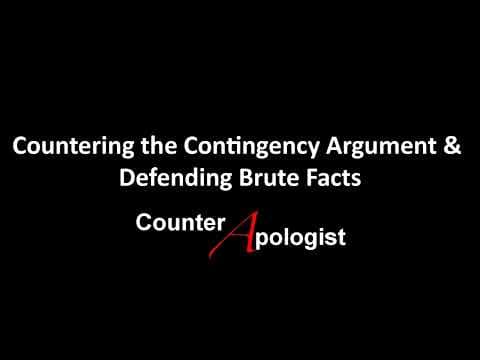
This blog post critiques the principle of sufficient reason and the concept of necessary beings, particularly in the context of theism. It argues that theists often draw arbitrary distinctions between contingent and necessary entities, using the example of the Christian Trinity to illustrate the incoherence of claiming necessity without sufficient justification. The post also explores the implications of brute facts in both theistic and atheistic frameworks, ultimately suggesting that all world-
Theistic apologists often invoke the principle of sufficient reason to argue for the existence of a necessary being that underlies all of reality. This principle distinguishes between contingent things—those that could have been different—and necessary things, which must exist in all possible worlds. The principle of sufficient reason serves as the first premise in the Leibnizian cosmological argument, famously presented by William Lane Craig:
Conclusion: Therefore, God exists.
There are numerous objections to the principle of sufficient reason, leading to various modifications aimed at addressing these challenges. However, this post aims to highlight the problems with what theists propose as necessary beings. It is crucial to establish boundaries regarding how both sides should approach arguments about necessity. It is improper to simply define an entity and its attributes as necessary without sufficient justification.
For instance, if an atheist were to point to the physical universe and its laws—summarized by a concise equation describing quantum field theory—and claim that this is the necessary entity underpinning reality, theists would likely object, deeming it ad hoc. The reason for this objection is straightforward: it is easy to conceive of those equations being different, and there is no formal logical derivation proving their necessity. Thus, drawing a neat circle around what appears to be contingent and labeling it as necessary does not provide any explanatory advantage; it merely arbitrarily designates something as necessary.
A prime example of this issue arises from Christian theology, where God is posited as a necessary being yet is also described as a Trinity—three persons in one being. This concept raises significant metaphysical assumptions about the nature of being and personhood, which many argue leads to logical contradictions. The question arises: why is God only three persons and not two, four, five, or any other number?
The Dry Apologist, a Christian YouTuber, attempts to explain the necessity of the Trinity by suggesting that God the Father necessarily exists with unlimited being, which includes intellect and will. According to this view, God's intellect reflects upon itself, resulting in the creation of the Son, who shares the same divine being. The shared will then reflects upon itself, birthing the Holy Spirit.
However, this explanation encounters several problems:
The principles needed to defend the Trinity appear ad hoc, as they are rationalizations to uphold specific Christian doctrines. Even non-Christian theists often reject these principles, indicating that they are not universally accepted. The theist is left with the challenge of explaining why these principles are necessary in all possible worlds when they seem contingent.
The issues surrounding brute facts extend beyond the Trinity and affect various theistic views. For instance, the moral argument posits that if God does not exist, objective moral values do not exist. This leads to the Euthyphro dilemma, forcing theists to confront whether goodness is inherent in God's nature or if it exists independently of God.
If goodness is defined by God's nature, then why is God's nature loving rather than hateful? If the theist attempts to provide reasons for God's attributes, they must draw from outside God's nature, undermining the moral argument. This again leads to the conclusion that God's attributes may be brute facts, lacking sufficient explanation.
Another significant issue arises when considering why God chose to create the universe as it is. If God's choices are arbitrary and lack necessitating reasons, then these choices are effectively brute facts. This leads to a modal collapse, where nothing is contingent, and everything is necessary.
Theists may argue that God's libertarian free will allows for arbitrary choices. However, this perspective fails to provide a real explanation for why one contingent thing is chosen over another. Unlike human preferences, which can be explained by biology and history, God's choices lack such context, making them appear random.
In conclusion, the critique of the principle of sufficient reason and the concept of necessary beings reveals significant flaws in theistic arguments. Both theists and atheists must confront the reality of brute facts—elements of existence that simply are without explanation. While theists may resist this notion, it is essential to recognize that all worldviews must grapple with the existence of brute facts. This understanding fosters a more honest discourse about the nature of reality and existence itself.