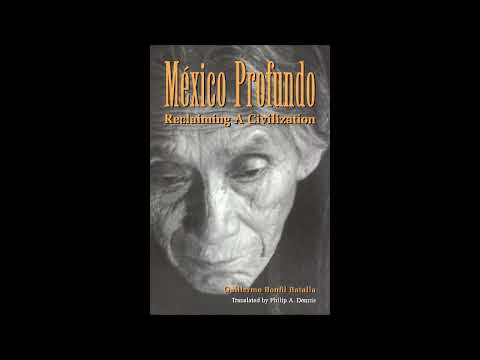
Chapter 3 of 'Mexico Profundo' explores the complex interplay between Indian and non-Indian cultures in Mexico, highlighting the persistence of Mesoamerican heritage in various social and cultural aspects despite colonial ideologies that seek to de-indianize the population. It discusses the historical and geographical factors contributing to cultural diversity, the impact of urbanization, and the ongoing relevance of Indian culture in contemporary Mexican society.
In Chapter 3 of "Mexico Profundo," the author delves into the intricate relationship between Indian and non-Indian cultures in Mexico, emphasizing the enduring presence of Mesoamerican heritage across various social and cultural dimensions. Despite the dominant colonial ideologies that attempt to restrict the living Mesoamerican heritage to a population recognized as Indian, the reality reveals a different truth.
The effective presence of Indian culture permeates almost every aspect of Mexican society. This cultural influence is expressed through diverse traits that undeniably trace their origins back to Mesoamerican civilization. The persistence of these cultural elements is so commonplace that many fail to recognize their profound significance or the historical processes that have allowed them to endure.
While diversity is evident within Indian cultures, the same cannot be said for the various cultural groups in non-Indian Mexico. The differences among these groups are stark and cannot be fully understood as mere variants or subcultures of a single civilization. Instead, they reflect a history of power dynamics shaped by colonial domination.
The lack of unity in non-Indian culture raises questions about the feasibility of integrating into a national culture that is often postulated as superior. Rather than a unified national culture, Mexico is characterized by a heterogeneous grouping of different and sometimes contradictory ways of life. This heterogeneity stems from the varying historical relationships each group has had with Mesoamerican civilization.
Geographical variation plays a crucial role in cultural diversity, serving as a foundational factor in the cultural configuration of Mexico. The distinct ecological niches, each with unique natural resources, have historically influenced regional life ways. However, cultural differences cannot be solely attributed to geography, as they are also shaped by historical and contemporary factors.
The cultural panorama of non-Indian society is further complicated by the urban-rural divide. Urban lifestyles differ significantly from rural ones, and this distinction is not accurately captured by census data alone. Many larger communities maintain rural cultural traits, while vast sectors of large cities reflect recent rural origins.
In addition to horizontal cultural differences, vertical distinctions based on class and social strata contribute to the complexity of non-Indian society. The cultural variation resulting from class divisions must be understood within the context of a society with common origins, where different groups participate in a shared culture to varying degrees.
Traditional rural communities, often not recognized as Indian, exhibit marked similarities to Indian culture. Despite their non-Indian identity, these communities retain many elements of Mesoamerican culture, particularly in agricultural practices and social organization. The basic economic activity remains agriculture, utilizing techniques rooted in Indian traditions.
The process of de-indianization is evident in the transformation of traditional Indian communities into what are now considered mestizo communities. This change reflects a broader ideological shift, where the pressures of the dominant society have led to a fragmentation of ethnic identity. While many Indian cultural traits persist, the communities themselves may no longer identify as Indian.
Cities in Mexico serve as bastions of colonial order, where the presence of Indian culture is often masked by the dominant non-Indian narrative. Urban areas were historically constructed over ancient Indian settlements, leading to a complex interplay of cultures. Despite the segregation imposed by colonial powers, Indian cultural elements continue to thrive in urban settings.
The accelerated growth of Mexican cities in recent decades has been largely driven by the migration of Indian and mestizo populations from rural areas. This migration has led to the urbanization of Indian culture, as newcomers bring their traditions and practices into the city, creating a vibrant cultural tapestry.
The cultural dynamics of Mexico are deeply rooted in the historical confrontation between Mesoamerican civilization and Western colonialism. The ongoing presence of Indian culture, despite efforts to de-indianize the population, highlights the resilience of Mesoamerican heritage. Understanding this complex cultural landscape requires acknowledging the historical processes that have shaped it and recognizing the enduring significance of Indian culture in contemporary Mexican society.