This blog post examines five quotes from prominent philosophers often misused by Christians to argue against atheism. It provides context and interpretations that highlight the positive aspects of existentialist thought, emphasizing freedom, responsibility, and the search for meaning without a divine creator.
In a recent discussion, Gavin Ortland claimed that atheism is unlivable, a statement I fundamentally disagree with. This blog post aims to explore five quotes from various philosophers that Christians often weaponize against atheism, arguing that they misinterpret the essence of these quotes. Instead of portraying a bleak existence without God, these quotes reveal a profound sense of freedom, responsibility, and the potential for meaning in a godless universe.
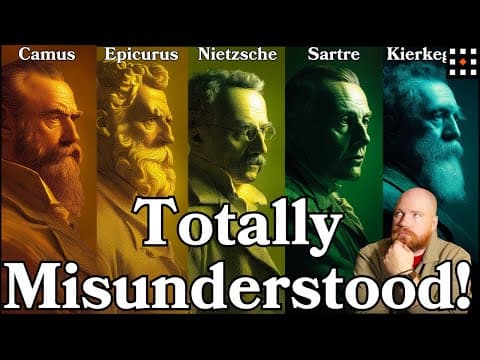
The conversation surrounding atheism and the existence of God often involves philosophical texts that Christians cite to illustrate the supposed emptiness of life without a divine creator. However, I believe that these interpretations are misguided. In this post, I will analyze five quotes from existentialist and absurdist thinkers, demonstrating how they can be understood in a more positive light.
Jean-Paul Sartre, a French existentialist philosopher, wrote Being and Nothingness in 1943. His quote, "Man is condemned to be free," is frequently misinterpreted by Christians who argue that it signifies the unbearable burden of freedom without God. They suggest that this freedom leads to moral confusion and despair.
However, Sartre's philosophy emphasizes radical freedom and responsibility. The term "condemned" does not imply a deterministic fate but rather acknowledges the reality of human existence. We are born into freedom, which means we must take ownership of our choices and their consequences. This responsibility can be daunting, but it also allows for a more ethical and meaningful life.
Christians often view Sartre's concept of freedom as a source of anxiety and moral chaos. They argue that without God, individuals are slaves to their sins and lack a moral compass. Yet, this perspective overlooks the beauty of human agency and the potential for moral maturation that comes with embracing freedom.
In The Myth of Sisyphus, Albert Camus presents the idea that the struggle for meaning in an absurd world is itself a source of fulfillment. Christians often misinterpret this quote to suggest that life without God is pointless, likening it to Sisyphus eternally rolling a rock up a hill.
Camus argues that meaning is found in the struggle itself, not in an ultimate outcome. The beauty of life lies in our experiences and the choices we make. The Christian perspective that life is meaningless without God fails to recognize the richness of human experience and the joy that can be derived from living authentically.
Søren Kierkegaard, often regarded as the father of existentialism, wrote The Concept of Anxiety in 1844. His quote highlights the anxiety that accompanies true freedom. Christians may interpret this anxiety as a sign of moral failure or confusion.
Kierkegaard's exploration of anxiety is not a condemnation of freedom but rather an acknowledgment of its complexity. The dizziness of freedom signifies the vast possibilities available to us. Rather than viewing anxiety as a negative, Kierkegaard suggests it is a sign of being awake to our responsibilities. This perspective challenges the notion that faith provides a secure anchor, as believers also grapple with their own anxieties regarding salvation and doctrine.
Friedrich Nietzsche's proclamation in The Gay Science that "God is dead" is one of the most misused quotes in discussions about atheism. Christians often interpret this as a triumphant declaration of atheism, suggesting that without God, life is devoid of meaning.
In reality, Nietzsche's statement serves as a warning about the implications of losing faith in God. He recognized that the death of God would lead to a moral vacuum, urging humanity to create its own values. Nietzsche's message is not one of despair but a call to responsibility and creativity in the face of existential challenges. It encourages individuals to confront the void left by the absence of divine authority and to build a meaningful existence based on human values.
Epicurus, an ancient Greek philosopher, famously stated that "Death is nothing to us." This quote is often used by Christians to argue that without God, life lacks meaning and hope.
Epicurus advocates for the acceptance of death as a natural part of life. He argues that fear of death and divine retribution complicates our existence. By accepting that death holds no power over us, we can focus on living fully in the present. The Christian interpretation that life is meaningless without God overlooks the profound peace that comes from embracing reality and finding joy in our relationships and experiences.
The quotes discussed in this post illustrate how philosophical texts can be misinterpreted to support the notion that atheism is unlivable. In reality, these thinkers offer insights into the beauty of freedom, responsibility, and the search for meaning in a godless world. Rather than viewing life without God as hopeless, we can embrace the challenge of creating our own values and finding fulfillment in our existence. As we continue to explore these ideas, it is essential to engage in open dialogue and challenge misconceptions about atheism and existentialism.