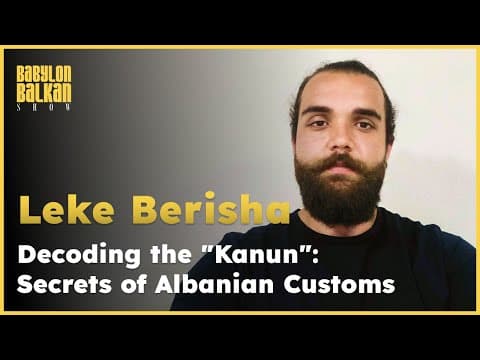
This blog post explores the Kanun, a traditional set of Albanian customary laws that govern social behavior, family relations, and property rights, particularly in the regions of Kosovo and Northern Albania. The discussion highlights its historical significance, its impact on modern Albanian society, and the cultural values it embodies, such as hospitality and the concept of Besa.
In this episode of the Babon Balcon Show, we delve into the fascinating topic of the Kanun, a traditional set of Albanian customary laws that have shaped the social fabric of the region for centuries. Our guest, Lekë Berisha, a 25-year-old surveying engineer from Kosovo, shares his insights on this unique aspect of Albanian culture, particularly as it pertains to the western part of Kosovo and its neighboring regions.
The Kanun is a codex of customary laws that governs various aspects of life in certain Albanian regions, particularly in Northern Albania and Western Kosovo. It is not part of the formal legal system but is deeply rooted in tradition and is followed by many in these communities. The Kanun consists of a set of rules and norms that dictate social behavior, family relations, and property rights.
The Kanun has its origins in ancient Greek law, with the term itself meaning "regulation." It has been passed down orally through generations and was only later documented in written form. The most prominent version is the Kanun of Lekë Dukagjini, which is named after a historical figure who is believed to have played a significant role in its codification.
The Kanun is divided into twelve chapters, each addressing different aspects of life:
The Kanun is not just a legal framework; it embodies the values and traditions of Albanian society. One of the most notable concepts within the Kanun is Besa, which refers to the pledge of honor to protect guests and uphold one's word. This cultural value emphasizes hospitality and loyalty, which are central to Albanian identity.
In Albanian culture, hospitality is paramount. The Kanun dictates that a guest is considered sacred, and hosts are obliged to protect them at all costs. This tradition fosters a strong sense of community and belonging, as individuals are expected to support one another, especially in times of need.
While the Kanun is not officially recognized in contemporary legal systems, its influence persists in daily life. Many Albanians still adhere to its principles, particularly in rural areas where traditional customs remain strong. The Kanun continues to shape social interactions, family dynamics, and community relations.
As society evolves, the Kanun faces challenges in adapting to modern legal frameworks. Conflicts may arise between customary laws and state laws, particularly regarding property rights and inheritance. However, many Albanians find ways to navigate these complexities, often blending traditional practices with contemporary legal standards.
The Kanun is a vital part of Albanian heritage, reflecting the values, traditions, and social structures that have defined the region for centuries. Understanding the Kanun provides valuable insights into the cultural identity of Albanians, particularly in Kosovo and Northern Albania. As we continue to explore and appreciate these customs, we gain a deeper understanding of the rich tapestry of Balkan culture.
In summary, the Kanun is more than just a set of laws; it is a living tradition that continues to influence the lives of many Albanians today. Through the lens of the Kanun, we can appreciate the importance of community, hospitality, and the enduring power of cultural heritage.