Explore how the Transformer Explainer tool makes understanding complex transformer models like GPT-2 accessible to everyone. This open-source, browser-based interactive visualization breaks down the model's architecture, token processing, and the math behind attention mechanisms using multi-level abstraction and Sankey diagrams. It also demonstrates the impact of the temperature parameter on text generation creativity, making AI concepts transparent and engaging.
Transformers are the backbone of modern generative AI models such as GPT-2, GPT-3, and ChatGPT. Despite their widespread use, the inner workings of these models often seem like a black box to many. How does a sequence of words transform into the next perfect word? This article explores a groundbreaking tool called Transformer Explainer that aims to demystify these complex models through interactive visualization.
Transformer Explainer is an open-source, interactive visualization tool designed specifically for non-experts. It runs a live GPT-2 model directly in your browser, requiring no installation or special hardware. This accessibility allows users to gain pure insight into how transformer models process text.
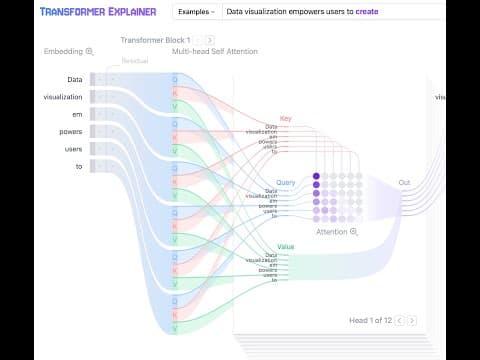
At the core of Transformer Explainer is a Sankey diagram, a type of flow chart commonly used to illustrate energy flow. Here, it maps the entire pipeline of token processing:
This Sankey diagram acts as a roadmap, showing precisely where the input data is at every stage. The design emphasizes the step-by-step transformation of data, helping users see the pattern and flow clearly.
Transformer Explainer stacks attention heads and collapses repeated transformer blocks to present the entire model architecture at a glance. This approach prevents users from getting lost in repetitive details while maintaining a comprehensive overview.
One of the biggest hurdles in understanding transformers is the intense mathematics involved, especially the attention mechanism calculations. Transformer Explainer addresses this by using multi-level abstraction:
This design allows users to engage with both the high-level concepts and the nitty-gritty math on demand, making the learning process less overwhelming.
A critical feature of Transformer Explainer is the temperature slider, often referred to as the "creativity dial." This slider controls the randomness in the model's next token predictions:
Users can adjust this slider in real time and watch the direct visual impact on the probability distribution, gaining an intuitive understanding of how temperature influences text generation.
The ability to run a live GPT-2 instance in the browser is a game changer for AI education. Transformer Explainer broadens access to complex neural network concepts, making them transparent and understandable for everyone.
By visualizing the token processing flow, the tool reveals that the transformer model is a deterministic system following a well-defined sequence of operations. It dispels the notion of AI as magic and highlights the mathematical and procedural foundations of these models.
If Transformer Explainer can clarify the workings of transformer models, it raises the question: which AI concepts remain opaque to you? For many, diffusion models for image generation or reinforcement learning mechanisms are still challenging to grasp.
Interactive tools similar to Transformer Explainer could be the key to unlocking understanding in these areas, fostering broader AI literacy and engagement.
Transformer Explainer represents a significant step forward in making AI technology accessible and comprehensible. By combining interactive visualization, multi-level abstraction, and real-time model execution, it transforms the way we learn about and interact with generative AI models.