This article outlines key considerations for preparing P&ID drawings for pump systems, including control systems, protection measures, maintainability, and monitoring requirements to ensure safe and efficient pump operation.
When designing a pump system, it is crucial to prepare a comprehensive Piping and Instrumentation Diagram (P&ID) that accurately reflects the operational requirements and safety measures necessary for effective pump performance. This article discusses essential tips for P&ID preparation specifically for pump systems, focusing on control systems, protection from upset conditions, maintainability, and monitoring capabilities.
Before delving into P&ID preparation, it is important to specify the pump correctly. This involves several calculations, including:
Once the pump specifications are established, the next step is to ensure that the pump is integrated into a system that supports smooth operation, which will be depicted in the P&ID.
A proper control system is vital for managing pump operations. While the main control scheme is typically developed in the Process Flow Diagram (PFD), the P&ID should reflect this control scheme accurately. Key considerations include:
To enhance clarity, it is essential to provide detailed information on control devices in the P&ID. For example, instead of simply indicating a flow controller (FC), specify the flow device that sends signals to the controller, ensuring operators can easily monitor performance.
Protecting the pump from conditions that could lead to damage is critical. For instance, if the liquid level in the vessel drops below the calculated NPSH, the pump may cavitate. To mitigate this risk:
Additionally, if a valve on the discharge line closes unexpectedly, it can lead to pump damage due to shut-off pressure or overpressure in the discharge pipe. To prevent these issues:
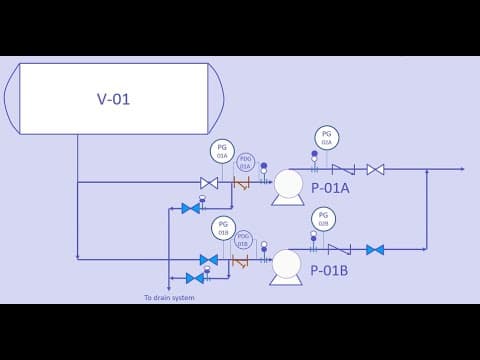
For effective maintenance, pumps should be designed for easy isolation from the system. This typically involves:
In addition, check valves should be installed on the discharge line to prevent backflow into the spare pump during operation. Drain lines should also be included to eliminate trapped liquid in the system when isolating the pump for maintenance.
To ensure optimal pump operation, it is essential to provide instruments that allow operators to monitor key performance parameters. Common instruments include:
These instruments should be accessible for field readings and may also be connected to the Distributed Control System (DCS) for remote monitoring, depending on the criticality of the parameters.
In summary, preparing a P&ID for pump systems involves careful consideration of various factors, including control systems, protection measures, maintainability, and monitoring requirements. By integrating these guidelines into the P&ID drawing, engineers can ensure the development of a safe, operable, and efficient pump system. Each project may have unique requirements, so it is essential to adapt these principles to fit specific operational contexts.
By following these tips, engineers can enhance the reliability and safety of pump operations, ultimately contributing to the overall efficiency of the system.