This blog post provides a comprehensive analysis of trusses using the method of joints, detailing the calculation of member forces, reactions at supports, and the principles involved in determining tensile and compressive forces in a truss structure.
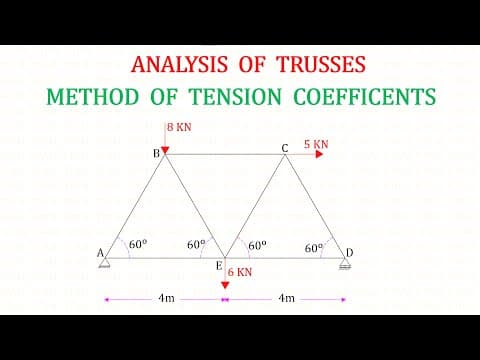
In structural engineering, analyzing trusses is crucial for ensuring stability and safety in constructions. This blog post delves into a specific problem involving the method of joints to find the member forces in a truss. We will explore the calculations step-by-step, focusing on the reactions at supports and the forces within the truss members.
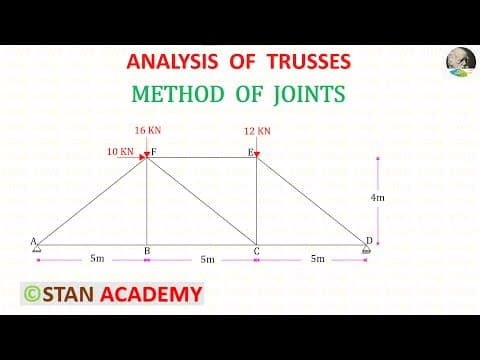
The truss in question has the following characteristics:
To begin, we need to calculate the vertical reactions at the supports. We will denote the vertical reaction at Point A as VA and at Point D as VD.
Taking moments about Point D, we consider clockwise moments as positive and anticlockwise moments as negative:
After performing the calculations, we find:
Using the equilibrium condition
[ \Sigma V = 0 ]
We have:
Substituting the known values:
Next, we apply the equilibrium condition for horizontal forces: [ \Sigma H = 0 ] Assuming HA acts to the left (negative), we have:
To proceed with the method of joints, we need to determine the angles between the members. Considering triangle DCE:
Using the tangent function: [ \Theta = \tan^{-1}\left(\frac{4}{5}\right) \approx 38.66^{\circ} ]
This angle applies to multiple members in the truss, allowing us to calculate other angles as needed.
In the method of joints, we initially assume all member forces are tensile. If we calculate a negative value, it indicates a compressive force. The equilibrium conditions for joints involve:
At joint D, we have forces FCD and FDE:
Applying ( \Sigma V = 0 ):
Applying ( \Sigma H = 0 ):
At joint E, we analyze forces FDE and FCE:
Applying ( \Sigma V = 0 ):
Applying ( \Sigma H = 0 ):
At joint C, we analyze forces FCF and FBC:
Applying ( \Sigma V = 0 ):
Applying ( \Sigma H = 0 ):
At joint B, we find:
At joint A, we find:
After analyzing all joints, we compile the results into a table:
Through the method of joints, we have successfully analyzed the truss and determined the forces acting within its members. This systematic approach not only aids in understanding the behavior of trusses under load but also ensures the safety and reliability of structural designs. Thank you for following along with this analysis.