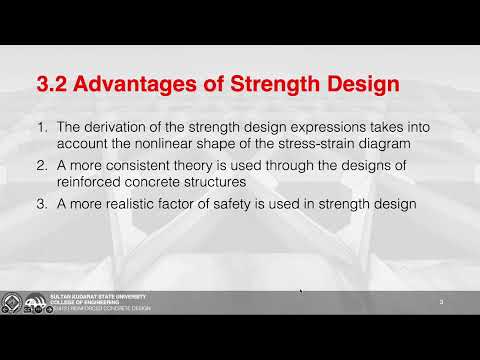
Strength design offers several advantages over traditional working stress design, including better load estimates, consistent safety factors, realistic load considerations, economical designs, and flexibility in material usage.
In the field of structural engineering, the design of reinforced concrete structures is critical for ensuring safety and efficiency. One of the prominent methodologies used is strength design, which presents several advantages over traditional working stress design (WSD). This article delves into the key benefits of strength design, highlighting its impact on structural integrity and economic efficiency.
One of the primary advantages of strength design is its derivation of expressions that account for the nonlinear shape of the stress-strain diagram. This consideration leads to more accurate estimates of a structure's load-carrying ability. By applying these equations, engineers can better predict how structures will perform under various loads, enhancing safety and reliability.
Strength design employs a more uniform theoretical approach throughout the design process of reinforced concrete structures. Unlike WSD, which utilized different methods for beams and columns, strength design maintains consistency. This uniformity simplifies the design process and ensures that all components of a structure are evaluated under the same theoretical framework, leading to more cohesive and reliable designs.
In strength design, a more realistic factor of safety is implemented. Designers can more accurately estimate the magnitudes of dead loads—permanent loads that a structure must support—compared to live or environmental loads, which can be more variable. In WSD, a single safety factor was applied to all types of loads, which could lead to over-conservatism or underestimation of safety in certain scenarios. Strength design allows for different safety factors for different load types, representing a significant improvement in safety considerations.
Strength design promotes a more uniform safety factor against collapse throughout the structure. This method takes advantage of higher strength materials, which were not fully utilized in WSD. As a result, structures designed using strength design can achieve better economic efficiency while maintaining safety, as they can withstand greater loads without requiring excessive material use.
Another notable advantage of strength design is the flexibility it offers in structural design. The percentage of steel reinforcement can be varied significantly, allowing for large sections to be constructed with a small percentage of steel or smaller sections with a larger percentage of steel. This flexibility contrasts with the relatively fixed approach of WSD, where the amount of steel was more rigidly determined. Consequently, if the same amount of steel is used in strength design as would have been in WSD for a specific beam, a smaller section can be achieved. Conversely, if the same size section is maintained as required by WSD, a reduced amount of steel will be necessary.
The advantages of strength design in reinforced concrete structures are clear. From improved load estimates and consistent theoretical applications to realistic safety factors and enhanced flexibility, strength design represents a significant advancement in structural engineering. By embracing these benefits, engineers can create safer, more economical, and efficient structures that meet the demands of modern construction.