The Golden Gate Bridge, an iconic suspension bridge, showcases remarkable engineering feats. Designed by Joseph Strauss, it overcomes challenges such as spanning 2.7 km over the Pacific Ocean, thermal expansion, and structural integrity through innovative solutions like finger expansion joints and a unique tower design. Its construction involved overcoming harsh environmental conditions and utilizing advanced techniques, making it a significant achievement in civil engineering.
When observing the Golden Gate Bridge floating over the Pacific Ocean, one cannot help but admire its beautiful suspension cable system. But what would happen if this cable system were absent? The answer is simple: it would lead to catastrophe. In this article, we will explore the engineering feats behind the Golden Gate Bridge, designed by Chief Engineer Joseph Strauss, and understand the complexities involved in its construction.
The Golden Gate Bridge is a suspension bridge, a design that allows for long spans without the need for numerous supporting piers. A simplified version of a suspension bridge can be constructed by erecting two towers at either end of a span and suspending a long cable between them. This cable takes on a parabolic shape, and a concrete road deck is supported by pillars. The suspension cables connect the main cable to the road deck, providing support along its length and preventing failure.
The decision to use a suspension design for the Golden Gate Bridge was influenced by several factors:
While the suspension design is advantageous, it presents its own challenges. One major issue is that the towers can bend inward due to the tensile load on the main cable. To counteract this, the main cable must be anchored to the ground, which can be costly. However, Strauss found a solution by moving the towers closer together, reducing the unsupported length of the bridge deck and the tension in the cable.
Connections are often the weakest points in any structural system. Strauss recognized that directly connecting steel suspenders to a concrete deck could lead to cracks due to the brittle nature of concrete. To solve this, he opted for a steel-to-steel connection, which is inherently stronger. The road deck was designed to be 27 meters wide to accommodate current and future traffic demands.
Constructing the Golden Gate Bridge was no small feat, especially given the foggy and windy conditions at the site. Workers prefabricated each member of the truss and transported them via ships to the construction site. They used a derrick to assemble the individual members, securing connections with rivets. A safety net was installed beneath the bridge deck to protect laborers during construction.
Another significant engineering challenge was thermal expansion. The concrete and steel structure would expand or contract with temperature changes. If the bridge were built as a single piece, it could suffer damage during hot weather. To mitigate this, Strauss implemented finger expansion joints, dividing the deck into seven separate pieces. These joints allow for movement during temperature fluctuations, accommodating up to 4 inches of expansion.
The height of the towers also posed a challenge. Strauss conducted experiments comparing tall and short tower designs. The taller design proved to be stronger, as it reduced tension in the cables. Ultimately, he calculated an optimal tower height of 746 feet, balancing strength and construction costs.
The construction of the Golden Gate Bridge faced numerous environmental challenges, particularly with the South Tower, which had to contend with violent Pacific Ocean currents. The foundation for the South Tower was built on hard strata, requiring divers to blast underwater and clear debris. A reinforced concrete slab was constructed to protect workers from the ocean's forces while they dug for the foundation.
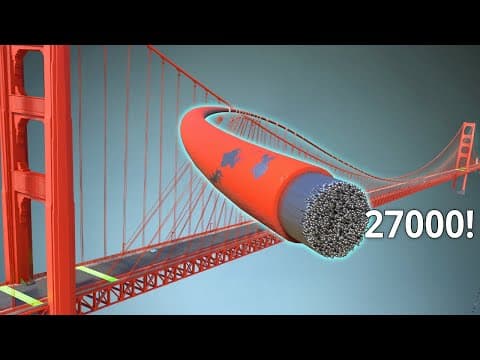
Once the foundation was ready, the construction of the towers began. Strauss designed a unique cellular structure for the towers, which was both economical and strong. The main cables, composed of 27,000 smaller wires, were laid down using a catwalk bridge and hydraulic presses to ensure tightness. The suspension cables were then attached, completing the structural framework.
An interesting incident occurred during the Golden Gate Bridge's 50th anniversary when over 300,000 people gathered on the bridge simultaneously. This overload caused the road deck to sag by nearly 2 meters, yet the bridge remained structurally sound. This incident highlighted the incredible engineering behind the Golden Gate Bridge, which has stood strong for decades.
The Golden Gate Bridge is not just a beautiful landmark; it is a testament to innovative engineering and design. Joseph Strauss's solutions to complex challenges in its construction have made it a significant achievement in civil engineering. The bridge continues to inspire awe and admiration, symbolizing the ingenuity of human creativity and resilience in the face of nature's challenges.