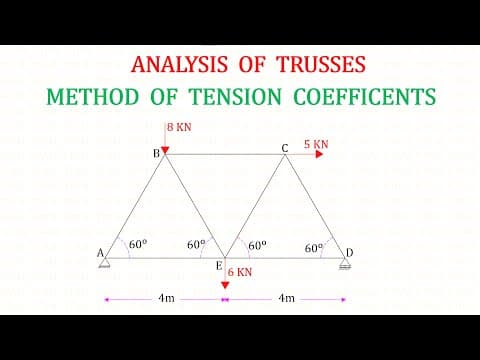
This blog post provides a detailed analysis of a truss structure using the method of tension coefficients, explaining the calculations for member forces, reactions at supports, and the significance of tension coefficients in determining the nature of forces within the truss.
In this post, we will explore the method of tension coefficients to analyze a truss structure. This method is essential for determining the forces acting on each member of the truss, which is crucial for ensuring structural integrity.
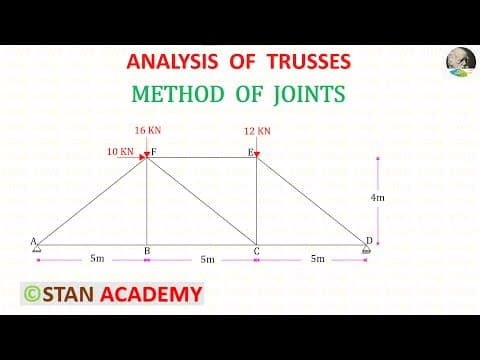
The truss in question has a hinged support at point A and a roller support at point D. The hinged support allows for two reactions, while the roller support provides only one vertical reaction from point C.
To begin our analysis, we will focus on finding the member forces using the method of tension coefficients.
We will set point A as the origin (0,0) and establish the coordinates for other points:
To find the length CF, we can use the tangent formula:
From our calculations, we find that the length CF is approximately 3.46 m.
Next, we will calculate the vertical reaction at point A (VA) by taking moments about point D. We will consider clockwise moments as positive and anticlockwise moments as negative:
From this equation, we find:
We can apply similar calculations to find the reaction at point D (VD) and the horizontal reaction (HA).
At joint A, we apply the equilibrium equations:
From these equations, we calculate:
At joint B, we again apply the equilibrium equations:
Calculating these gives:
At joint D, we can find T_CD and T_DE using similar equilibrium equations. At joint C, we focus on finding T_CE.
After calculating the tension coefficients for each member, we can compile the results in a table:
| Member | Tension Coefficient | Length (m) | Force (kN) |
|---|---|---|---|
| AB | -1.97 | 4 | Compression |
| AE | 2.23 | 4 | Tension |
| BE | -0.34 | 4 | Compression |
| BC | -0.82 | 4 | Compression |
| CD | TBD | 4 | TBD |
| DE | TBD | 4 | TBD |
In conclusion, we have successfully analyzed the truss structure using the method of tension coefficients. By calculating the member forces and understanding the nature of these forces, we can ensure the structural integrity of the truss. Thank you for following along with this analysis.