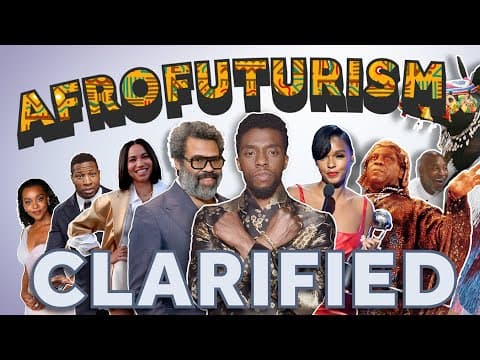
Afrofuturism is a cultural movement that reimagines the future through a Black lens, blending elements of science fiction, history, and African culture. Coined by Mark Derry in 1994, it encompasses various artistic expressions and serves as a means of liberation and creativity for the African diaspora. The movement has gained mainstream recognition through works like Black Panther and events like the Afropunk Festival, highlighting the importance of imagination in shaping new futures.
When envisioning science fiction and fantasy, many might picture iconic franchises like Lord of the Rings, Star Wars, or Harry Potter. While these narratives often tackle themes of discrimination, marginalization, and colonialism, they predominantly feature white characters, leaving marginalized voices largely unheard. In response, Black creators have forged a unique narrative through Afrofuturism, a movement that reimagines the future through a Black cultural lens.
The term "Afrofuturism" was coined in 1994 by Mark Derry, an author and cultural critic, in his essay titled "Black to the Future." Derry questioned the scarcity of African American voices in science fiction, a genre that seems particularly suited to address the concerns of African American novelists. He highlighted the work of Black artists and writers who explore magical and impossible themes while incorporating their Black identity. Although the term was introduced in the 1990s, the themes of Afrofuturism have been explored by members of the African diaspora for centuries.
In essence, Afrofuturism is a way of envisioning the future or alternate realities through the lens of Black culture. It intersects imagination, liberation, mysticism, and technology, creating a rich tapestry of artistic expression.
Natasha Womack, author of the book "Afrofuturism" and a fiction writer and dance therapist, describes Afrofuturism as encompassing several key categories. It can be seen as an aesthetic present in music and dance, a worldview or epistemology, and a creative process that helps individuals overcome obstacles.
Identifying Afrofuturism can be challenging due to its diverse expressions. For instance, the film "Black Panther" is often cited as a quintessential example, but the movement's manifestations vary widely. The remixing of cultural elements is central to African diaspora cultures, leading to a multitude of interpretations.
Artists like Sun Ra incorporate ancient Egyptian imagery while claiming extraterrestrial origins, blending history with science fiction. Similarly, artist Nick Cave creates sound suits that obscure the wearer's race and gender, challenging audience perceptions while rooted in African traditions.
Afrofuturism boasts a rich canon of influential figures and works. Notable science fiction writer Octavia Butler is celebrated for her novels, including "Kindred," which features a time-traveling Black woman, and "Parable of the Sower," set in a post-apocalyptic world.
Musician and actress Janelle Monáe embodies Afrofuturism through her unique aesthetic, merging past and future styles. Her performances often reflect a blend of 1950s fashion with futuristic elements, showcasing the versatility of the movement.
The Afropunk Festival is a significant cultural event that embodies Afrofuturism. Founded in the early 2000s in Brooklyn, the festival has grown to attract over 100,000 attendees annually, with events in Brazil, South Africa, and London. It celebrates alternative Black artists and provides a space for self-expression and creativity, emphasizing the connection of the diaspora through music, art, and fashion.
Afrofuturism has gained considerable traction in mainstream culture, with works like "Lovecraft Country" and Jordan Peele's genre-bending films capturing global attention. The success of "Black Panther" demonstrated a growing demand for narratives that explore the Black speculative imagination.
Artworks associated with Afrofuturism are now featured in prominent museums. For instance, Nick Cave's retrospective at the Guggenheim Museum and the immersive Afrofuturist period room at the Metropolitan Museum of Art highlight the movement's significance in contemporary art.
Afrofuturism does not shy away from the past; rather, it uses the experiences of discrimination and subjugation faced by many Black individuals to envision a better future. The Afrofuturist period room at the Met, for example, incorporates the history of Seneca Village, a thriving Black community displaced in 1857 to make way for Central Park.
Mark Derry's essay references George Orwell's quote: "Who controls the past, controls the future; who controls the present, controls the past." By examining history, Afrofuturists can imagine futures that diverge from past injustices, fostering hope and creativity.
Imagination and dreaming are vital components of Afrofuturism, serving as tools for hope and liberation. As individuals reconcile with their histories and envision new futures, they are propelled by the actions they take today. Figures like Martin Luther King Jr., Harriet Tubman, and Malcolm X can be seen as early Afrofuturists, striving to create new realities through their efforts.
Afrofuturism is not just a movement; it is a powerful reminder of the potential for creativity and imagination to shape a better future for all.