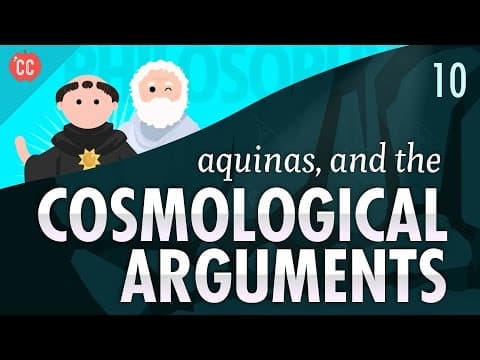
This blog post delves into Thomas Aquinas' four cosmological arguments for the existence of God, examining their foundations, implications, and the critiques they face in contemporary philosophy.
The existence of God has been a topic of intense debate throughout history, and one of the most significant contributors to this discourse was Thomas Aquinas. In the 11th century, Anselm of Canterbury introduced the ontological argument for God's existence, which sparked considerable discussion among medieval philosophers. Nearly 200 years later, Aquinas encountered Anselm's argument but found it lacking. As a devout believer and philosopher, Aquinas sought to provide a more robust foundation for belief in God through empirical evidence and logical reasoning. This led him to formulate five arguments for God's existence, four of which are known as the cosmological arguments.
Aquinas' cosmological arguments aim to demonstrate God's existence through observations about the universe. Despite living in a time with limited scientific understanding, Aquinas grounded his arguments in what he perceived as physical evidence. Let's explore these four arguments in detail.
Aquinas' first cosmological argument is the Argument from Motion. He observed that everything in the universe is in motion and that movement is caused by movers—entities that initiate motion. Aquinas reasoned that if everything in motion was set into motion by something else, there must be a first mover that itself is unmoved. This leads to the conclusion that God is the Unmoved Mover. The argument can be summarized as follows:
The second argument, the Argument from Causation, parallels the first but focuses on causes and effects rather than motion. Aquinas posited that:
This argument emphasizes that every effect must have a cause, and ultimately, there must be a First Thing that initiated the chain of causation.
Aquinas' third argument is the Argument from Contingency. He distinguished between necessary beings (those that must exist) and contingent beings (those that could potentially not exist). He argued:
This argument asserts that for anything to exist, there must be something that exists necessarily, preventing an infinite regress of contingent beings.
The fourth argument, known as the Argument from Degrees, posits that we understand concepts like good and bad, or big and small, in relation to one another. Aquinas argued:
This argument suggests that without a perfect standard, our understanding of value would be arbitrary.
While Aquinas' cosmological arguments are historically significant, they have faced substantial criticism from both theistic and atheistic philosophers. Here are some key critiques:
Lack of Specificity: The arguments do not establish the existence of a specific deity. Even if one accepts the arguments, they do not necessarily lead to the personal God worshipped in many religious traditions.
Polytheism: Aquinas' arguments do not rule out the possibility of multiple gods. His reasoning could support the existence of a committee of gods rather than a singular divine being.
Infinite Regress: Critics argue that Aquinas' insistence on the impossibility of infinite regress is unfounded. If infinite regress is possible, then his first two arguments collapse.
Self-Defeating Nature: Some philosophers contend that Aquinas' arguments are self-defeating. If everything must have a cause, then God should also require a cause. If God is exempt from this rule, then other entities might be as well, suggesting that God is not necessary for existence.
Aquinas' cosmological arguments provide a fascinating exploration of the philosophical underpinnings of belief in God. While they have sparked significant discussion and debate, they also invite critical engagement. Philosophy thrives on dialogue, and Aquinas' work encourages us to examine our beliefs and the arguments that support them. Whether one agrees with Aquinas or offers counterarguments, the pursuit of understanding the existence of God remains a vital and engaging endeavor in philosophy. In the next discussion, we will delve into Aquinas' fifth argument, the teleological argument, further expanding our exploration of this profound topic.