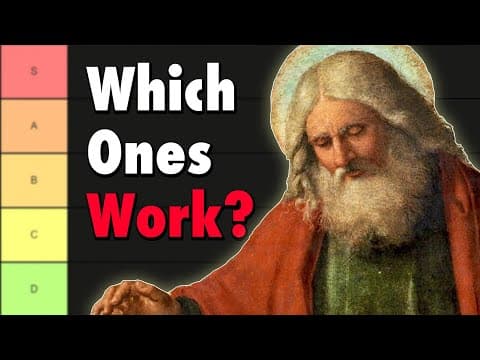
This blog post delves into a tier list analysis of popular arguments for the existence of God, discussing their strengths and weaknesses, including the contingency argument, cosmological argument, ontological arguments, fine-tuning argument, moral argument, and the resurrection of Jesus. Each argument is evaluated based on its philosophical merit and explanatory power, leading to a comprehensive understanding of their implications in the discourse on theism and atheism.
In this blog post, we will explore various arguments for the existence of God, categorizing them into a tier list based on their philosophical merit and explanatory power. This analysis will cover popular arguments such as the contingency argument, cosmological argument, ontological arguments, fine-tuning argument, moral argument, and the resurrection of Jesus.
The existence of God has been a topic of philosophical debate for centuries. Various arguments have been proposed to support theism, each with its strengths and weaknesses. In this discussion, we will evaluate these arguments and place them into a tier list ranging from S (superior) to F (failing).
The contingency argument posits that everything that exists contingently must have an explanation for its existence. This leads to the conclusion that there must be a necessary being, which many identify as God.
The contingency argument is placed in the S tier due to its robust philosophical foundation and explanatory power.
The cosmological argument, particularly the Kalam version, asserts that everything that begins to exist has a cause, and since the universe began to exist, it must have a cause. This cause is often identified as God.
The cosmological argument is placed in the B tier, as it raises important questions but faces significant philosophical challenges.
The ontological argument, particularly Anselm's version, claims that the very concept of a greatest conceivable being implies its existence. If we can conceive of such a being, it must exist in reality.
The ontological argument is placed in the D tier due to its controversial nature and the widespread skepticism surrounding it.
The fine-tuning argument suggests that the precise conditions of the universe are so improbable that they imply the existence of a designer.
The fine-tuning argument is placed in the A tier for its compelling nature and the significant philosophical implications it raises.
The moral argument posits that if God does not exist, objective moral values do not exist. Since objective moral values do exist, God must exist.
The moral argument is placed in the E tier due to its reliance on contested premises and the availability of alternative explanations for morality.
The argument from the resurrection claims that the historical accounts of Jesus rising from the dead provide evidence for God's existence.
The resurrection argument is placed in the D tier, as it has some explanatory power but is undermined by competing hypotheses.
In summary, the arguments for God's existence vary significantly in their philosophical robustness and explanatory power. The contingency argument stands out as the strongest, while the moral argument and the ontological argument face substantial challenges. This tier list serves as a guide for understanding the complexities of these arguments and their implications in the ongoing discourse surrounding theism and atheism.