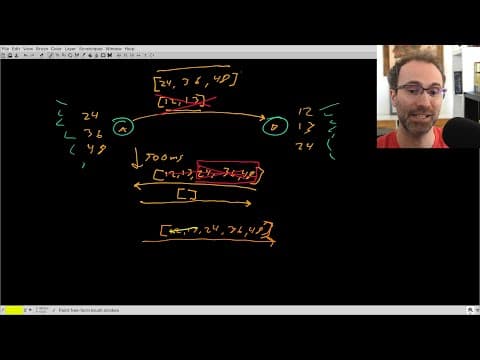
This blog post delves into the implementation of distributed systems challenges using Rust and the Maelstrom framework. It covers the basics of message passing, the design of a simple echo server, and the development of a unique ID generator, culminating in a more complex gossip protocol for efficient message dissemination across nodes.
In this blog post, we will explore the implementation of distributed systems challenges using Rust and the Maelstrom framework. Maelstrom is a distributed systems testing framework that orchestrates message passing between nodes, allowing us to emulate various network conditions such as delayed, reordered, or dropped messages. This exploration will cover the basics of message passing, the design of a simple echo server, and the development of a unique ID generator, culminating in a more complex gossip protocol for efficient message dissemination across nodes.
Maelstrom provides a set of exercises designed to test the correctness of distributed systems implementations. The challenges we will tackle include:
To begin, we need to set up our Rust environment and create a new project. We will use the following command to create a new binary:
cargo new rustangan
The name "Rustangan" is inspired by a battle spell from the anime Naruto, reflecting our focus on Rust programming.
The first challenge is to implement a simple echo server that responds to incoming messages. Each node in the Maelstrom framework is represented as a binary that communicates via JSON messages. The echo server will receive a message and respond with the same message body, prefixed with an "echo" type.
The message protocol consists of three main components:
We will define a struct for the message and implement serialization and deserialization using the Serde library. The echo server will handle incoming messages and respond accordingly.
Here is a simplified version of the echo server implementation:
use serde::{Serialize, Deserialize};

#[derive(Serialize, Deserialize)]
struct Message {
    source: String,
    destination: String,
    body: Body,
}

#[derive(Serialize, Deserialize)]
struct Body {
    #[serde(rename = "type")]
    message_type: String,
    content: String,
}

fn handle_message(input: Message) -> Message {
    Message {
        source: input.destination,
        destination: input.source,
        body: Body {
            message_type: "echo".to_string(),
            content: input.body.content,
        },
    }
}
The next challenge is to implement a globally unique ID generation system. This system must be available even in the face of network partitions. We will design a service that generates unique IDs based on the node ID and a local message ID.
The unique ID generator will maintain a counter for the message ID and combine it with the node ID to create a globally unique identifier. Here’s a basic implementation:
struct UniqueIDGenerator {
    node_id: String,
    message_id: usize,
}

impl UniqueIDGenerator {
    fn new(node_id: String) -> Self {
        UniqueIDGenerator { node_id, message_id: 0 }
    }

    fn generate_id(&mut self) -> String {
        self.message_id += 1;
        format!("{}-{}", self.node_id, self.message_id)
    }
}
The final challenge involves creating a gossip protocol that allows nodes to share messages with each other efficiently. The goal is to ensure that all nodes eventually receive all broadcast messages.
The gossip protocol will work by having each node maintain a list of messages it has seen and periodically share this list with its neighbors. When a node receives a gossip message, it will update its own list of known messages and propagate the new messages to its neighbors.
Here’s a basic outline of the gossip protocol implementation:
struct GossipNode {
    known_messages: HashSet<String>,
    neighborhood: Vec<String>,
}

impl GossipNode {
    fn gossip(&mut self) {
        for neighbor in &self.neighborhood {
            // Send known messages to the neighbor
            // Receive messages from the neighbor and update known_messages
        }
    }
}
In this blog post, we explored the implementation of distributed systems challenges using Rust and the Maelstrom framework. We started with a simple echo server, moved on to a unique ID generator, and finally developed a gossip protocol for efficient message dissemination. These exercises not only enhance our understanding of distributed systems but also provide practical experience in implementing them using Rust.
As we continue to explore more complex challenges, we can further refine our implementations and tackle additional distributed systems concepts. Stay tuned for more insights and implementations in future posts!