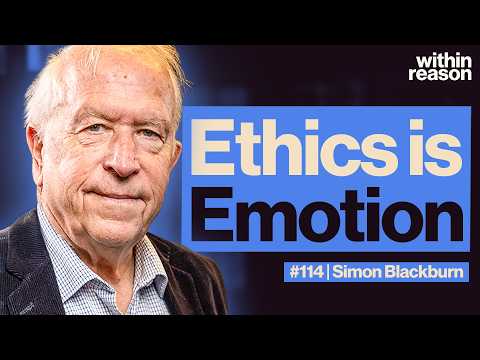
In this blog post, Simon Blackburn discusses ethical emotivism, the distinctions between cognitivism and non-cognitivism, and the implications of these theories on moral language and truth. He critiques traditional ethical frameworks and emphasizes the importance of understanding ethics as expressions of attitudes rather than objective truths. Blackburn's insights challenge conventional views on morality, truth, and the nature of ethical discourse, advocating for a more nuanced understanding of
In a recent discussion, philosopher Simon Blackburn delves into the complexities of ethical emotivism, a theory that suggests moral statements are expressions of emotional attitudes rather than objective truths. This blog post summarizes key points from Blackburn's conversation, highlighting the distinctions between cognitivism and non-cognitivism, the implications of these theories on moral language, and the critique of traditional ethical frameworks.
Most people familiar with ethics recognize two primary perspectives: realism and anti-realism. Realists assert that ethical truths exist independently of human opinions, while anti-realists argue that ethics is a construct of human sentiment and social agreement. Blackburn emphasizes that this dichotomy is foundational but introduces a more nuanced distinction between cognitivism and non-cognitivism.
Cognitivism posits that ethical statements can be true or false, implying that moral claims have truth values. In contrast, non-cognitivism suggests that ethical statements do not convey factual information but rather express feelings or attitudes. Blackburn notes that these terms are often used interchangeably with realism and anti-realism, complicating the discourse.
Blackburn discusses the desire for truth in ethical statements, such as the claim that "murder is wrong." He points out that many people intuitively want to assert that such statements are true in the same way that scientific claims can be true. However, he highlights the challenges of establishing a non-natural property of "wrongness" that would allow for such truth claims. This leads to the question of how we can meaningfully discuss ethical truths without falling into metaphysical quandaries.
Blackburn critiques G.E. Moore's intuitionism, which posits that moral properties are non-natural and require a special mode of knowing. He argues that this perspective has led to unnecessary complications in ethical discussions. Instead, he advocates for a return to the Scottish sentimental tradition, where ethics is understood through human sentiments and reactions rather than abstract properties.
Blackburn expresses concern over the current state of ethical language, suggesting that the traditional oppositions of realism and anti-realism have become stale. He notes that fewer philosophers identify strictly as realists or anti-realists today, indicating a shift towards more flexible understandings of ethical discourse.
One of the contemporary theories Blackburn discusses is the deflationary theory of truth, which posits that asserting something is true does not add any significant information beyond the assertion itself. For example, saying "the chair is red" is equivalent to saying "it is true that the chair is red." This perspective challenges the need for a robust metaphysical account of truth in ethics, suggesting that ethical statements can be understood similarly.
Blackburn identifies himself with ethical emotivism, which posits that moral statements express emotional attitudes rather than factual claims. He argues that when someone says, "murder is wrong," they are expressing a disapproval of murder rather than making a truth claim. This leads to the idea that ethical discourse is fundamentally about persuading others to share one's sentiments.
A significant challenge for emotivism is the Frager-Geach problem, which questions how ethical statements can function in logical arguments if they lack truth values. Blackburn addresses this by suggesting that when ethical statements are expressed in indicative forms, they can facilitate inferences and discussions about moral implications. This allows for a more structured approach to ethical reasoning without necessitating a commitment to objective truths.
Blackburn emphasizes the importance of understanding ethics as interconnected with human sentiments and social practices. He argues that ethical discussions should focus on what people do and how they express their attitudes rather than abstract philosophical inquiries about the nature of moral properties.
Blackburn prefers the term "attitude" over "emotion" to describe the sentiments expressed in ethical statements. He argues that attitudes encompass a broader range of dispositions, including those that do not evoke strong emotional responses. This perspective allows for a more nuanced understanding of ethical discourse, recognizing the complexity of human motivations and beliefs.
Simon Blackburn's exploration of ethical emotivism challenges traditional views on morality, truth, and the nature of ethical discourse. By emphasizing the importance of sentiments and attitudes in ethical discussions, Blackburn advocates for a more flexible and nuanced understanding of ethics that moves beyond rigid dichotomies. His insights encourage readers to reconsider the foundations of ethical reasoning and the role of emotions in shaping moral beliefs.