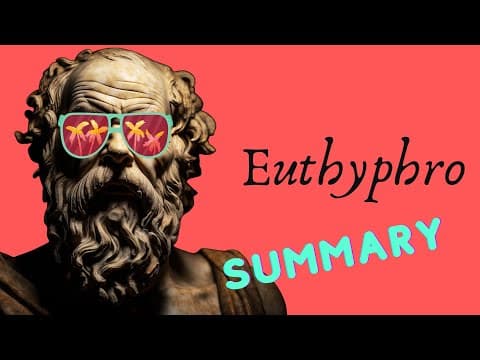
Plato's dialogue 'Euthyphro' features Socrates and Euthyphro discussing the nature of piety, leading to the famous Euthyphro's dilemma which questions whether morality is defined by divine command or exists independently. The dialogue critiques divine command theory and supports the notion of objective moral truths.
Plato's dialogue, Euthyphro, presents a profound philosophical discussion between Socrates and Euthyphro, a priest who is on his way to prosecute his father for the death of a worker. This dialogue not only delves into the complexities of piety but also raises significant questions about morality and its foundations.
The dialogue unfolds in Athens, where Socrates is also en route to court, facing charges of impiety and corrupting the youth. Euthyphro, confident in his moral stance, believes his father is guilty of wrongdoing for binding a worker in chains and leaving him to die, despite the worker having killed another worker. This sets the stage for a rich exploration of ethical concepts.
At the heart of the dialogue is Socrates' quest to understand the essence of piety or holiness. Euthyphro, as a priest, claims to possess knowledge about piety, but Socrates challenges him to define it. This leads to a critical examination of the relationship between the gods and morality.
One of the most significant contributions of this dialogue is the formulation of what is now known as Euthyphro's dilemma. Socrates poses a pivotal question:
"Is the pious loved by the gods because it is pious, or is it pious because it is loved by the gods?"
This question encapsulates the central theme of the dialogue and raises fundamental issues regarding the nature of morality.
The dilemma presents two contrasting views:
Socrates argues against the notion that piety can be defined merely by the gods' preferences, as this could lead to contradictions and inconsistencies in moral reasoning. He suggests that there must be objective standards of morality that transcend divine command.
The Euthyphro dialogue has had a lasting influence on philosophical thought, particularly in the realm of ethics. It critiques divine command theory and supports the idea of moral realism, which posits that objective moral truths exist regardless of human beliefs or attitudes. This dialogue has inspired countless discussions and interpretations throughout history, shaping the landscape of ethical philosophy.
In conclusion, Plato's Euthyphro serves as a critical examination of the nature of piety and morality. Through the dialogue between Socrates and Euthyphro, we are invited to reflect on the foundations of our moral beliefs and the relationship between divine authority and ethical standards. The questions raised in this dialogue continue to resonate, prompting ongoing exploration of what it means to be moral in a complex world.