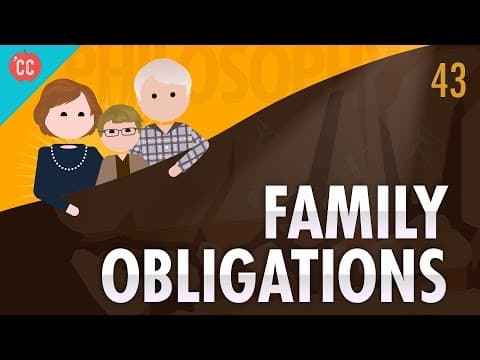
This blog post delves into the philosophical views on family obligations, particularly the arguments presented by Jane English, who asserts that adults do not owe their parents anything. It discusses three main perspectives on parental obligations, the concept of family as a contract, and the ethics of care, while also considering the implications of these views on personal relationships and societal norms.
For many, the relationship with parents is one of the most significant in life. Parents nurture, support, and guide their children, leading to the question of what obligations, if any, children owe to their parents once they reach adulthood. Contemporary American philosopher Jane English presents a thought-provoking argument that challenges traditional views on this topic, suggesting that once grown, individuals do not owe their parents anything.
English's perspective can be contrasted with two other prevalent views regarding obligations to parents:
The Unconditional View: This perspective posits that simply by virtue of being a parent, one is entitled to certain obligations from their children, including presence and attention, until death.
The Conditional View: According to this view, obligations are based on the quality of parenting received. Terrible parents may not deserve anything, while good parents may warrant significant obligations from their children.
The Friendship View: English advocates for this view, which asserts that once individuals reach adulthood, they do not owe their parents anything, regardless of the benefits received during childhood.
English argues that the relationship between parents and children can be viewed through a contractual lens. When parents choose to have a child, they incur a responsibility to raise that child. This creates a moral obligation on the part of the parents, not the children. Since no one chooses to be born, children cannot be held accountable for obligations they did not incur.
Some may argue that children implicitly accept a contract by benefiting from their parents' care. However, English counters this by stating that children lack the moral capacity to enter into such contracts. While adults can form agreements with their parents, the benefits received during childhood do not equate to a moral debt. Parents provide care out of love and not with the expectation of repayment.
English suggests that the ideal relationship between adult children and their parents should resemble that of friendship. In friendships, there is no tallying of favors; help is given out of love and desire to support one another. Thus, while adult children may choose to assist their parents, it should not be seen as an obligation but rather as an expression of love.
The idea that familial bonds create special obligations is often taken for granted. However, philosophers challenge this notion, arguing that obligations should not be based solely on genetic ties. For instance, adopted individuals may feel no obligation to biological relatives they have never met, while they may have strong ties to the family that raised them. This perspective emphasizes that love, rather than blood, forms the foundation of familial relationships.
Philosopher Hugh LaFollette proposes a controversial idea: that potential parents should be required to obtain a license before having children. This suggestion stems from the belief that parenting is a significant responsibility that can have lasting impacts on a child's life. By requiring a license, society could ensure that only those capable of raising children are allowed to do so, similar to how other potentially harmful activities are regulated.
Claudia Mills offers another perspective, arguing that family members hold a unique place in our lives as permanent and unchosen connections. These relationships provide grounding and continuity amidst the changes we experience throughout life. Maintaining connections with family can be valuable, as they remind us of our roots and the people we once were.
The discussion of family obligations also touches on the ethics of care, which emphasizes the importance of personal relationships and the love shared within them. This ethical framework suggests that morality should prioritize those we are closest to, as these relationships enrich our lives. However, critics argue that this approach may lead to neglecting those without support networks, highlighting the need for a balance between caring for loved ones and addressing the needs of strangers.
The exploration of family obligations reveals a complex interplay of philosophical perspectives. While traditional views emphasize unconditional obligations based on familial ties, thinkers like Jane English and Claudia Mills encourage a reevaluation of these assumptions. By considering the nature of love, friendship, and the potential need for parental licensing, we can better understand the moral landscape of family relationships. Ultimately, the question of what we owe our parents may not have a definitive answer, but it invites us to reflect on the nature of love, obligation, and the connections that shape our lives.