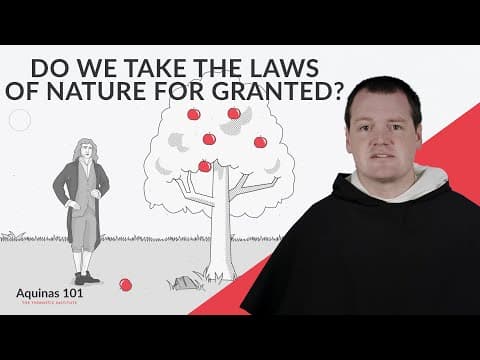
This blog post delves into Aquinas' perspective on the natural order, arguing that the regularity of nature suggests the existence of an intelligent being, rather than randomness. It discusses the implications of natural laws and the necessity of an intelligent creator in understanding the universe.
In our everyday lives, we observe various natural phenomena that seem predictable and consistent. For instance, puppies grow into dogs, heavy objects fall to the ground, and like charges repel each other. These observations lead us to recognize universal patterns or "Laws" of nature, such as Newton's third law of motion, which states that every action has an equal and opposite reaction, and the principle of conservation of energy.
These principles have become so ingrained in our understanding that we often take them for granted. However, the philosopher Thomas Aquinas, particularly in his "Fifth Way," posits that the regularity of natural activity necessitates the existence of an intelligent being. This assertion may seem outdated or peculiar to modern audiences, but it highlights a significant aspect of our perception of the natural world.
Aquinas argues that if there were no intelligent ordering of the world, then all natural activities would occur by chance. While contemporary discussions often emphasize the randomness and chaos present in nature, it is crucial to recognize that such randomness operates within a framework of fundamental order. For example, the seemingly random distribution of galaxies and stars is governed by consistent gravitational, chemical, and nuclear interactions.
If chance were the ultimate cause of all natural phenomena, we would expect to see complete unpredictability. Heavy objects would occasionally float away, salt might explode upon contact with water, and like charges would sometimes attract. In a truly random universe, even the language we use to describe these phenomena would lack coherence, as concepts like weight, charge, or chemical properties rely on a consistent order.
Aquinas emphasizes that the very categorization of natural entities, which is foundational to scientific inquiry, cannot stem from pure chance. Instead, it requires an underlying intelligence that provides intelligibility to the natural order.
This leads to a critical question: Are chance and intelligence the only two options for explaining the natural order? Some might argue for a middle ground, suggesting that nature behaves according to established Laws of Nature, such as Newton's laws or the laws of thermodynamics. Indeed, our understanding of these laws has significantly advanced the field of science, particularly physics.
The mathematical frameworks we use to describe natural phenomena have fostered an instinct to uncover deeper and more complex orders within the universe. However, while we often discuss the Laws of Nature, we rarely pause to consider their origin. These laws are not physical agents that manipulate the world; rather, they represent patterns and mathematical rules that govern physical interactions.
At this juncture, we encounter a non-material yet intelligible reality that either constrains physical order or describes the inherent constraints we observe. The transition from this understanding to Aquinas' notion of an intelligent being directing the natural order is not a significant leap.
Throughout history, scientists and philosophers have approached the concept of the "Laws of Nature" in various ways, some open to the idea of God and others seeking to exclude Him. Ultimately, the intelligibility of the natural order is not self-evident or self-explanatory. While Aquinas' appeal to intelligence may seem unusual, it reflects a deeper inquiry into why there are Laws of Nature at all.
There is much more to explore regarding how those who embrace Aquinas' philosophy of nature interpret the "Laws of Nature" and God's role in the physical world. Currently, scientific endeavors are revealing the natures of physical and biological substances and their interactions. Universal laws, such as conservation of energy and momentum, describe consistent patterns across all physical substances.
Despite the advancements in modern science, which Aquinas could only partially foresee, his intuition regarding the necessity of an intelligent creator remains compelling. In fact, a deeper reflection on scientific discoveries reinforces the argument for an intelligent being orchestrating the natural order.
In conclusion, the exploration of God’s role in the ordering of the physical world invites us to reconsider our understanding of natural laws and the underlying intelligence that may govern them. As we continue to uncover the complexities of the universe, the need for an intelligent creator becomes increasingly evident, prompting further inquiry into the relationship between science and philosophy.