This blog post delves into a thought experiment about human nature, contrasting the views of philosophers Rousseau and Hobbes on whether humanity is inherently good or bad. It discusses the implications of civilization on morality and the complexities of human behavior, ultimately suggesting that humans possess inherent power rather than a clear moral alignment.
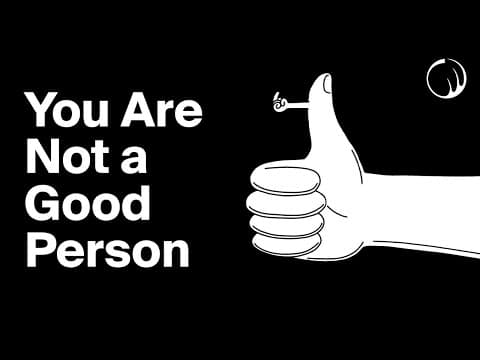
In a thought-provoking video, the question of whether humanity is inherently good or evil is explored through a philosophical lens. This discussion invites us to consider our origins as early humans and the implications of civilization on our moral compass.
Imagine yourself as one of the earliest humans, living in a small group of a few dozen individuals. Your life revolves around basic needs: food, water, survival, and leisure. In this primitive state, there are no laws, governments, or organized religions. The threats you face are simple yet pervasive. The question arises: Are you happier in this state compared to the complexities of modern life?
While it may seem that life was simpler and perhaps more satisfying in the past, the reality is nuanced. The thought experiment encourages us to reflect on fundamental philosophical questions about humanity, progress, morality, and politics.
This exploration leads us to ponder whether humanity is inherently good, bad, or perhaps neither. Are the advancements of civilization beneficial for human experience, or do they complicate our lives and moral understanding?
The past is often romanticized, particularly by figures like 18th-century philosopher Jean-Jacques Rousseau. Rousseau believed that early humans, living in a state of nature, were inherently good and that civilization corrupted this goodness. He famously stated that civilization was a poison rather than an elixir, arguing that it led to pride, greed, and vanity, which he termed "amour-propre."
Rousseau's tumultuous upbringing shaped his views. Born in Geneva in 1712, he faced abandonment and isolation, which influenced his philosophical outlook. His pivotal moment came when he encountered an essay contest question: "Has the restoration of the sciences and arts contributed to the purification of morals?" This question ignited a profound shift in his thinking, leading him to argue that humanity was better off before civilization.
In his essay, Discourse on the Arts and Sciences, Rousseau contended that the arts and sciences did not purify morals but rather corrupted humanity. He believed that in the state of nature, humans experienced simplicity, connection, and a more intuitive morality.
Rousseau's ideas culminated in his later work, The Social Contract, where he proposed that society should be governed by the collective will of the people rather than a monarch. He envisioned a society where individuals cooperate to establish conditions that benefit everyone, thus maintaining their freedom while contributing to the common good.
In stark contrast to Rousseau, philosopher Thomas Hobbes presented a bleak view of human nature. He believed that without a governing authority, humanity would descend into chaos, characterized by fear and violence. Hobbes argued that humans are inherently bad and that civilization is necessary to impose order and protect individuals from their worst instincts.
The debate between Rousseau and Hobbes highlights the complexity of human nature. Can we truly categorize humanity as inherently good or bad? Both philosophers present compelling arguments, yet the reality is that human behavior is influenced by a myriad of factors, including societal structures, historical context, and individual experiences.
Ultimately, rather than labeling humanity as good or evil, it may be more accurate to recognize our inherent power. We have created complex societies, moral frameworks, and systems of governance that reflect our capabilities and aspirations. Our progress is profound, marked by both achievements and failures.
Understanding human nature requires a deep exploration of our history and the philosophical questions that arise from it. As we navigate the complexities of existence, we must acknowledge that the line between good and evil runs through every human heart. The journey of understanding who we are is intertwined with the legacy of our ancestors and the choices we make today.
In this exploration of human nature, we are reminded that while we may not have definitive answers, the pursuit of understanding is a powerful endeavor that shapes our collective future.