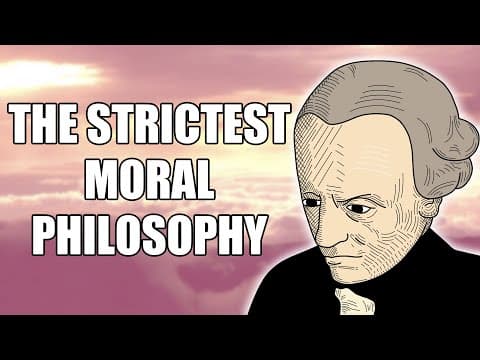
This blog post delves into Immanuel Kant's ethical philosophy as presented in his work 'Groundwork for the Metaphysics of Morals.' It discusses the concepts of a priori principles, the importance of a good will, the categorical imperative, and the implications of truthfulness in moral dilemmas, emphasizing Kant's pursuit of universal moral laws that transcend cultural and temporal boundaries.
Immanuel Kant is often regarded as one of the most influential philosophers in history, touching on various branches of philosophy, including metaphysics, epistemology, and ethics. His work, Groundwork for the Metaphysics of Morals, serves as a foundational text for understanding his moral philosophy, although it is essential to note that this book is just the beginning of his exploration into ethics, with further elaboration found in The Metaphysics of Morals.
To grasp Kant's moral philosophy, we must first define the title of his work. The term "metaphysics" in this context refers to a philosophy grounded in a priori principles—those that can be deduced through reason alone, independent of experience. For instance, the statement "if it is Monday, then it is not Saturday" can be understood without needing to check the calendar. Kant distinguishes between empirical philosophy, which relies on experience, and pure philosophy, which is based solely on rational deduction.
Kant argues that a metaphysics of morals is necessary to establish a pure morality that can guide us universally. He believes that experience can corrupt moral principles, as moral beliefs vary across cultures and change over time. By seeking a moral framework that is independent of context, Kant aims to create a set of ethical guidelines that are eternal and universally applicable.
To illustrate his moral philosophy, Kant presents a challenging scenario involving a murderer. Imagine you are hiding a friend from a murderer, and the murderer knocks on your door asking for your friend's whereabouts. Should you tell the truth or lie to protect your friend? Kant's stance is clear: one should never lie, even in this dire situation.
Kant emphasizes that telling the truth is a formal duty, regardless of the consequences. He argues that the act of lying could lead to more harm than telling the truth, as the outcomes of our actions are uncertain and based on experience. Thus, the moral worth of an action lies not in its consequences but in the intention behind it. Telling the truth is fulfilling one's duty, while lying would compromise the universality of moral law.
Central to Kant's ethics is the notion of the good will. For Kant, a good will is inherently good, regardless of the outcomes it produces. It is the intention behind actions that matters most. To act out of duty—such as refusing to steal a wallet solely because it is wrong—demonstrates a good will. Moral worth arises when actions are performed out of respect for duty, not for personal gain or fear of punishment.
Kant clarifies that moral actions must stem from a sense of duty. For example, if a surgeon saves a life because it is his duty, he retains moral worth, even if the patient later becomes a criminal. The surgeon's intention to save lives is what makes his action morally commendable, irrespective of the patient's future actions.
Kant introduces the categorical imperative as a fundamental principle of his moral philosophy. The first formulation states: "Act only according to that maxim whereby you can at the same time will that it should become a universal law." This means that one should only act in ways that could be universally applied without contradiction.
This formulation aligns closely with the golden rule of treating others as you would like to be treated. However, Kant's approach emphasizes that moral rules must apply universally, considering the implications for all individuals, not just oneself. This universality is crucial for establishing a consistent moral framework.
Kant further elaborates on the categorical imperative with the means formula: "Act in such a way that you treat humanity, whether in your own person or in the person of another, always at the same time as an end and never merely as a means." This highlights the importance of respecting the autonomy of others while recognizing that we often rely on one another in various capacities.
While Kant asserts that there is only one categorical imperative, he provides different formulations that imply one another. The universality formula and the means formula are interconnected, as treating others as ends necessitates considering the broader implications of our actions on humanity as a whole.
Kant's Groundwork for the Metaphysics of Morals presents a rigorous framework for understanding ethics through the lens of duty, good will, and universal principles. His insistence on the importance of truthfulness and the categorical imperative challenges us to consider the moral implications of our actions in a broader context. By striving for a moral philosophy that transcends cultural and temporal boundaries, Kant lays the groundwork for a universal ethical system that remains relevant in contemporary discussions of morality.